
You can have the fastest website, a flawless technical setup, and hundreds of backlinks—but if your pages don’t clearly answer what people are searching for, rankings will always be harder than they need to be.
That’s where on-page SEO comes in.
On-page SEO is the part of search engine optimization you control directly. It’s about making every page as useful, understandable, and relevant as possible for both readers and search engines.
Unlike algorithm updates or competitor activity, on-page SEO is something you can improve today. And in my experience, it’s often the highest ROI work most websites aren’t doing consistently.
TL;DR
What it is: On-page SEO is the process of optimizing the content and HTML elements of an individual webpage to improve its visibility in search engines.
Who it’s for: Anyone creating website content, including marketers, bloggers, ecommerce businesses, publishers, and SEO professionals.
Biggest takeaway: Great on-page SEO isn’t about repeating keywords. It’s about creating the best page for a specific search intent.
Gary’s opinion: If I could only improve one area of SEO for most businesses, I’d start with on-page optimization. Strong pages continue to generate value long after they’re published.
What Is On-Page SEO?
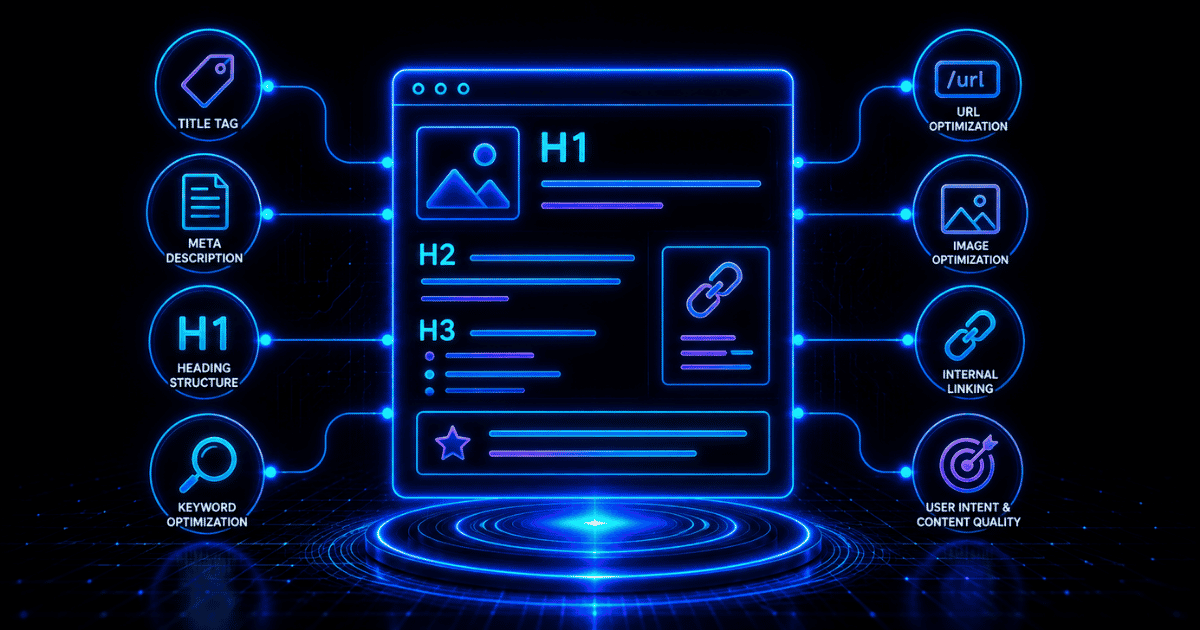
On-page SEO refers to everything you optimize on an individual webpage to help it rank higher in search results.
This includes:
- Page title
- URL
- Headings
- Body content
- Images
- Internal links
- Meta description
- Structured content
- User experience
- Calls to action
Unlike off-page SEO, which focuses on backlinks and authority, on-page SEO is completely under your control.
Think of it this way:
Technical SEO makes your website accessible.
Off-page SEO builds credibility.
On-page SEO makes each page worth ranking.
Why On-Page SEO Matters
Search engines have one primary goal:
Deliver the best answer to the user’s question.
Your page needs to clearly demonstrate:
- What it’s about
- Who it’s for
- Why it’s useful
- How it answers the searcher’s intent
Strong on-page SEO helps improve:
- Organic rankings
- Click-through rate
- User engagement
- Time on page
- Internal navigation
- AI citations
- Featured snippets
- Conversion rates
The better your page satisfies intent, the more opportunities it has to perform well.
The Core Elements of On-Page SEO
1. Search Intent
Everything starts with intent.
Before writing a single word, ask:
What is the searcher actually trying to accomplish?
Most searches fall into one of four categories:
| Intent | Example |
|---|---|
| Informational | What is on-page SEO? |
| Commercial | Best SEO tools |
| Transactional | Buy Semrush |
| Navigational | Google Search Console login |
The biggest mistake I see is writing informational content for commercial searches—or vice versa.
Match the page to the intent.
2. Page Titles
Your title tag is often the first thing people see in search results.
A good title should:
- Clearly describe the page
- Include the primary keyword naturally
- Encourage clicks
- Stay concise
- Avoid unnecessary repetition
Instead of:
“SEO | SEO Services | SEO Optimization”
Try:
“On-Page SEO: The Complete Beginner’s Guide”
Simple wins.
3. Heading Structure
Your H1 should describe the page.
H2s organize major topics.
H3s break complex sections into smaller ideas.
A logical heading structure helps:
- Readers scan content
- Search engines understand hierarchy
- AI systems retrieve specific sections
- Featured snippets identify answers
Think of headings as your article’s table of contents.
4. Content Quality
Google doesn’t rank pages because they’re long.
It ranks pages because they’re useful.
Great content typically includes:
- Clear definitions
- Original insights
- Practical examples
- Helpful visuals
- Comparisons
- Step-by-step explanations
- Current information
- Direct answers
The goal isn’t more words.
The goal is fewer unanswered questions.
5. Keyword Optimization
Keywords still matter.
Keyword stuffing doesn’t.
Instead, naturally include:
- Primary keyword
- Related phrases
- Synonyms
- Semantic variations
- Industry terminology
- Relevant entities
If your article genuinely covers the topic well, these terms often appear naturally.
Write for humans first.
6. Internal Linking
Internal links help both users and search engines.
They:
- Build topical authority
- Distribute authority throughout the site
- Improve crawling
- Keep visitors engaged
- Connect authority clusters
For example, this article should naturally link to:
- Technical SEO
- Internal Linking
- Traditional SEO
- Topical Authority
- Best SEO Tools
Every page should help readers discover the next relevant page.
7. Images
Images improve both engagement and comprehension.
Optimize them by:
- Compressing file sizes
- Using descriptive filenames
- Adding meaningful alt text
- Choosing modern image formats
- Avoiding oversized uploads
Images should support the content—not simply fill space.
8. URLs
Simple URLs are almost always better.
Good:
/on-page-seo/Less ideal:
/seo-services-best-on-page-seo-guide-2026-final/Keep URLs:
- Short
- Descriptive
- Readable
- Permanent
Don’t change URLs unless there’s a good reason.
On-Page SEO Checklist
Before publishing, ask yourself:
✅ Does the page satisfy one clear search intent?
✅ Is the title descriptive?
✅ Does the H1 match the topic?
✅ Are headings organized logically?
✅ Is the content useful?
✅ Have I answered common questions?
✅ Are internal links included?
✅ Are images optimized?
✅ Is the URL clean?
✅ Does the page load quickly?
If you can answer “yes” to all of these, you’re already ahead of many websites.
On-Page SEO in the AI Era
AI search changes how information is presented.
It doesn’t eliminate the need for strong pages.
In fact, AI systems often favor content that is:
- Clearly organized
- Easy to extract
- Well defined
- Factually accurate
- Context rich
- Properly structured
That means:
- Direct definitions
- Short summaries
- Comparison tables
- FAQ sections
- Logical headings
- Self-contained explanations
Good on-page SEO naturally supports AEO and GEO.
You’re optimizing for people first—and making life easier for AI systems along the way.
Common On-Page SEO Mistakes
Some of the most common issues include:
- Targeting multiple topics on one page
- Writing without understanding intent
- Weak headings
- Thin content
- Keyword stuffing
- Missing internal links
- Duplicate title tags
- Poor image optimization
- Publishing and never updating
On-page SEO isn’t a one-time task.
The best-performing pages are usually refined over time.
Gary’s Take
If I were auditing a website today, I’d spend more time evaluating pages than chasing backlinks.
I’ve seen businesses double organic traffic simply by improving pages they already had.
Better structure.
Better answers.
Better internal links.
Better intent matching.
No fancy tricks.
No secret algorithm loopholes.
Just genuinely better pages.
That’s still one of the highest ROI activities in SEO.
Pros and Cons
Pros
- Fully within your control
- Improves rankings
- Supports AI visibility
- Better user experience
- Higher engagement
- Stronger conversions
- Builds topical authority
Cons
- Takes time to do well
- Requires ongoing updates
- Doesn’t replace technical SEO
- Doesn’t eliminate the need for authority signals
- Results may take weeks or months
Verdict
Best For
- Blogs
- Business websites
- Ecommerce
- SaaS
- Publishers
- Agencies
- Local businesses
Who Should Prioritize It?
Almost everyone.
Whether you’re writing your first article or managing thousands of pages, on-page SEO should be part of every publishing workflow.
Overall Recommendation
Think of every page as a product.
Would someone leave that page feeling like they found the best answer available?
If the answer is yes, you’re probably on the right track.
Frequently Asked Questions
What is on-page SEO?
On-page SEO is the practice of optimizing an individual webpage’s content and HTML elements to improve search visibility and user experience.
What’s the difference between on-page and off-page SEO?
On-page SEO focuses on elements you control within your website, while off-page SEO involves external signals like backlinks, mentions, and digital PR.
Is keyword density still important?
Not in the way it once was. Focus on covering the topic naturally and comprehensively instead of repeating the same phrase a specific number of times.
How often should I update on-page SEO?
Review important pages at least every 6–12 months or whenever rankings, traffic, or search intent change.
Does on-page SEO help AI search?
Yes. Clear structure, direct answers, logical headings, and well-organized content make pages easier for AI systems to understand and reference.
What is the most important on-page SEO factor?
Search intent. If the page doesn’t answer what the user is actually looking for, no amount of optimization will consistently overcome that problem.
Is on-page SEO enough to rank?
Not by itself. Strong technical SEO, site authority, content quality, and backlinks all contribute to overall search performance.
Related Articles
- What Is Traditional SEO?
- Technical SEO
- Internal Linking
- Topical Authority
- Traditional SEO vs AI Search
- Best SEO Tools
Building a smarter marketing stack isn’t about buying more tools—it’s about choosing the right ones.
That’s the kind of growth I like.
— Gary