
For years, earning a search result meant getting your webpage into a ranked list.
AI search changes the format.
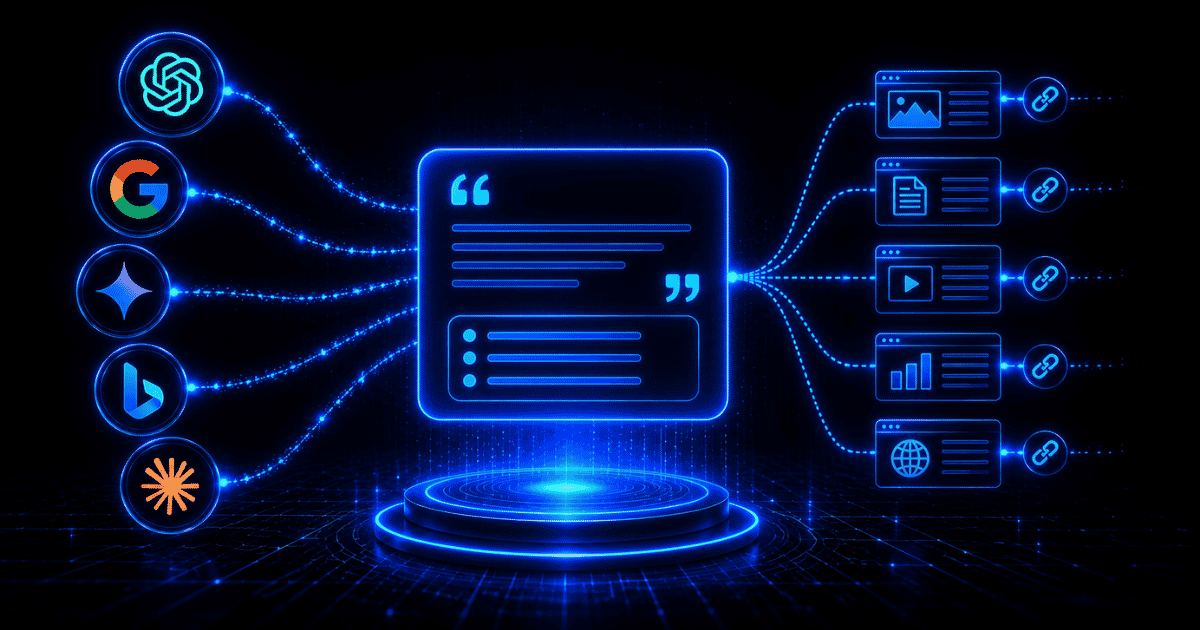
A user can now ask ChatGPT, Perplexity, Claude, or Google an entire question and receive a summarized answer assembled from multiple sources. When the system identifies the webpages supporting that response, it may display links or references alongside the generated answer.
Those references are commonly called AI citations.
For marketers, the opportunity is straightforward: your content can influence the answer even when your webpage isn’t presented as a traditional blue-link result.
The complicated part is figuring out why one source gets cited while another equally relevant page remains invisible.
TL;DR
What they are: AI citations are references or links connecting claims in an AI-generated response to the sources used to support that answer.
Who they’re for: Search marketers, publishers, SaaS companies, ecommerce brands, researchers, agencies, and any organization that depends on digital discovery.
Biggest takeaway: An AI citation can increase credibility and brand visibility, but it doesn’t guarantee meaningful traffic or prove that every generated claim accurately represents the source.
Gary’s opinion: Treat AI citations as earned references, not a new kind of ranking. Publish information worth retrieving, make it easy to understand, and always evaluate citation quality—not merely citation quantity.
What Is an AI Citation?
An AI citation is a visible reference connecting part of an AI-generated answer to an external source.
Depending on the platform, the citation may appear as:
- An inline reference
- A numbered source
- A linked publication name
- A citation card
- A list of sources beneath the response
- A link associated with a particular sentence or claim
ChatGPT search responses can include inline citations and a Sources panel containing cited and related links. Perplexity says its answers include numbered citations linking to original sources. Claude’s web-search responses also include citations designed to let users inspect the supporting material.
The purpose is attribution and verification.
In theory, a user should be able to open the citation and determine where the information came from.
In practice, users still need to confirm that the cited page supports the complete claim being made.
How Do AI Citations Work?
AI citations are typically produced through a retrieval process.
1. The system interprets the question
The AI identifies what the user wants to know, including context and likely intent.
For example:
What is the best email platform for a creator selling online courses?
The system may recognize that the answer needs to address:
- Creator-focused features
- Email automation
- Digital-product support
- Pricing
- Relevant alternatives
2. The system retrieves information
Depending on the platform, the system may search:
- The live web
- A search index
- Licensed databases
- Uploaded files
- Connected applications
- Internal knowledge sources
ChatGPT search can retrieve timely web information before generating an answer, while Claude’s web-search tools use current web content to ground responses.
3. The system generates an answer
The model synthesizes information from the retrieved sources.
It may combine several pages into one explanation, comparison, or recommendation.
4. The system displays supporting sources
The platform associates parts of the response with links or citations to the retrieved material.
The final answer may cite one source repeatedly, use several sources, or include additional relevant links that weren’t directly cited inline.
AI Citations vs Traditional Search Rankings
AI citations and organic rankings are related, but they aren’t the same outcome.
| Traditional ranking | AI citation |
|---|---|
| Places a webpage within a ranked results list | Connects a generated claim to a supporting source |
| Visibility is usually measured by position | Visibility may be measured by citation or mention frequency |
| Often targets a specific query | May result from a longer conversational prompt |
| Usually presents the page as the result | May present only a summarized claim from the page |
| Commonly seeks a website click | May influence the user without generating a click |
Google says its AI Overviews and AI Mode surface relevant links and may create opportunities for a broader range of websites to appear. Google also emphasizes that established SEO fundamentals remain important for inclusion in these experiences.
That overlap matters.
Strong crawlability, useful content, clear internal linking, and recognized authority can support both traditional rankings and AI-search visibility.
Why Do AI Citations Matter?
They provide visible attribution
A citation tells the user that the answer has supporting material beyond the model’s internal generation.
That makes verification easier and can increase confidence in the response.
They build brand awareness
A citation may introduce your publication or company to a user who has never encountered it through traditional search.
Even without a click, repeated inclusion can associate your brand with a topic.
They can generate referral traffic
Users may open a citation to:
- Confirm the claim
- Explore the topic in more depth
- Compare products
- View original data
- Read the complete explanation
The click is not guaranteed, but the source has an opportunity to earn it.
They reveal source influence
Citation monitoring can help marketers identify which pages and domains are shaping AI-generated answers.
This provides a new way to evaluate authority beyond rankings and backlinks alone.
What Makes Content More Likely to Earn AI Citations?
No platform publishes a complete citation formula, and different systems retrieve information differently.
Still, several practical qualities can improve a page’s usefulness as a source.
Clear, direct answers
Define important concepts plainly and early.
A retrieval system should not need to interpret three paragraphs of background before finding the answer.
Self-contained sections
Each major section should explain one idea completely.
Descriptive headings, concise paragraphs, lists, and tables make specific passages easier to retrieve and represent accurately.
Original information
Unique assets create stronger reasons to cite your page, including:
- Proprietary research
- Surveys
- Benchmarks
- Experiments
- Expert interviews
- Case studies
- Original frameworks
- Firsthand product testing
Google’s guidance for generative search emphasizes valuable, unique, non-commodity content rather than content that simply repeats what is already available.
Verifiable sourcing
Claims should be supported by authoritative evidence.
Link to original studies, official documentation, filings, or primary datasets where appropriate.
Strong topical context
A page is more credible when it belongs to a connected authority cluster rather than existing as an isolated article.
Supporting content helps demonstrate that the publisher understands the broader subject.
Current information
Reviews, software comparisons, pricing, regulations, and market data require regular updates.
Outdated information is less useful to users and retrieval systems.
What AI Citations Do Not Guarantee
A citation does not guarantee accuracy
The AI may oversimplify, misinterpret, or overextend what the source says.
Anthropic advises users to inspect cited sources because original pages may contain important context or details missing from the response.
A citation does not guarantee a click
The generated answer may satisfy the user entirely.
AI visibility and referral traffic should therefore be measured separately.
A citation does not guarantee endorsement
A source may be cited as evidence of a limitation, criticism, or competing viewpoint.
Measure sentiment and context—not just appearance.
A high-ranking page is not automatically cited
AI retrieval may select a passage from another source that better matches the specific wording and context of the prompt.
Traditional rankings remain useful but aren’t a complete proxy for citation performance.
How to Measure AI Citations
A practical citation-measurement program may track:
- Total citations
- Unique cited URLs
- Citation frequency by platform
- Prompt coverage
- Share of cited sources
- Competitor citations
- Citation sentiment
- Citation prominence
- AI referral traffic
- Assisted conversions
The prompt set matters enormously.
Tracking ten random prompts may produce an attractive score with little business value. Use questions that reflect real awareness, evaluation, comparison, and buying behavior.
Gary’s Take
I’d approach AI citations the way I approach backlinks.
One strong citation from a commercially relevant answer may be more valuable than dozens of appearances for vague informational prompts.
I’d focus first on creating pages that offer something AI systems have a reason to retrieve:
- A clearer explanation
- Better evidence
- Original testing
- A useful comparison
- Current product information
- A strong, attributable point of view
Then I’d monitor where those sources appear and improve the surrounding authority cluster.
The wrong strategy is adding an FAQ section to every page and assuming the citation machine will begin dispensing links.
Structure helps.
Authority, usefulness, and distinct information give the structure something worth retrieving.
Pros and Cons of AI Citations
Pros
- Provide visible source attribution
- Increase brand exposure
- Create referral opportunities
- Reveal which content influences AI answers
- Reward original and well-supported information
- Support credibility within generated responses
Cons
- Do not guarantee clicks
- May represent the source imperfectly
- Vary across platforms and prompts
- Can fluctuate between repeated searches
- Lack a universal measurement standard
- Require ongoing monitoring and verification
Verdict
AI citations are becoming an important part of search visibility, particularly for brands that publish educational, research-driven, or comparison content.
They should not replace traditional SEO metrics. Instead, treat them as another signal showing whether your content is helping shape the answers customers receive.
The best way to earn more citations is not to chase a secret markup trick. Build content that is accessible, direct, original, credible, current, and genuinely useful as supporting evidence.
Frequently Asked Questions
What is an AI citation?
An AI citation is a reference or link showing which external source supports information included in an AI-generated response.
How are AI citations different from backlinks?
A backlink exists on another webpage. An AI citation appears inside or alongside a generated answer and may change depending on the prompt and platform.
Do ChatGPT answers include citations?
ChatGPT responses that use search may include inline citations and a Sources panel with cited and related links.
Does Perplexity cite its sources?
Yes. Perplexity says each answer includes numbered citations linking to original sources so users can inspect them.
Can AI citations improve SEO?
They may increase brand visibility, referral traffic, and recognition, but an AI citation is not itself a guaranteed traditional ranking improvement.
Does schema help earn AI citations?
Structured data can help search engines understand page content, but schema alone does not guarantee inclusion or citation. Content quality and accessibility remain more important.
How can a website earn more AI citations?
Publish original, well-supported information; answer questions directly; strengthen topical authority; maintain accurate content; and make important pages technically accessible.
Related Articles
- What Is AI Visibility?
- How AI Citations Work
- How to Increase AI Citations
- AI Citation Best Practices
- Best AI Citation Tools
Building a smarter marketing stack isn’t about buying more tools—it’s about choosing the right ones.
That’s the kind of growth I like.
— Gary
The changes actually worth knowing
A short briefing that filters the noise into useful AI, marketing, technology, tools, and ideas for marketers and businesses.