
Every marketer eventually asks the same question:
“What’s the best marketing stack?”
Unfortunately, that’s a little like asking, “What’s the best toolbox?”
The answer depends on what you’re trying to build.
I’ve seen businesses spend thousands of dollars each month on software they barely use, while others grow faster with five well-chosen tools and a clear process.
The goal isn’t to own the biggest marketing stack.
The goal is to build one that saves time, produces measurable results, and scales with your business.
This guide walks through the marketing stack I’d recommend if I were starting over today.
Editorial note: These recommendations reflect practical task fit, value, usability, limitations, and how the tools work together. They are not a claim that every product was personally tested. See the editorial and review methodology.
TL;DR
What it is: A marketing stack is the collection of software you use to attract customers, create content, automate workflows, measure performance, and grow revenue.
Who it’s for: Business owners, marketers, agencies, creators, and teams looking to build an efficient, modern marketing operation.
Biggest takeaway: The best marketing stack isn’t the one with the most tools—it’s the one with the fewest tools that solve your biggest problems well.
Gary’s opinion: Buy software only after you’ve identified a repeatable workflow. Every subscription should earn its place by saving time or improving results.
What Is a Marketing Stack?
A marketing stack is the collection of platforms and software that support your marketing efforts.
A modern stack typically includes tools for:
- AI writing
- Research
- SEO
- Website management
- Analytics
- Email marketing
- Automation
- Design
- Video
- CRM
- Conversion optimization
Think of your stack as your marketing operating system.
Each tool should perform a specific job while integrating smoothly with the others.
The Principles Behind My Stack
When I evaluate software, I don’t start with features.
I start with five questions.
1. Does it save measurable time?
If a tool promises automation but creates more work, it doesn’t belong.
2. Does it improve quality?
Speed matters.
Better outcomes matter more.
3. Does it integrate well?
Your marketing stack shouldn’t require twenty browser tabs and twelve manual exports.
Good software plays nicely with the rest of your systems.
4. Will I actually use it?
Many tools are impressive during a demo.
Very few become part of a daily workflow.
5. Is it worth the cost?
The cheapest tool isn’t always the best.
The most expensive tool usually isn’t either.
I look for return on investment—not feature count.
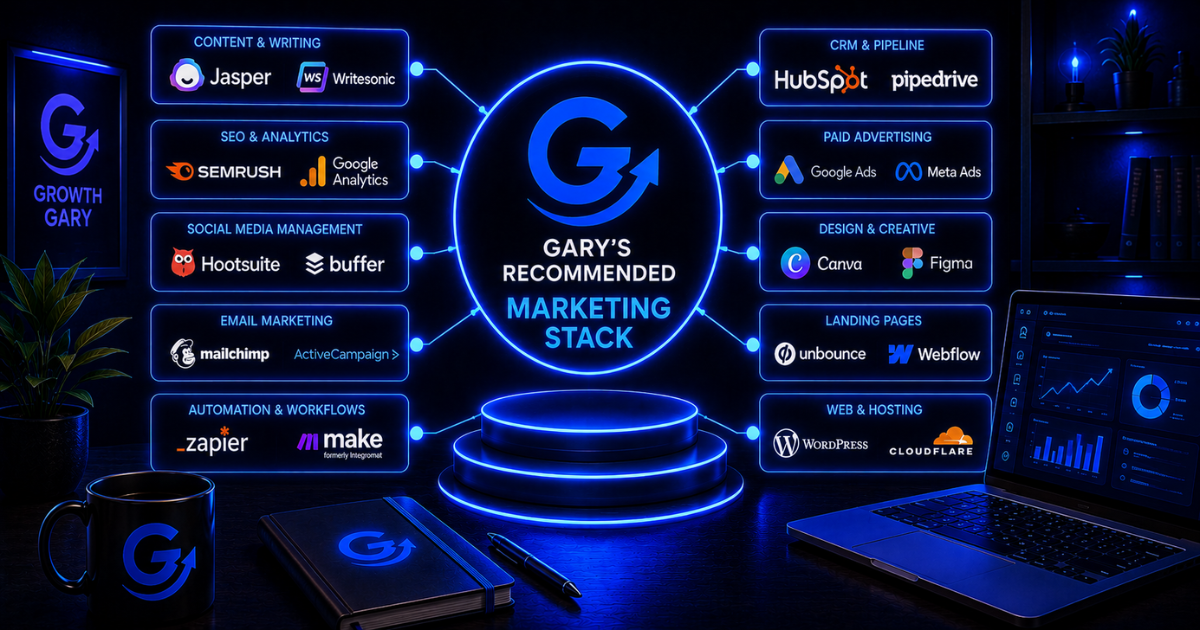
Gary’s Recommended Marketing Stack
AI Writing
Recommended
- Jasper
- Writesonic
- ChatGPT
Best for
- Long-form content
- Marketing copy
- Campaign planning
- Content repurposing
Why
AI writing is now one of the biggest productivity multipliers for marketing teams.
I use it primarily for:
- research
- outlines
- drafting
- rewriting
- brainstorming
—not publishing unedited content.
SEO & Content Optimization
Recommended
- Semrush
- Surfer
Why
Semrush remains one of the strongest all-around SEO platforms because it combines:
- keyword research
- competitor analysis
- technical audits
- backlink analysis
- rank tracking
Surfer complements it by helping optimize content around search intent and topical relevance.
Website Platform
WordPress
Still my recommendation for most businesses.
Why?
Because it offers:
- flexibility
- SEO control
- plugin ecosystem
- ownership
- scalability
Unless you’re building an ecommerce business, WordPress remains difficult to beat.
Hosting
I prioritize:
- speed
- uptime
- support
- scalability
The hosting provider matters far less than people think.
Poor hosting can absolutely hurt performance.
Premium hosting cannot rescue a poorly built website.
Email Marketing
My current favorites:
- Kit
- Beehiiv
Kit
Best for:
- creators
- newsletters
- automation
Beehiiv
Best for:
- publication-style newsletters
- audience growth
- referral programs
Both are excellent.
Which one is right depends on your business model.
Marketing Automation
Zapier
Still the easiest platform for connecting software.
Make
Excellent for more advanced workflows and visual automation.
If your business depends heavily on automation, Make often provides more flexibility.
If you’re just getting started, Zapier is usually easier to learn.
Design
Canva
The easiest recommendation on this list.
Unless you’re a professional designer creating high-end brand assets every day, Canva provides incredible value.
Video
Descript
One of my favorite productivity tools.
It makes editing video feel much closer to editing a Word document.
For marketers producing podcasts, webinars, tutorials, or social content, it can save a tremendous amount of time.
CRM & Marketing Platform
HubSpot
If your budget allows, HubSpot remains one of the strongest all-in-one marketing platforms available.
Strengths include:
- CRM
- marketing automation
- forms
- reporting
- sales enablement
It’s not inexpensive.
But for many growing businesses, consolidating multiple platforms into one can simplify operations.
My Stack by Business Size
| Business | Recommended Approach |
|---|---|
| Solo creator | ChatGPT, WordPress, Kit, Canva |
| Small business | Add Semrush, Zapier, Descript |
| Agency | Add Jasper, Surfer, HubSpot, Make |
| Enterprise | Build around HubSpot, Semrush, enterprise analytics, and custom automation |
Notice that I don’t recommend the exact same stack for everyone.
The right software depends on complexity.
Common Marketing Stack Mistakes
The biggest problems I see aren’t technical.
They’re strategic.
Buying overlapping software
Many companies pay for three tools that all perform essentially the same task.
Chasing new features
Software releases exciting AI announcements every week.
That doesn’t mean you need every update.
Ignoring integration
The best individual tools don’t always create the best overall system.
Measuring subscriptions instead of results
Software should improve:
- leads
- revenue
- efficiency
- reporting
- customer experience
Not simply increase your monthly expenses.
Gary’s Take
If I were starting GrowthGary today with a limited budget, my stack would be surprisingly small.
I’d choose:
- WordPress
- Semrush
- ChatGPT
- Jasper
- Canva
- Kit
- Zapier
That’s enough to build content, optimize it, grow an audience, automate repetitive work, and measure progress.
As revenue grows, I’d add more specialized tools only when they solve a specific problem.
The strongest marketing teams I know aren’t the ones with the biggest software budget.
They’re the ones that know exactly why each tool exists.
Every subscription should have a job description.
Pros & Cons
Pros
- Reduces repetitive work
- Creates consistent workflows
- Improves reporting
- Supports scalable growth
- Makes marketing more measurable
Cons
- Software costs add up quickly
- Too many tools create unnecessary complexity
- Poor integrations waste time
- Learning curves vary widely
Verdict
Build your stack deliberately.
Start with a few high-impact tools.
Master them.
Measure the results.
Only expand when your business genuinely needs additional capabilities.
A lean, integrated marketing stack almost always outperforms a bloated collection of disconnected software.
Frequently Asked Questions
What is a marketing stack?
A marketing stack is the collection of software used to manage marketing activities such as content creation, SEO, analytics, email marketing, automation, design, and customer relationship management.
How many marketing tools do I need?
Most small businesses can operate effectively with five to eight core tools.
What’s the best AI writing tool?
It depends on your workflow. Jasper, Writesonic, ChatGPT, and other platforms each have strengths depending on whether you’re creating long-form content, marketing copy, or general research.
Do I need both Zapier and Make?
Not usually. Most businesses should start with one automation platform and expand only if they outgrow its capabilities.
Is WordPress still the best CMS?
For most content-driven websites, WordPress remains one of the strongest options because of its flexibility, SEO capabilities, and extensive plugin ecosystem.
Should I buy an all-in-one platform?
Sometimes. Businesses that rely heavily on CRM, marketing automation, and reporting may benefit from an integrated platform like HubSpot. Others may prefer specialized tools connected through automation.
How should I evaluate new marketing software?
Measure whether it saves time, improves quality, integrates with your existing systems, and delivers a measurable return on investment.
Related Articles
- What Is AI Marketing?
- Best AI Marketing Tools
- What Is AI Writing?
- Best Marketing Automation Software
- Best Content Marketing Tools
Building a smarter marketing stack isn’t about buying more tools—it’s about choosing the right ones.
That’s the kind of growth I like.
— Gary