
Most marketers aren’t wondering whether artificial intelligence will affect their work anymore.
They’re wondering which parts of their work should actually use it.
That’s an important distinction because AI marketing can mean anything from drafting an email subject line to predicting customer behavior across millions of data points. Put all of that under one label, and the term starts becoming about as useful as “digital transformation”—technically accurate, but not especially helpful before your second cup of coffee.
So, what is AI marketing in practical terms, and where does it genuinely create value?
TL;DR
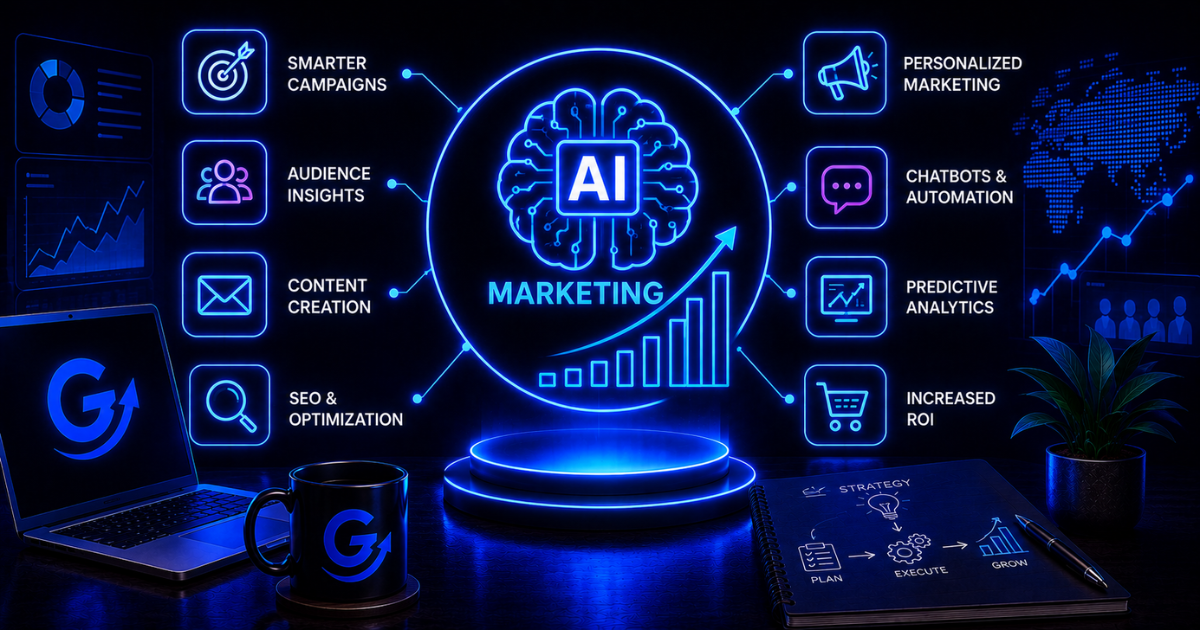
What it is: AI marketing is the use of artificial intelligence to improve marketing research, content production, personalization, automation, analytics, and decision-making.
Who it’s for: Marketers, business owners, agencies, creators, and teams looking to work more efficiently or make better use of customer data.
Biggest takeaway: AI marketing is not a replacement for marketing strategy. It is a set of capabilities that can make a good strategy faster, more scalable, and more measurable.
Gary’s opinion: Start with a real business problem—not a shiny tool. If AI doesn’t save time, improve quality, or increase measurable performance, it hasn’t earned a subscription.
What Does AI Marketing Mean?
AI marketing is the application of artificial intelligence technologies to marketing activities, workflows, and decisions.
These technologies can analyze information, recognize patterns, generate content, automate actions, and recommend next steps. In practice, AI may help a marketer:
- Research customers and competitors
- Generate content ideas and drafts
- Personalize emails or website experiences
- Segment audiences
- Score and route leads
- Optimize advertising campaigns
- Automate repetitive workflows
- Analyze campaign performance
- Predict likely customer behavior
AI marketing does not replace disciplines such as SEO, content marketing, email marketing, advertising, analytics, or conversion optimization.
Instead, it adds new capabilities to each one.
How Does AI Marketing Work?
AI marketing systems typically work by processing data, identifying patterns, and producing an output or recommendation.
The exact process depends on the use case.
Generative AI creates new material
Generative AI tools produce text, images, audio, video, summaries, and ideas based on instructions and existing information.
Common uses include:
- Writing first drafts
- Developing campaign concepts
- Creating social content
- Producing design variations
- Summarizing research
- Repurposing long-form content
Large language models such as those used by ChatGPT, Claude, and Gemini are examples of generative AI.
Predictive AI estimates what may happen
Predictive systems use historical data to identify likely future outcomes.
Marketing applications include:
- Lead scoring
- Churn prediction
- Purchase propensity
- Revenue forecasting
- Customer lifetime value
- Campaign performance modeling
Predictive AI is often less visible than generative AI, but it can have a larger business impact when the underlying data is strong.
Automation systems take action
AI-powered automation can trigger actions based on rules, behavior, or model recommendations.
Examples include:
- Sending a follow-up email
- Routing a lead to sales
- Adjusting an advertising bid
- Updating a CRM record
- Generating a weekly report
- Alerting a team to unusual performance
The smartest output in the world is not particularly valuable if it remains trapped in a dashboard no one checks.
Where Is AI Used in Marketing?
AI can support nearly every stage of the customer journey.
| Marketing Function | Common AI Applications |
|---|---|
| Research | Audience analysis, competitor research, trend discovery and summarization |
| Content | Ideation, drafting, editing, repurposing and optimization |
| SEO | Keyword research, content briefs, technical analysis and search visibility monitoring |
| Segmentation, personalization, subject lines and send-time optimization | |
| Advertising | Audience targeting, bidding, creative testing and budget allocation |
| CRO | Behavioral analysis, copy testing and personalized experiences |
| Automation | Lead routing, nurture workflows, reporting and system integration |
| Analytics | Anomaly detection, forecasting, attribution support and summaries |
The right application depends on the quality of your process and data.
Worth knowing
AI tends to magnify what is already there. A clear process becomes faster. A disorganized process becomes automated confusion.
AI Marketing vs Traditional Marketing
AI marketing and traditional marketing are not competing strategies.
Traditional marketing provides the fundamentals:
- Customer understanding
- Positioning
- Messaging
- Offers
- Distribution
- Creative judgment
- Measurement
AI can improve the speed, scale, and precision of those activities.
| Traditional Approach | AI-Assisted Approach |
|---|---|
| Manually review customer feedback | Summarize thousands of comments and identify themes |
| Create one campaign concept | Generate and evaluate multiple starting concepts |
| Segment customers with fixed rules | Identify behavioral patterns and dynamic segments |
| Build reports manually | Automate reporting and highlight anomalies |
| Apply one experience to everyone | Personalize experiences using customer data |
The best approach usually combines both.
Human marketers define the strategy, standards, and final decisions. AI supports execution and analysis.
What Are the Benefits of AI Marketing?
Greater efficiency
AI can reduce the time required for research, drafting, analysis, and routine administration.
That allows marketers to spend more time on strategy, creative direction, customer understanding, and decision-making.
Faster experimentation
AI makes it easier to create multiple variations of headlines, advertisements, emails, and landing-page copy.
More variations do not automatically mean better marketing, but they can help teams test ideas faster.
Improved personalization
AI can help tailor messages and recommendations based on customer behavior, preferences, and lifecycle stage.
Personalization is most useful when it improves relevance. Adding someone’s first name to an email and calling it artificial intelligence is setting the bar rather low.
Better use of data
AI can identify patterns that are difficult to spot manually, especially across large datasets.
This can support forecasting, audience segmentation, anomaly detection, and campaign analysis.
What Are the Limitations of AI Marketing?
AI marketing introduces real tradeoffs.
Accuracy
Generative AI can produce incorrect information, invented sources, or misleading conclusions. Outputs require review.
Generic content
Without strong inputs and human expertise, AI often creates polished but interchangeable material.
Data quality
Predictive systems are only as reliable as the data supporting them. Poor data creates poor recommendations at greater speed.
Privacy and compliance
Marketers must consider how customer, employee, and proprietary information is processed and stored.
Tool overload
Many platforms now include overlapping AI features. Paying for five products that perform the same task is not a sophisticated marketing stack.
How Should a Business Start Using AI Marketing?
Begin with one measurable workflow.
A simple process looks like this:
- Identify a repetitive or expensive marketing task.
- Document the current process and baseline performance.
- Select one AI use case that addresses the bottleneck.
- Keep a human approval step.
- Measure time, quality, cost, and business results.
- Expand only after the workflow proves useful.
Good starting points include research summaries, content briefs, meeting notes, campaign reporting, and repurposing approved content.
High-risk starting points include unsupervised publishing, sensitive customer communication, and major budget decisions without review.
Gary’s Take
If I were building an AI marketing program today, I would avoid starting with the question:
Which AI tools should we buy?
I’d start with:
Where is the marketing team losing time, quality, or visibility?
Then I’d choose the smallest useful solution.
AI should make marketing more focused—not create another layer of complexity. I’ve seen teams spend hours managing tools that were supposed to save them hours. That’s not automation. That’s a new hobby.
Use AI where the outcome is clear and measurable. Keep human judgment where context, credibility, and accountability matter most.
Pros and Cons of AI Marketing
Pros
- Reduces time spent on repetitive work
- Accelerates research and production
- Supports personalization at scale
- Makes experimentation easier
- Helps teams interpret large datasets
- Connects marketing workflows more efficiently
Cons
- Requires careful review
- Can create generic or inaccurate content
- Depends heavily on data quality
- Introduces privacy and governance concerns
- Can lead to unnecessary software spending
- Does not replace strategy or expertise
Verdict
AI marketing is valuable for businesses with clear goals, defined processes, and people capable of reviewing the output.
It is less useful for companies hoping technology will compensate for unclear positioning, weak offers, or poor measurement.
The overall recommendation is straightforward: use AI to improve specific parts of marketing, measure the results, and expand deliberately.
Frequently Asked Questions
What is AI marketing in simple terms?
AI marketing means using artificial intelligence to support marketing tasks such as research, content creation, personalization, automation, and analytics.
What is an example of AI in marketing?
Examples include generating content drafts, scoring leads, personalizing product recommendations, optimizing ad bids, and summarizing campaign performance.
Is AI marketing the same as marketing automation?
No. Marketing automation executes workflows, while AI can generate, predict, analyze, or recommend. Many platforms combine both.
Does AI marketing replace marketers?
AI can automate parts of marketing work, but strategy, creative judgment, customer understanding, and accountability still require people.
What are the best uses of AI in marketing?
Strong use cases include research, content planning, reporting, personalization, lead scoring, workflow automation, and campaign analysis.
What are the risks of AI marketing?
Key risks include inaccurate outputs, privacy concerns, generic content, biased recommendations, poor data, and overdependence on software.
How do you measure AI marketing ROI?
Compare the cost of the tool and implementation with outcomes such as time saved, increased output, improved conversion rates, reduced costs, or additional revenue.
Related Articles
- The Beginner’s Guide to AI Marketing
- How to Build an AI Marketing Strategy
- AI Marketing vs Traditional Marketing
- Best AI Marketing Tools
- Measuring AI Marketing ROI
Building a smarter marketing stack isn’t about buying more tools—it’s about choosing the right ones.
That’s the kind of growth I like.
— Gary
The changes actually worth knowing
A short briefing that filters the noise into useful AI, marketing, technology, tools, and ideas for marketers and businesses.