
Marketing teams are being asked to produce more content, analyze more data, personalize more campaigns, and respond faster—all without adding more hours to the day.
Naturally, the software industry’s answer has been to add “AI” to nearly every product dashboard.
Some of those features are genuinely useful. Others are a chatbot wearing a tiny marketing hat.
The challenge for beginners isn’t finding AI marketing tools. It’s understanding where artificial intelligence actually improves marketing, where human judgment still matters, and how to build a practical system without wasting money on ten overlapping subscriptions.
This guide will help you start with the fundamentals.
TL;DR
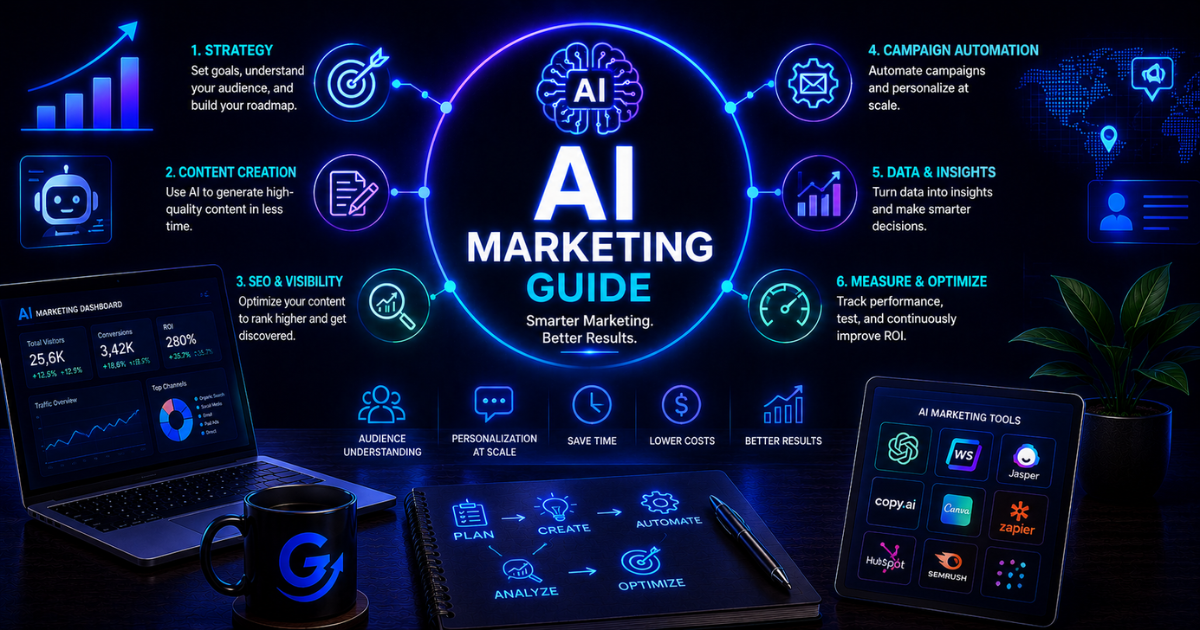
What it is: AI marketing is the use of artificial intelligence to research audiences, create content, personalize campaigns, automate workflows, analyze performance, and support marketing decisions.
Who it’s for: Business owners, marketers, creators, agencies, and teams that want to improve efficiency without lowering quality.
Biggest takeaway: AI works best as an assistant inside a sound marketing strategy. It cannot rescue weak positioning, poor data, or an unclear offer.
Gary’s opinion: Start with one repetitive, measurable task. Improve that workflow before adding another tool. A smaller stack you actually use will beat a crowded stack you barely understand.
What Is AI Marketing?
AI marketing is the practical use of artificial intelligence within marketing activities and workflows.
These systems can help marketers:
- Analyze customer and campaign data
- Generate or edit written content
- Create images, audio, and video
- Personalize emails and website experiences
- Automate repetitive processes
- Research competitors and market trends
- Predict likely customer behavior
- Summarize performance and recommend actions
AI marketing is not a separate discipline that replaces content marketing, email marketing, SEO, advertising, or analytics. It is a capability that can improve each of them.
Think of AI as an additional layer across the marketing funnel rather than a completely new funnel.
How Is AI Used Across the Marketing Funnel?
AI can support marketing from initial research through customer retention.
| Funnel Stage | Common AI Marketing Uses |
| Awareness | Audience research, SEO research, content ideas, social posts and creative production |
| Consideration | Educational content, email nurturing, lead scoring and personalized recommendations |
| Conversion | Landing-page copy, ad optimization, sales enablement and chatbot support |
| Retention | Customer segmentation, lifecycle email, churn analysis and support automation |
| Measurement | Reporting, attribution analysis, trend detection and performance summaries |
The best use case depends on the problem you’re trying to solve.
Using AI because a tool has a glowing purple button is not a strategy.
Where Should a Beginner Start?
Start with a task that is repetitive, time-consuming, and easy to measure.
Good early use cases include:
Research and summarization
AI can organize notes, summarize source material, identify themes, and help you prepare a first-pass research outline.
Human review is still necessary, especially when the work depends on current facts, precise quotations, or authoritative sources.
Content planning
AI can help turn audience questions into:
- Topic clusters
- Editorial calendars
- Content briefs
- Frequently asked questions
- Repurposing plans
This is often more useful than immediately asking AI to write a finished article.
Drafting and editing
AI writing tools can support outlines, first drafts, headline options, summaries, and editing.
The final content should still include human judgment, subject expertise, original examples, and fact-checking. Otherwise, you’re mostly publishing sentences that sound correct while quietly hoping they are.
Workflow automation
Tools such as Zapier, Make, and marketing platforms with built-in automation can move information between systems, trigger follow-ups, assign leads, and reduce manual reporting.
Automation works best after the underlying process is clear. Automating a messy process merely creates a faster mess.
Analytics and reporting
AI can summarize campaign data, identify anomalies, and translate dashboards into plain-language observations.
It can help you find the question. It should not be trusted blindly to provide the final business conclusion.
What AI Marketing Cannot Fix
AI is powerful, but it does not replace the foundations of marketing.
It cannot reliably fix:
- A product people don’t want
- An unclear audience
- Weak brand positioning
- Poor customer data
- A confusing website
- An uncompetitive offer
- A lack of credible expertise
- A broken measurement setup
AI can produce more campaigns. It cannot guarantee those campaigns are worth producing.
That distinction matters because many companies adopt AI as a production solution when their real problem is strategic.
How to Build a Simple AI Marketing Strategy
A beginner-friendly AI marketing strategy can follow five steps.
1. Identify the bottleneck
Choose one problem, such as slow content research, inconsistent email production, repetitive reporting, or poor lead follow-up.
2. Define the desired outcome
Use a measurable result:
- Reduce research time by 30%
- Publish two additional articles each month
- Cut weekly reporting time from three hours to one
- Improve email response time
- Increase qualified leads without increasing ad spend
3. Select one tool
Choose a tool that directly addresses the problem. Avoid buying an entire stack before validating the first workflow.
4. Keep a human review step
Assign responsibility for accuracy, brand voice, privacy, approvals, and final decisions.
5. Measure the result
Compare the new process against the old one. Track time saved, output quality, conversion performance, cost, and adoption.
If the tool creates more review work than it saves, it has not earned its place.
Choosing AI Marketing Tools
The right tool depends on the job.
| Need | Tool Category | Common Examples |
| Writing and editing | AI writing tools | Jasper, Writesonic, Copy.ai, Grammarly |
| Research | AI research and search tools | ChatGPT, Perplexity and specialized research platforms |
| Design | AI design tools | Canva and image-generation platforms |
| Video and audio | AI media tools | Descript and AI video platforms |
| SEO and content optimization | SEO tools | Semrush, Surfer and Frase |
| Automation | Workflow platforms | Zapier and Make |
| CRM and campaigns | Marketing platforms | HubSpot and similar systems |
| Email publishing | Email platforms | Kit and Beehiiv |
Pricing changes frequently, so evaluate the current plan limits before subscribing.
Strengths
AI marketing tools can provide:
- Faster production
- More consistent workflows
- Easier experimentation
- Better use of existing data
- Lower barriers to creating drafts and prototypes
Weaknesses
They may also introduce:
- Inaccurate information
- Generic content
- Privacy and compliance risks
- Duplicate subscriptions
- Excessive dependence on automation
- More output than your team can review
Alternatives
Sometimes the best alternative is not another AI product. It may be:
- A stronger template
- A clearer process
- Better analytics configuration
- A trained specialist
- A simpler existing software feature
Tools should earn their place through outcomes, not novelty.
Gary’s Take
If I were building an AI marketing system from scratch, I would start with research, content planning, and reporting.
Those activities consume substantial time but still allow a marketer to keep strategic control.
I would not begin by fully automating brand communication or publishing unreviewed AI content. Your company’s voice should not become a live experiment conducted by an unsupervised robot with excellent grammar.
My rule is straightforward:
Use AI to accelerate judgment—not replace it.
The strongest marketers will not be the people who automate everything. They’ll be the people who understand which work deserves automation and which work still needs experience, creativity, and accountability.
Pros and Cons of AI Marketing
Pros
- Saves time on repeatable tasks
- Helps smaller teams increase output
- Supports faster testing and iteration
- Makes data easier to interpret
- Enables greater personalization
- Connects marketing workflows more efficiently
Cons
- Can generate incorrect or generic material
- Requires human oversight
- May create privacy concerns
- Encourages unnecessary software spending
- Cannot replace strategy or original expertise
Verdict
AI marketing is useful for nearly every modern marketing team, but adoption should be selective.
It is best for marketers with clear processes, measurable objectives, and enough expertise to review the output.
It is less useful for businesses hoping software will define their audience, create their strategy, and produce results without oversight.
My overall recommendation is to begin with one workflow, measure the improvement, and expand only when the first use case proves valuable.
Frequently Asked Questions
What is AI marketing in simple terms?
AI marketing is the use of artificial intelligence to support research, content, personalization, automation, analytics, and marketing decisions.
Is AI marketing only for large companies?
No. Small businesses and individual marketers can use AI for research, writing, design, email, reporting, and workflow automation.
Will AI replace marketers?
AI will automate portions of marketing work, but strategy, judgment, creativity, accountability, and customer understanding still require people.
What is the best AI marketing tool for beginners?
There is no universal best tool. Choose one based on a specific task, such as writing, design, automation, research, SEO, or email marketing.
How much does AI marketing cost?
Costs range from free features to enterprise platforms costing thousands per month. Beginners should validate one use case before purchasing multiple subscriptions.
Is AI-generated marketing content good for SEO?
It can perform well when it is accurate, original, useful, properly edited, and created for readers. Publishing large amounts of shallow AI content is not a sound SEO strategy.
How do I measure AI marketing ROI?
Compare tool and labor costs with measurable outcomes such as time saved, additional output, lead volume, conversion rate, revenue, or reduced operating expense.
Related Articles
- What Is AI Marketing?
- How to Build an AI Marketing Strategy
- Best AI Marketing Tools
- What Is AI Writing?
- What Is Marketing Automation?
Building a smarter marketing stack isn’t about buying more tools—it’s about choosing the right ones.
That’s the kind of growth I like.
— Gary