
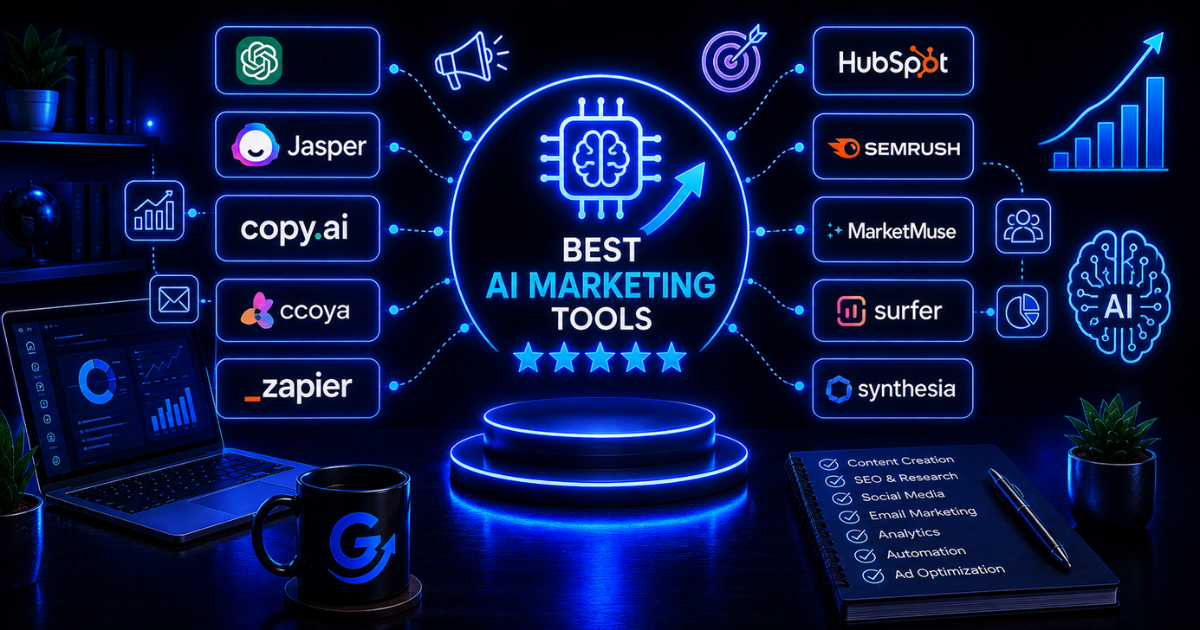
The AI marketing software market has reached an interesting stage.
Nearly every platform now claims to generate content, automate campaigns, analyze customers, and dramatically improve productivity—sometimes before lunch.
The problem isn’t finding AI tools. It’s separating genuinely useful platforms from expensive collections of features your team may never use.
The best AI marketing tool depends on the job you need done. A strong SEO platform won’t replace an email system, and a brilliant writing assistant won’t repair a broken customer journey.
Here are the tools I’d put on a serious marketer’s shortlist.
TL;DR
What they are: AI marketing tools help marketers research opportunities, create content, design campaigns, automate workflows, manage customers, and measure performance.
Who they’re for: Marketing teams, agencies, creators, publishers, and businesses looking to increase output without sacrificing control.
Biggest takeaway: There is no single best AI marketing platform. The right stack combines a small number of tools with clearly defined jobs.
Gary’s opinion: Start with your biggest bottleneck. Don’t buy eight AI tools because you have eight browser tabs open. Choose one, measure its impact, and make it earn its renewal.
The Best AI Marketing Tools at a Glance
| Tool | Best for | Pricing overview |
|---|---|---|
| HubSpot | CRM and integrated marketing automation | Free tools available; paid marketing products scale from entry-level plans to significantly more expensive professional and enterprise packages |
| Semrush | SEO, competitive research and AI visibility | Paid SEO plans begin around the low hundreds per month, with separate AI-search products and add-ons |
| Jasper | Brand-controlled marketing content | Pro plan available; business pricing adds more advanced workflows and usage-based elements |
| Canva | Design and campaign creative | Free plan plus paid Pro, Business and Enterprise options |
| Zapier | Connecting tools and automating workflows | Free tier available; paid plans scale by automation volume and team requirements |
| Descript | Video, podcast and audio editing | Free plan; paid subscriptions start around $16 per month |
| Grammarly | Editing, rewriting and brand consistency | Free plan; Pro is $12 per user monthly when billed annually or $30 month-to-month |
| Beehiiv | Newsletter growth and monetization | Free Launch plan; Scale starts around $43 monthly when billed annually |
Pricing and packages change frequently, so always confirm the current limits before subscribing.
1. HubSpot: Best All-in-One AI Marketing Platform
HubSpot is my choice for businesses that want customer relationship management, lead generation, email, forms, automation, reporting, and content tools inside one connected platform.
Its main advantage is consolidation.
Rather than moving customer information among several disconnected systems, teams can manage much of the customer journey in one environment. HubSpot offers free marketing capabilities, while paid tiers add deeper automation, reporting, content and AI functionality. Its professional packages can become expensive quickly, so businesses should model total costs carefully as contacts and feature needs grow.
Best for
- Growing businesses
- B2B marketing teams
- CRM-driven organizations
- Lead generation and nurturing
- Companies consolidating multiple platforms
Strengths
- Broad, integrated feature set
- Strong CRM foundation
- Marketing and sales alignment
- Scalable automation and reporting
Weaknesses
- Costs rise considerably at advanced levels
- Can be excessive for a simple newsletter or content site
- Setup and governance require planning
Alternatives
ActiveCampaign, Kit, Beehiiv or a lighter CRM connected through Zapier.
2. Semrush: Best for SEO and Competitive Marketing Research
Semrush is one of the most complete platforms for keyword research, competitor analysis, site auditing, rank tracking, backlinks and AI-search visibility.
It’s best suited to marketers whose growth strategy depends heavily on organic search and competitive intelligence. Semrush now separates some capabilities into specialized toolkits, including SEO, social media and AI visibility products, so buyers should verify exactly what their chosen plan includes. Current SEO pricing begins around $117 per month when billed annually, with higher tiers and add-ons increasing the cost.
Best for
- SEO teams
- Agencies
- Competitive research
- Content opportunity analysis
- AI-search monitoring
Strengths
- Extensive search and competitor data
- Broad toolkit
- Strong research capabilities
- Useful for both traditional and AI search
Weaknesses
- Can feel overwhelming
- Add-ons raise the total cost
- Smaller businesses may use only a fraction of it
Alternatives
Ahrefs, Moz, Surfer or Frase, depending on the task.
3. Jasper: Best for Structured Marketing Content
Jasper is designed specifically around marketing production rather than acting as a general-purpose assistant.
Its strengths include brand controls, campaign workflows, reusable knowledge and content production across articles, emails, advertisements and social media. Jasper’s Pro plan is currently listed at $59 per month when billed annually or $69 monthly, while business offerings use more advanced pricing and credit structures.
Best for
- Marketing teams producing content at scale
- Brand-controlled workflows
- Campaign development
- Agencies managing multiple voices
Strengths
- Marketing-specific interface
- Brand and workflow controls
- Useful across multiple content formats
Weaknesses
- More expensive than many general AI assistants
- Still requires editing and fact-checking
- May be unnecessary for occasional writing
Alternatives
Writesonic, Copy.ai, ChatGPT or Claude.
4. Canva: Best for AI-Assisted Marketing Design
Canva remains one of the easiest ways for non-designers to create social graphics, presentations, advertisements, videos and branded campaign assets.
The free plan is capable enough for basic work. Canva Pro adds premium content, brand functionality, background removal and dozens of AI-assisted creative features.
Best for
- Small marketing teams
- Social media content
- Campaign creative
- Presentations and lead magnets
Strengths
- Easy to learn
- Large template and media library
- Handles multiple creative formats
- Strong collaboration features
Weaknesses
- Template-heavy work can look generic
- Not a full replacement for professional design
- Advanced team costs require review
Alternatives
Adobe Express, Figma or specialized image-generation tools.
5. Zapier: Best for Marketing Workflow Automation
Zapier connects marketing tools and lets users automate actions without writing custom integrations.
A workflow might move a website lead into a CRM, notify sales, add the contact to an email sequence and create a follow-up task automatically.
Zapier currently offers a free allowance of 100 tasks per month and paid tiers for larger workflows, teams and enterprise governance. It also provides a 14-day trial of its Professional plan.
Best for
- No-code automation
- Connecting marketing platforms
- Lead routing
- Reporting workflows
- Small and midsize teams
Strengths
- Large integration ecosystem
- Accessible for beginners
- Quick to deploy
- Useful across departments
Weaknesses
- Task costs can grow with volume
- Complex workflows become difficult to maintain
- Not every process should be automated
Alternatives
Make, n8n or native platform automations.
6. Descript: Best for AI Video and Podcast Editing
Descript lets marketers edit audio and video by editing the corresponding transcript.
It combines recording, transcription, screen capture, multitrack editing, audio enhancement and AI-generated media. A free plan is available, and paid subscriptions currently begin at approximately $16 per month.
Best for
- Podcasts
- Video tutorials
- Webinar repurposing
- Social clips
- Interview editing
Strengths
- Text-based editing is intuitive
- Combines several production functions
- Useful for repurposing long-form recordings
Weaknesses
- Advanced editing may still require dedicated software
- AI edits need review
- Usage limits vary by plan
Alternatives
Adobe Premiere Pro, CapCut or Riverside.
7. Grammarly: Best for Editing and Brand Consistency
Grammarly is useful for improving clarity, tone, grammar and consistency across everyday marketing communication.
The free version handles basic assistance. Grammarly Pro adds full-sentence rewrites, tone adjustment, brand controls, plagiarism and AI-content detection, and generative prompts. Pro currently costs $12 per user per month when billed annually or $30 with monthly billing.
Best for
- Editing
- Email communication
- Brand consistency
- Distributed content teams
Strengths
- Works across many applications
- Easy to adopt
- Useful for polishing human and AI drafts
Weaknesses
- Can overcorrect intentional style
- Not a replacement for an editor
- Generative features overlap with other tools
Alternatives
LanguageTool, ProWritingAid or built-in AI editing assistants.
8. Beehiiv: Best for Newsletter-Led Growth
Beehiiv is designed for publishers and creators building newsletter businesses.
Its feature set includes email publishing, websites, audience analytics, recommendations, advertising, paid subscriptions, digital products and automation. Beehiiv offers a free Launch plan, while Scale is currently listed at $43 per month when billed annually.
Best for
- Newsletter publishers
- Creator-led businesses
- Audience monetization
- Referral-driven growth
Strengths
- Built specifically for newsletter growth
- Monetization features
- Free starting option
- Strong publishing focus
Weaknesses
- Less suitable as a complete CRM
- Advanced automation may require other tools
- Some businesses may be better served by Kit or HubSpot
Alternatives
Kit, Substack or Mailchimp.
How to Choose the Right AI Marketing Tools
Don’t begin with the software.
Begin with the bottleneck.
Ask:
- What marketing task consumes the most time?
- What outcome needs to improve?
- What do existing tools already provide?
- Who will own the platform?
- How will success be measured?
Then choose the smallest tool that solves the problem.
A five-tool stack used every day is usually more valuable than a 15-tool stack held together by unused trials and optimism.
Gary’s Take
If I were building a practical stack for a growing content-driven business, I’d start with:
- Semrush for search research
- Jasper or another primary AI writer for structured production
- Canva for design
- Zapier for automation
- Beehiiv or Kit for audience ownership
- Grammarly for editing
I’d add HubSpot when the business needed a more serious CRM and lifecycle-marketing system. I’d add Descript when video or podcasting became a consistent channel.
The point isn’t to own all eight.
The point is to know why each one is there.
Pros and Cons of AI Marketing Tools
Pros
- Reduce repetitive work
- Increase production capacity
- Improve consistency
- Support faster experimentation
- Connect marketing systems
- Make data easier to use
Cons
- Subscription costs accumulate
- Features frequently overlap
- AI output still requires review
- Tools can add complexity
- Poor implementation reduces ROI
Verdict
AI marketing tools are most valuable when they support a defined strategy and measurable workflow.
Use HubSpot for integrated customer management, Semrush for search intelligence, Jasper for structured marketing content, Canva for creative production, Zapier for automation, Descript for video, Grammarly for editing and Beehiiv for newsletter growth.
Don’t buy them all automatically.
Build the stack your business needs—not the one software companies would like you to finance.
Frequently Asked Questions
What is the best AI marketing tool overall?
There is no universal winner. HubSpot is strongest as an integrated marketing platform, while specialized tools perform better for individual functions such as SEO, design, writing or automation.
What is the best free AI marketing tool?
Canva, Grammarly, Zapier, HubSpot and Beehiiv offer free starting options, although limits and included features vary.
What are the best AI tools for content marketing?
Jasper, Canva, Grammarly, Semrush and Descript cover writing, design, editing, research and multimedia production.
Can small businesses use AI marketing tools?
Yes. Small businesses should begin with one or two tools tied to specific problems rather than investing in a large enterprise stack.
Are AI marketing tools worth paying for?
They are worth paying for when the time saved, quality gained or revenue produced exceeds the subscription and implementation costs.
Can AI marketing tools replace a marketing team?
No. They can automate and accelerate tasks, but positioning, strategy, creativity, judgment and accountability still require people.
How many AI marketing tools should a business use?
Use only the tools required to support defined workflows. Many small teams can operate effectively with four to seven core platforms.
Related Articles
- What Is AI Marketing?
- Gary’s Recommended Marketing Stack
- Best AI Writing Tools
- Best Marketing Automation Software
- Best Content Marketing Tools
Building a smarter marketing stack isn’t about buying more tools—it’s about choosing the right ones.
That’s the kind of growth I like.
— Gary
The changes actually worth knowing
A short briefing that filters the noise into useful AI, marketing, technology, tools, and ideas for marketers and businesses.