
Not every marketing team has a full-time graphic designer.
Even if they do, that designer probably doesn’t want to spend the afternoon resizing Facebook ads into Instagram Stories, LinkedIn banners, Pinterest pins, presentation slides, email headers, and YouTube thumbnails.
That’s why Canva has become one of the most popular design platforms in the world.
What started as a simple drag-and-drop graphic editor has evolved into an all-in-one visual content platform complete with AI-powered design tools, presentations, videos, whiteboards, websites, brand management, and collaborative workspaces.
But is Canva still worth paying for now that AI image generators and creative platforms seem to launch every week?
After years of using Canva across marketing campaigns, here’s how I’d evaluate it.
TL;DR
What it is: Canva is an online design platform that helps individuals and teams create graphics, presentations, videos, documents, websites, social media content, and marketing assets using templates and AI-powered design tools.
Who it’s for: Marketers, creators, agencies, educators, small businesses, nonprofits, and anyone producing visual content regularly.
Biggest takeaway: Canva isn’t trying to replace Adobe Photoshop. It’s trying to help marketers create professional-looking content faster—and it succeeds remarkably well.
Gary’s opinion: If I could only recommend one design platform to the average marketer, Canva would probably be it.
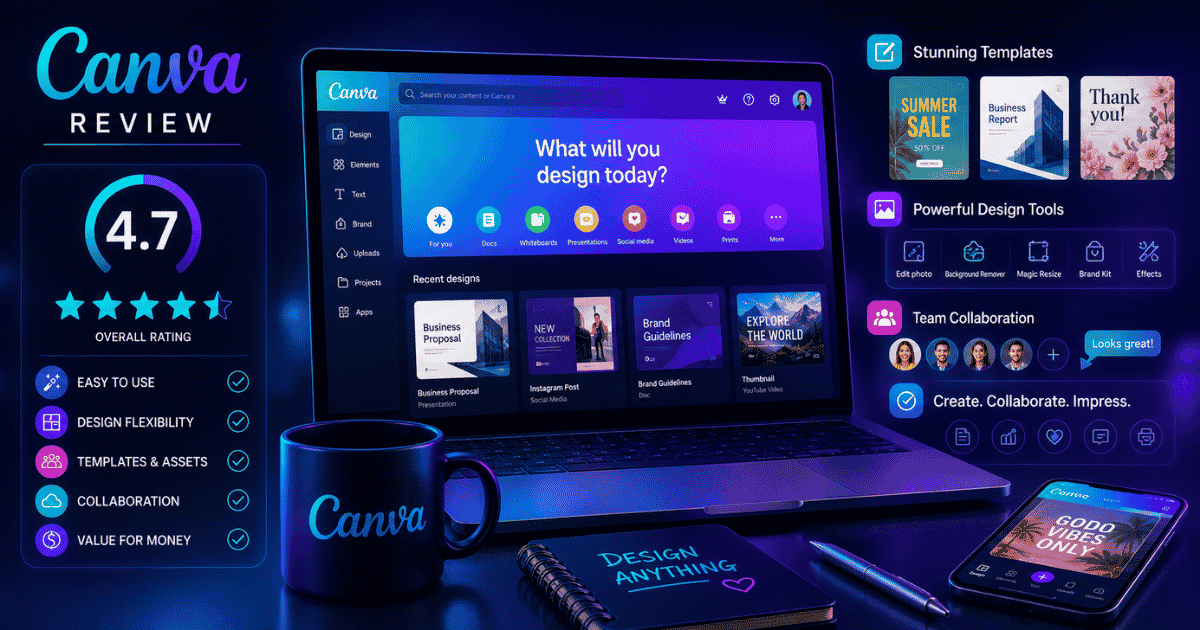
Canva at a Glance
| Category | Assessment |
|---|---|
| Best For | Marketing teams and content creators |
| Pricing | Free plan available; Pro starts around $15/month or $120/year |
| Ease of Use | ★★★★★ |
| Learning Curve | Very low |
| AI Features | Excellent |
| Overall Recommendation | Highly Recommended |
What Is Canva?
Canva is a cloud-based design platform built for people who need professional-looking visuals without professional design software.
You can create:
- Social media graphics
- Blog images
- Presentations
- Infographics
- PDFs
- Whitepapers
- Ebooks
- Email graphics
- Logos
- Videos
- Print materials
- Websites
- Digital ads
Everything happens inside your browser.
No complicated software.
No steep learning curve.
That’s been Canva’s biggest competitive advantage from the beginning.
Canva’s Best Features
1. Templates
Templates remain Canva’s greatest strength.
There are thousands available for nearly every marketing need:
- Facebook Ads
- Instagram Posts
- LinkedIn Graphics
- Presentations
- Flyers
- Posters
- Brochures
- Whitepapers
- Reports
- Infographics
- Business Cards
Instead of designing from scratch, you simply customize.
For busy marketing teams, that’s a massive time saver.
2. Magic Studio (AI)
Canva has invested heavily in AI.
Magic Studio includes tools for:
- AI image generation
- Magic Design
- Magic Write
- Background removal
- Object replacement
- Image expansion
- Automatic resizing
- AI presentations
- AI editing
Instead of opening multiple programs, many creative tasks now happen inside one platform.
3. Brand Kit
For businesses, Brand Kit might be the most valuable feature.
You can store:
- Logos
- Brand colors
- Fonts
- Templates
- Approved graphics
- Brand guidelines
Every team member works from the same assets.
That keeps marketing consistent.
4. Magic Resize
Anyone who has ever redesigned one graphic for six different social platforms will appreciate this feature.
Create one design.
Resize it instantly for:
- YouTube
- TikTok
- Stories
- Display ads
It isn’t always perfect.
But it’s dramatically faster than rebuilding everything manually.
5. Collaboration
Canva works surprisingly well for teams.
Multiple users can:
- Edit simultaneously
- Leave comments
- Approve designs
- Share folders
- Create templates
- Manage brand assets
For marketing departments, this removes a surprising amount of back-and-forth.
What Canva Does Well
Extremely beginner friendly
This is still Canva’s biggest advantage.
Someone with almost no design experience can produce attractive marketing assets within an hour.
That’s rare.
Speed
Need:
- A presentation?
- Social graphics?
- Ebook?
- Lead magnet?
- Webinar slides?
Canva gets you there incredibly quickly.
AI without complexity
Many AI creative tools still require prompt engineering.
Canva hides much of that complexity.
The AI feels like part of the editing experience rather than a completely separate application.
Huge content library
Canva includes:
- Photos
- Icons
- Videos
- Music
- Illustrations
- Charts
- Mockups
- Animations
For everyday marketing work, it’s often enough.
Where Canva Falls Short
Professional image editing
Photoshop still wins.
If you’re doing detailed retouching or advanced compositing, Canva isn’t the right tool.
Brand originality
Templates are incredibly helpful.
They’re also incredibly popular.
If everyone starts from the same template, everyone’s marketing begins looking similar.
Custom branding still matters.
AI images
They’re improving quickly.
But they still occasionally produce:
- distorted hands
- strange text
- inconsistent faces
- odd perspectives
Human review remains essential.
Canva vs Other Design Tools
| Tool | Better choice when… |
|---|---|
| Canva | Marketing production is the priority |
| Adobe Firefly | Professional creative workflows matter |
| Photoshop | Advanced image editing is required |
| Figma | Product design and UI/UX are the focus |
| ChatGPT Images | You want conversational image generation and editing |
| Midjourney | You need highly artistic concept imagery |
None completely replaces the others.
Most professional teams eventually use two or three together.
Who Should Use Canva?
Canva is excellent for:
- Small businesses
- Marketing teams
- Agencies
- Content creators
- Coaches
- Course creators
- Bloggers
- Social media managers
- Nonprofits
- Educators
If your job involves producing visual content every week, Canva probably belongs in your toolkit.
Who Should Probably Look Elsewhere?
Canva may not be enough if you need:
- Professional illustration
- Advanced photo manipulation
- Enterprise publishing
- Motion graphics
- Hollywood-quality video editing
- Complex product design
Adobe Creative Cloud or Figma are stronger options for those workflows.
Gary’s Take
I’ve recommended Canva to more businesses than almost any other marketing tool.
Why?
Because it solves an incredibly common problem.
Marketing teams constantly need “good enough” creative produced quickly.
Canva excels there.
It’s not trying to beat Photoshop.
It’s trying to eliminate the friction between an idea and a finished marketing asset.
And honestly, I think that’s why it’s become one of the most valuable tools in modern marketing.
If I were building a small marketing team tomorrow, Canva would almost certainly be one of the first software subscriptions I’d purchase.
Pros and Cons
Pros
- Extremely easy to learn
- Excellent template library
- Strong AI tools
- Brand Kit saves enormous time
- Great collaboration features
- Affordable
- Works entirely in the browser
Cons
- Templates can become overused
- Limited advanced editing
- AI images still require review
- Not built for professional illustration
- Large design libraries can become disorganized without governance
Verdict
Best For
- Marketing teams
- Content creators
- Agencies
- Entrepreneurs
- Bloggers
- Social media managers
- Small businesses
Probably Not For
- Professional graphic designers needing advanced editing
- Product designers building complex interfaces
- Creative studios producing high-end commercial artwork
Overall Recommendation
Canva continues to be one of the best investments a marketer can make.
It dramatically reduces production time, lowers the barrier to creating professional-looking content, and now includes enough AI features to simplify much of the creative workflow without making it feel overly technical.
If you’re looking for one design platform that covers 90% of everyday marketing work, Canva remains one of my easiest recommendations.
Frequently Asked Questions
Is Canva worth paying for?
Yes. Canva Pro is worth the cost for most marketers because features like Brand Kit, Magic Resize, premium templates, background removal, and AI tools can save hours every month.
Is Canva good for professional marketing?
Absolutely. Many agencies, in-house marketing teams, and creators use Canva for social media, presentations, ebooks, lead magnets, email graphics, and advertising assets.
Is Canva better than Adobe?
For everyday marketing production, Canva is usually faster and easier. Adobe Creative Cloud remains the better choice for advanced editing, professional illustration, and high-end creative production.
Does Canva have AI?
Yes. Canva’s Magic Studio includes AI-powered tools for image generation, writing assistance, design suggestions, background removal, object editing, presentation creation, and image expansion.
Can Canva replace Photoshop?
For many marketers, yes. For professional photographers, illustrators, and designers who require advanced editing, Photoshop remains significantly more capable.
Is Canva Free enough?
The free plan is excellent for occasional users. Businesses producing content regularly will likely benefit from Canva Pro’s premium assets, Brand Kit, collaboration features, and AI capabilities.
What are the best Canva alternatives?
Popular alternatives include Adobe Firefly, Figma, Adobe Express, Midjourney, ChatGPT Images, and VistaCreate, depending on your workflow and creative needs.
Related Articles
- What Is AI Design?
- Best AI Design Tools
- Adobe Firefly Review
- ChatGPT Images Review
- AI Design Best Practices
- Prompt Engineering for Images
Building a smarter marketing stack isn’t about buying more tools—it’s about choosing the right ones.
That’s the kind of growth I like.
— Gary