
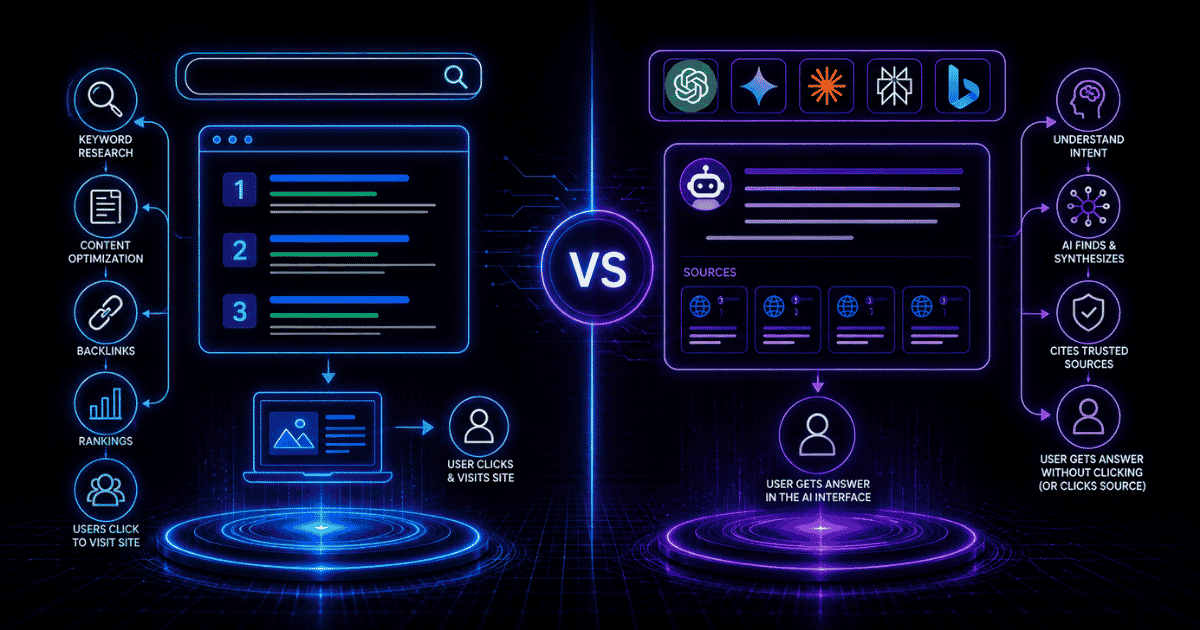
Search used to feel fairly straightforward.
Someone typed a query into Google, scanned a list of links, clicked a result, and visited a website. Marketers optimized pages to earn one of those clicks.
Now the same person might ask ChatGPT, use Google’s AI Mode, read an AI Overview, continue with follow-up questions, and receive a summarized answer supported by selected sources. ChatGPT search, for example, can search the web and return timely answers with links and inline citations. Google’s AI features similarly generate responses while providing links for deeper exploration.
That changes the search experience—but it doesn’t erase traditional SEO.
The smarter strategy is understanding how the two systems overlap and where they require different tactics.
TL;DR
What it is: Traditional SEO improves visibility in conventional search results, while AI-search optimization improves the likelihood that a brand or page appears within generated answers, citations, and conversational recommendations.
Who it’s for: SEO professionals, marketers, publishers, businesses, and anyone relying on digital discovery.
Biggest takeaway: AI search changes how information is presented, but it still depends heavily on accessible, trustworthy, well-structured web content.
Gary’s opinion: Don’t choose between traditional SEO and AI search. Build a strong SEO foundation, then make that content easier for AI systems to understand, retrieve, and cite.
What Is Traditional SEO?
Traditional SEO is the process of improving a website so its pages can rank in standard search-engine results.
The familiar workflow looks like this:
- A search engine discovers a page.
- It processes and potentially indexes the page.
- Its ranking systems evaluate the page against a search query.
- The engine displays a ranked set of results.
Google describes Search as a largely automated system built around crawling, indexing, and serving results. Its ranking systems examine many signals to identify relevant and useful content from the pages in its index.
Traditional SEO commonly includes:
- Technical SEO
- Keyword and intent research
- On-page optimization
- Content development
- Internal linking
- Link earning
- Local SEO
- Page-experience improvements
- Measurement of rankings, traffic, and conversions
Its main objective is usually to earn visibility and generate a website visit.
What Is AI Search?
AI search uses generative systems to interpret a question, retrieve information, and produce a synthesized response.
Instead of only returning ten links, an AI-search experience may:
- Answer the question directly
- Summarize several sources
- Provide citations
- Recommend products or actions
- Compare competing options
- Maintain conversational context
- Respond to follow-up questions
Google says AI Overviews are intended to help users understand complex topics more quickly and provide links for further exploration. ChatGPT search similarly combines conversational answers with current information and links to relevant web sources. Bing’s generative search has also been described as understanding queries, reviewing sources, and dynamically generating results.
The primary objective for marketers is not always a blue-link click.
It may be:
- Being cited
- Being mentioned
- Appearing as a recommended option
- Influencing a generated response
- Establishing brand recognition
- Earning a click from an AI-generated answer
Traditional SEO vs AI Search at a Glance
| Area | Traditional SEO | AI Search |
|---|---|---|
| Typical output | Ranked links and search features | Generated answers with supporting sources |
| Primary unit of visibility | Webpage | Passage, page, entity, brand, or source |
| User behavior | Search, scan, click | Ask, read, refine, continue |
| Common metrics | Rankings, clicks, traffic, conversions | Citations, mentions, share of voice, referral traffic |
| Optimization focus | Relevance, authority, indexability, usability | Extractability, credibility, entities, citations, context |
| Main risk | Losing rankings or clicks | Being excluded from the generated answer |
| Business goal | Attract qualified visits | Influence answers and earn consideration |
The systems are different, but the foundations overlap substantially.
How Traditional SEO and AI Search Overlap

Both need accessible content
A page that cannot be crawled or properly understood has a weak foundation for traditional rankings and AI discovery.
Google’s guidance for AI features says existing SEO fundamentals remain relevant, including crawlability, internal links, page experience, and useful textual content. Google also states that no special AI-specific file or schema is required to appear in its generative search features.
Both reward useful information
Traditional search systems aim to prioritize helpful and reliable content created for people. Google applies the same general guidance to AI-supported search visibility rather than recommending a completely separate content philosophy.
Useful content generally has:
- A clear purpose
- Accurate information
- Direct answers
- Logical organization
- Original value
- Appropriate depth
- Evidence or experience
- A trustworthy publisher
Both benefit from authority
Backlinks, brand recognition, expert sourcing, citations, reviews, and broader reputation can all help establish credibility.
AI systems may use these signals differently than traditional ranking systems, but becoming a recognizable, well-supported source is useful across both environments.
Both depend on topical relationships
A single article rarely establishes deep authority.
A connected cluster—cornerstone content, supporting guides, research, comparisons, resources, and internal links—provides more context about what a site knows.
Google explicitly notes that links help it discover pages and understand their relevance.
What Changes With AI Search?

Individual passages matter more
Traditional SEO often evaluates a page as a ranking candidate.
AI retrieval systems may identify a specific section that directly answers the user’s question.
That makes self-contained sections more valuable. Each major section should explain its topic clearly without depending on five earlier paragraphs for context.
Entities and brands become more important
AI systems need to understand:
- Who the company is
- What it offers
- Which topics it is associated with
- Whether independent sources support those associations
- How the brand compares with alternatives
Traditional keywords still matter, but recognizable entities and consistent brand context carry greater strategic importance.
The click is no longer guaranteed
An AI response may satisfy the user without requiring a website visit.
That means visibility can create value even when it doesn’t immediately generate traffic.
Marketers may need to measure:
- Brand mentions
- AI citations
- Recommendation frequency
- Sentiment
- Referral visits
- Assisted conversions
- Branded-search growth
A ranking report alone cannot capture that.
Conversational depth matters
Traditional search often begins with separate queries:
- Best email marketing platform
- Kit vs Beehiiv
- Is Beehiiv good for creators?
AI search may handle all three within one conversation.
Content therefore needs to support definitions, comparisons, objections, limitations, and buying decisions—not merely one keyword.
Does AI Search Require Different Content?

Not entirely, but it rewards some characteristics more strongly.
Content designed for both traditional and AI search should include:
- Direct definitions near the top
- Descriptive headings
- Concise summaries
- Clear comparisons
- Specific examples
- Named entities
- Verifiable claims
- Updated information
- Original experience or data
- Logical internal links
- Clear authorship and publisher context
Structured data can also help search engines understand page content, although it should accurately represent what visitors can see on the page.
The goal is not to make content sound robotic.
The goal is to remove unnecessary ambiguity.
Which Should Marketers Prioritize?
For most businesses, traditional SEO should remain the foundation.
Without strong technical accessibility, useful content, sensible architecture, and established authority, AI-search tactics have very little to build upon.
A practical order is:
- Fix crawling and indexation.
- Build clear authority clusters.
- Match pages to search intent.
- Strengthen internal linking.
- Demonstrate expertise and trust.
- Structure answers for easy extraction.
- Build brand mentions and third-party validation.
- Measure both traditional and AI visibility.
Google’s own guidance reinforces this integrated approach: success in AI features rests largely on the same fundamentals used for traditional organic search rather than a separate set of secret requirements.
Gary’s Take
If I were building a search program today, I would probably allocate more attention to AI visibility than I did two years ago.
But I would not shift the budget away from traditional SEO fundamentals.
I’d build one content system capable of serving both.
That means technically sound pages, strong topic clusters, direct answers, original insight, credible sourcing, and clear brand context.
The mistake would be treating GEO or AEO like an escape hatch from SEO.
If a site is thin, confusing, slow, unsupported, and poorly connected, adding a summary box and three FAQs will not transform it into an authoritative source.
AI search makes strong fundamentals more valuable—not optional.
Pros and Cons
Traditional SEO
Pros
- Produces measurable website traffic
- Targets demonstrated search demand
- Supports long-term visibility
- Offers mature analytics and reporting
Cons
- Rankings can take time
- Competition is high
- Search features may reduce clicks
- Traditional metrics provide an incomplete picture
AI Search
Pros
- Creates new brand-discovery opportunities
- Supports complex and conversational queries
- Can generate citations and recommendations
- Rewards clear expertise and topical depth
Cons
- Measurement remains less standardized
- Citations and mentions may fluctuate
- Visibility does not always generate traffic
- Platforms interpret and retrieve content differently
Verdict
Let’s look at a final summary.

Ok, brass tax: Who should invest in traditional SEO?
Nearly every business that depends on online discovery.
Who should invest in AI-search optimization?
Organizations with established content, meaningful expertise, competitive categories, or audiences increasingly using AI assistants for research and buying decisions.
Overall recommendation: Treat AI search as an extension of SEO, not its replacement. Build one authoritative content ecosystem that can rank, be retrieved, earn citations, and support customer decisions wherever search occurs.
Frequently Asked Questions
Is AI search replacing traditional SEO?
No. AI search is changing how information is discovered and presented, but crawling, indexing, content quality, authority, and technical accessibility remain important.
What is the main difference between SEO and AI-search optimization?
Traditional SEO focuses primarily on ranked results and website visits. AI-search optimization also targets citations, mentions, generated answers, and conversational recommendations.
Can a page rank in Google but never appear in AI answers?
Yes. Traditional rankings and AI citations are related but not identical outcomes.
Do backlinks matter for AI search?
Backlinks can contribute to authority and discovery, but AI visibility may also depend on content clarity, brand recognition, third-party mentions, relevance, and retrieval suitability.
Does schema improve AI-search visibility?
Structured data helps search engines understand eligible page content, but schema alone does not guarantee rankings or citations.
Should content be written differently for AI search?
The core message should still serve people. Clear definitions, self-contained sections, credible evidence, comparisons, and direct answers can make content easier for both search engines and AI systems to interpret.
What should businesses measure besides rankings?
Track organic traffic, conversions, branded searches, AI mentions, citations, referral visits, sentiment, assisted conversions, and visibility across relevant platforms.
Related Articles
- What Is Traditional SEO?
- What Is AI Search?
- How Google Search Works
- What Are AI Citations?
- What Is AI Visibility?
Building a smarter marketing stack isn’t about buying more tools—it’s about choosing the right ones.
That’s the kind of growth I like.
— Gary