
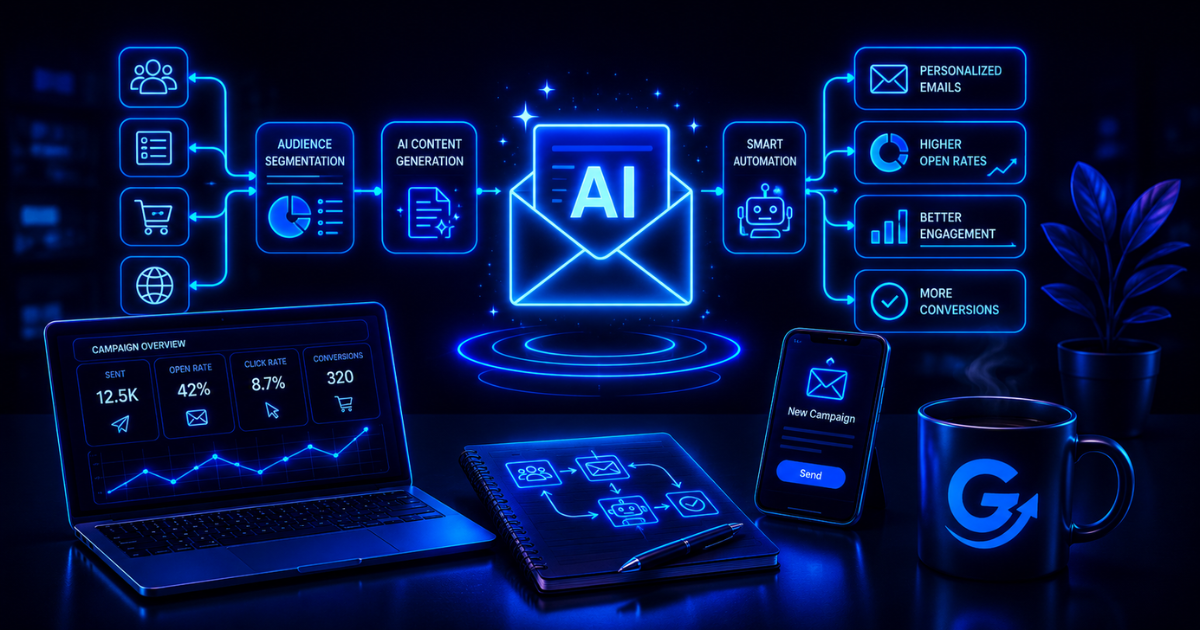
AI email marketing is the use of artificial intelligence to help create, personalize, optimize, automate, and analyze email campaigns.
If regular email marketing is the system for building and communicating with an email audience, AI is an added layer that can help marketers make parts of that system faster or smarter.
AI can help with things like:
- Writing subject lines
- Drafting email copy
- Personalizing messages
- Segmenting subscribers
- Predicting send times
- Recommending products
- Analyzing campaign performance
- Testing variations
- Building automated email workflows
The important distinction is that AI email marketing is still email marketing.
AI doesn’t replace the fundamentals: permission, audience quality, useful content, deliverability, segmentation, and a reason for subscribers to keep opening.
If you’re new to the channel itself, start with Growth Gary’s guide to what email marketing is. AI makes much more sense once you understand the system it’s being added to.
How Does AI Email Marketing Work?
AI email marketing works by using customer data, campaign data, machine learning, and generative AI to assist with decisions or tasks that marketers would otherwise perform manually.
A basic email campaign might require a marketer to:
- Choose an audience.
- Write a subject line.
- Write the email.
- Select a send time.
- Send the campaign.
- Review the results.
AI can potentially assist at every one of those steps.
For example, an AI-enabled email platform might:
Customer data → identify audience segment → generate email draft → personalize content → recommend send time → send campaign → analyze performance
Current platforms already use AI across several of these functions. HubSpot, for example, supports AI-generated email content including subject lines, preview text, body copy, and calls to action, while Klaviyo uses AI for tasks such as content creation, personalization, and send-time optimization.
The goal isn’t to remove the marketer.
The goal is to reduce unnecessary manual work and improve decisions where the data can actually help.
AI Email Marketing vs. Regular Email Marketing
The easiest way to understand AI email marketing is to compare it with the traditional process.
| Traditional Email Marketing | AI Email Marketing |
|---|---|
| Marketer writes every subject line | AI suggests or generates subject lines |
| Marketer creates each draft manually | AI generates a starting draft |
| Segments are built manually | AI can help identify useful audience groups |
| Send times are chosen manually | AI can recommend send times |
| Personalization uses fixed rules | AI can support more dynamic personalization |
| Testing requires manual setup | AI can help generate and evaluate variations |
| Reporting shows campaign data | AI can help summarize and interpret results |
The fundamentals haven’t changed.
You’re still trying to send the right message to the right person.
AI just gives you more ways to get there.
What Can AI Do in Email Marketing?
AI email marketing covers several different use cases.
AI Can Help Write Emails
This is probably the most obvious use.
Generative AI can help draft:
- Subject lines
- Preview text
- Email body copy
- Calls to action
- Promotional messages
- Newsletter introductions
- Product descriptions
- Follow-up emails
Platforms such as HubSpot and Mailchimp now provide AI-assisted email creation inside their marketing products.
That can save time, particularly when the hardest part is getting from a blank page to a usable first draft.
But I wouldn’t automatically send the first thing AI writes.
The marketer still needs to check:
- Accuracy
- Tone
- Offer
- Brand voice
- Relevance
- CTA
- Legal or compliance issues
AI can draft.
You still own the send button.
AI Can Personalize Email Content
Traditional personalization often looks like:
Hi {{First Name}}
Useful, but hardly revolutionary.
AI can potentially personalize around much richer information, including:
- Previous purchases
- Product interests
- Engagement history
- Customer lifecycle stage
- Browsing behavior
- Account activity
- Subscriber preferences
Klaviyo describes AI email marketing as using data to dynamically tailor messaging and improve relevance across customer interactions.
The important word is relevant.
Personalization isn’t valuable because it proves you have lots of data.
It’s valuable when it helps someone receive a better message.
AI Can Help With Email Segmentation
Segmentation means dividing an email audience into groups.
Traditional segments might include:
- Prospects
- Customers
- Repeat customers
- Inactive subscribers
- Newsletter subscribers
- People interested in a particular product
AI can help marketers identify patterns within larger customer datasets and create more useful groupings.
For example, instead of manually defining:
Everyone who bought Product A
an AI-enabled platform may help identify people who share behaviors associated with a high likelihood of purchasing Product B.
That can become useful.
It can also become unnecessarily complicated.
If three simple segments already tell you everything you need to know, you don’t need machine learning to create 47 micro-audiences nobody knows how to market to.
AI Can Help Determine When to Send Emails
Send-time optimization uses historical engagement data to estimate when a subscriber may be more likely to interact with an email.
Instead of sending a campaign to everybody at 9:00 a.m., the platform may distribute messages at different times based on individual or segment-level behavior.
Klaviyo lists send-time prediction as one of the uses of AI within its email marketing platform.
This is a good example of AI doing something that’s difficult to manage manually at scale.
A marketer can write the email.
They probably don’t want to manually determine 50,000 individual delivery times.
AI Can Help Automate Email Campaigns
This is where AI email marketing begins to overlap with marketing automation.
Traditional email automation uses predefined rules:
Subscriber joins list → send welcome email
Customer abandons cart → send reminder
Subscriber doesn’t engage for 90 days → start re-engagement campaign
AI can add another layer by helping decide:
- Which message to send
- Which content to recommend
- Which audience to target
- When to send
- How to prioritize customers
- Which campaign variation to use
Mailchimp describes traditional email automation as using predefined rules based on customer actions or inaction, while newer AI capabilities can assist with generating, testing, and optimizing parts of those campaigns.
If you’re still sorting out the broader automation side, Growth Gary’s best marketing automation software guide covers the platforms designed to manage these kinds of journeys.
AI Can Help Analyze Email Performance
Email platforms already generate plenty of data.
The problem is turning it into something useful.
AI can help summarize or interpret:
- Click performance
- Conversions
- Audience engagement
- Campaign trends
- Subject-line performance
- Segment differences
- Testing results
Instead of staring at a dashboard and asking:
So… what happened?
AI can potentially help surface patterns worth investigating.
That’s valuable when it improves a decision.
It’s less valuable when the AI simply turns the dashboard into three paragraphs of obvious observations.
What Are the Benefits of AI Email Marketing?
AI can make email marketing more efficient, but the benefits depend on how it’s used.
Faster Email Production
AI can speed up the first draft.
That matters for marketers producing frequent newsletters, promotions, nurture campaigns, and lifecycle emails.
More Personalization at Scale
Manual personalization becomes difficult as an audience grows.
AI can potentially use larger amounts of customer data to create or select more relevant content.
Less Repetitive Work
Generating variations, analyzing reports, categorizing customers, and drafting routine campaign content can consume a lot of time.
Those are reasonable places to look for AI assistance.
Faster Testing
AI makes it easier to produce multiple subject lines, headlines, calls to action, or email variations.
The important part is still testing them.
Generating 20 versions doesn’t tell you which version works.
Better Use of Customer Data
A large customer database contains patterns that may be difficult to identify manually.
Machine learning can help platforms use that information for segmentation, recommendations, prediction, or personalization.
What Are the Limitations of AI Email Marketing?
AI can make email easier.
It can also make bad email much easier to produce.
That’s an important distinction.
AI Can Produce Generic Copy
AI is very good at producing copy that sounds like marketing.
Sometimes that’s the problem.
You know the style:
🚀 Ready to supercharge your results?
If every company is using similar models to produce similar promotional copy, sounding human becomes more valuable, not less.
AI Doesn’t Know Your Audience Automatically
A language model may know a lot about email marketing.
It doesn’t automatically know why your subscribers joined your list.
You still need to provide context about:
- Audience
- Product
- Brand
- Goal
- Offer
- Customer stage
- Desired action
Better context usually produces better output.
AI Can Be Wrong
Generated emails can contain incorrect claims, outdated information, invented product details, or language you didn’t intend to use.
Review matters.
More Personalization Can Become Creepy
Just because you have customer data doesn’t mean you should reference all of it.
There’s a difference between:
Here’s a product similar to something you purchased.
and:
We noticed you looked at this item at 11:43 p.m. from your couch.
Technology doesn’t eliminate judgment.
Automation Can Scale Mistakes
A bad email manually sent to 10 people is embarrassing.
A bad automated campaign sent to 100,000 people is a meeting.
Test workflows before turning them loose.
Is AI Email Marketing the Same as Email Automation?
No.
Email automation automatically sends emails based on triggers or rules. AI email marketing uses artificial intelligence to create, personalize, predict, optimize, or analyze parts of email marketing.
An automation can work without AI.
For example:
New subscriber → send welcome email
No AI is required.
AI might enhance that workflow by recommending the best welcome message or adapting content based on the subscriber.
So:
Automation determines when something happens.
AI can help determine what should happen or what the message should contain.
There’s overlap, but they’re not the same thing.
Do You Need AI for Email Marketing?
No.
You can run an excellent email program without AI.
That’s worth saying clearly.
If you have a small email list, a straightforward newsletter, and a simple welcome sequence, you may not need advanced AI features at all.
Start with the fundamentals covered in Growth Gary’s email marketing guide:
- Build a permission-based list
- Give people a reason to subscribe
- Send something useful
- Segment when it improves relevance
- Watch deliverability
- Measure meaningful actions
- Respect the audience
Then ask where AI removes real friction.
Not where you can add AI because the software has a shiny button for it.
How Should You Start Using AI in Email Marketing?
Keep it simple.
1. Start With Email Marketing Fundamentals
Before adding AI, understand the underlying channel.
If you’re still building the basic system, start with what email marketing is and how it works.
AI won’t fix a weak list, unclear offer, or bad email strategy.
2. Pick One Repetitive Task
Choose something that consumes time.
Good starting points include:
- Drafting subject lines
- Creating first drafts
- Summarizing campaign results
- Generating test variations
- Repurposing content into newsletter copy
3. Keep a Human Review Step
Don’t automatically publish AI-generated marketing emails without review.
Check factual claims, tone, links, offers, personalization, and customer context.
4. Measure Whether It Actually Helps
Don’t measure:
We used AI 87 times this month.
Measure:
- Time saved
- Campaign production speed
- Engagement
- Conversion
- Error rate
- Review time
If AI creates a draft in 20 seconds but requires 40 minutes of rewriting, the productivity gain may be imaginary.
5. Add More AI Only When the Use Case Is Clear
Once a simple use case works, consider more advanced applications such as:
- Predictive segmentation
- Send-time optimization
- Product recommendations
- Automated personalization
- Campaign optimization
Grow into the complexity.
Don’t start there.
Gary’s Take: AI Should Make Your Email Better, Not Just Faster
Email is one of the easiest places to misuse generative AI.
Why?
Because AI makes producing more email incredibly easy.
But your subscribers aren’t sitting around wishing businesses would send them more emails.
They want better reasons to open the emails they’re already receiving.
So I’d use AI primarily to:
- Remove repetitive work
- Produce stronger starting drafts
- Find useful patterns
- Improve personalization
- Make testing easier
I wouldn’t use it to flood an audience with content simply because production became cheaper.
The goal isn’t automated volume.
It’s useful communication with less unnecessary work.
What AI Email Marketing Tools Are Available?
Many mainstream email and marketing automation platforms now include AI capabilities.
Examples include:
- HubSpot
- Mailchimp
- Klaviyo
- ActiveCampaign
- Brevo
- GetResponse
AI features differ substantially between platforms and change quickly.
Some emphasize content generation.
Others focus more heavily on personalization, predictive analytics, segmentation, recommendations, or automation.
HubSpot currently provides AI-assisted email creation, while Mailchimp and Klaviyo both position AI as part of broader email creation, personalization, and optimization workflows.
Don’t choose an email platform because it has the longest AI feature list.
Choose it because the underlying email platform fits your business.
The AI features are the bonus.
Is AI Email Marketing Worth It?
AI email marketing is worth using when it helps you create better campaigns, reduce repetitive work, use customer data more effectively, or make faster decisions.
It’s especially useful for teams managing:
- Large email lists
- Frequent campaigns
- Complex segmentation
- Ecommerce lifecycle email
- Multiple customer journeys
- Significant testing
- Large amounts of campaign data
It’s less important when your email program is still simple.
A useful weekly newsletter doesn’t need an AI command center.
Sometimes the highest-performing marketing technology is still:
write something worth reading → send it to people who asked for it
Then add sophistication when the business needs it.
FAQs About AI Email Marketing
What is AI email marketing?
AI email marketing is the use of artificial intelligence to assist with email creation, personalization, segmentation, automation, optimization, and campaign analysis.
How is AI used in email marketing?
AI can generate subject lines and email drafts, recommend send times, identify audience segments, personalize content, analyze campaign data, generate test variations, and support automated workflows. Current email platforms already provide several of these capabilities.
Can AI write marketing emails?
Yes. Generative AI can create email drafts, subject lines, preview text, and calls to action. Human review remains important for accuracy, tone, relevance, and brand consistency.
Can AI personalize emails?
Yes. AI can use customer and behavioral data to support more dynamic personalization, recommendations, and audience segmentation. The value depends on the quality of the underlying data and strategy.
Is AI email marketing the same as marketing automation?
No. Marketing automation automatically executes workflows using triggers and rules. AI can assist those workflows by generating content, predicting behavior, personalizing messages, or helping decide what action to take.
Do small businesses need AI email marketing?
Not necessarily. Small businesses should first build the fundamentals of a useful email marketing program. AI becomes valuable when it solves a specific problem or removes enough repetitive work to justify the added complexity.
Will AI replace email marketers?
AI can automate and accelerate individual tasks, but email strategy still requires decisions about audience, positioning, offers, customer relationships, brand voice, and business objectives. Current platforms themselves generally position AI as an assistant to marketers rather than a substitute for the overall marketing function.
Related Growth Gary Content
- What Is AI Marketing?
- Best Marketing Automation Software
- What Is Workflow Automation?
- Best AI Marketing Tools
- Gary’s Recommended Marketing Stack
Explore This Topic
- AI Email Marketing Tools
- AI Email Marketing Examples
- AI Email Personalization
- AI Email Automation
- AI Email Marketing for Small Businesses
- How to Use AI to Write Marketing Emails
- AI Email Marketing vs. Email Automation
- AI Email Marketing Prompts
- AI Email Marketing Best Practices
- Best AI Email Marketing Software
AI can make email marketing faster and smarter.
Just don’t let it distract from the part that matters most: giving people a good reason to keep reading your emails.
— Gary