
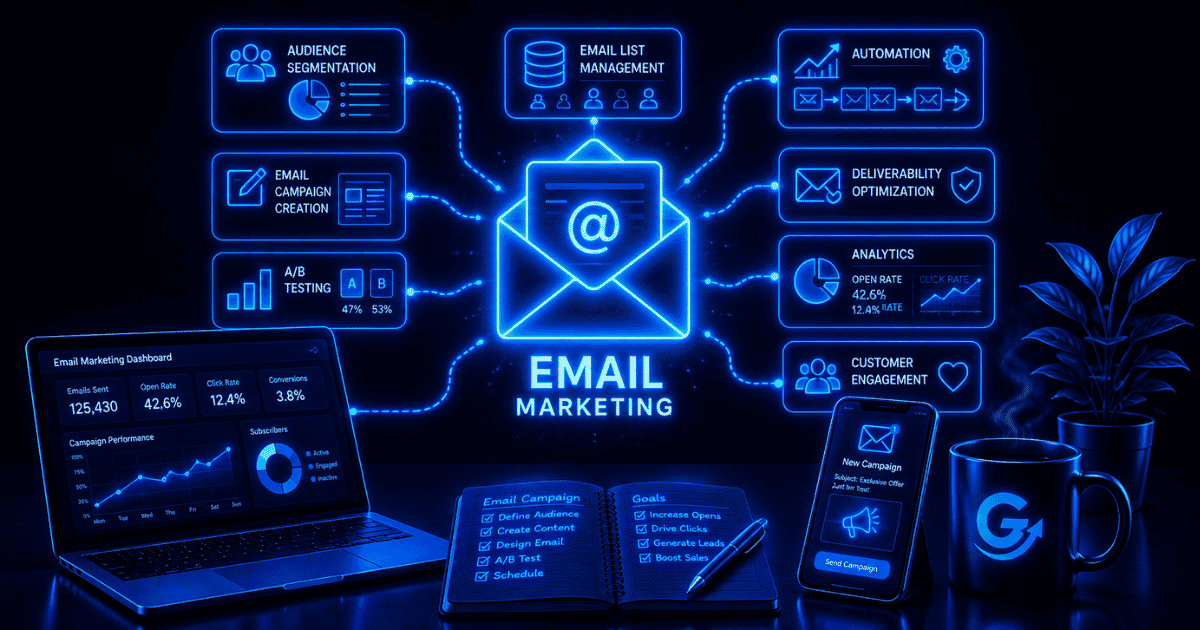
Email marketing is the use of email to communicate with an audience for the purpose of building relationships, promoting products or services, educating subscribers, generating leads, and driving repeat business.
That can include:
- Newsletters
- Welcome emails
- Product announcements
- Lead nurture sequences
- Promotional campaigns
- Abandoned-cart emails
- Event reminders
- Customer onboarding
- Re-engagement campaigns
- Post-purchase follow-ups
At its best, email marketing gives businesses a direct way to communicate with people who have chosen to hear from them.
That last part matters.
Unlike social media, where distribution depends heavily on a platform’s algorithm, an email list is a much more direct audience relationship. You still depend on email providers for deliverability, of course, but you aren’t asking Instagram or LinkedIn whether you’re allowed to reach your own subscribers today.
The simplest definition is:
Email marketing is a digital marketing strategy that uses permission-based email communication to build relationships and move subscribers toward a desired action.
The goal isn’t to send more email.
It’s to send useful email to the right people at the right time.
How Does Email Marketing Work?
Email marketing works by collecting permission from people who want to receive communication, storing those contacts in an email platform, segmenting the audience when useful, and sending relevant messages based on interests, behavior, or timing.
A basic email marketing process looks like this:
- A person joins your email list.
- Their information is stored in an email marketing platform.
- They receive emails based on your campaign or automation rules.
- They open, click, reply, purchase, unsubscribe, or take another action.
- You measure those actions and improve future emails.
That process can be extremely simple.
A small business might collect newsletter signups and send one useful email every Friday.
A larger company might operate dozens of automated sequences based on purchases, product usage, lifecycle stage, geography, and customer behavior.
Both are email marketing.
The sophistication should match the business.
Why Is Email Marketing Important?
Email marketing is valuable because it gives businesses a repeatable way to communicate directly with people who have already shown some level of interest.
That might mean they:
- Subscribed to a newsletter
- Downloaded a guide
- Created an account
- Purchased a product
- Registered for an event
- Requested information
- Joined a waiting list
You aren’t necessarily starting from zero.
You Own More of the Audience Relationship
This is one of email’s biggest strategic advantages.
A business can spend years building a social following only to see organic reach decline when a platform changes its algorithm.
An email list isn’t completely independent—you still depend on inbox providers and good deliverability—but the relationship is much more direct.
You control:
- Your subscriber database
- Your sending schedule
- Your messaging
- Your segmentation
- Your offers
- Your customer data
That’s valuable.
Email Works Across the Customer Journey
Email isn’t only useful for promotions.
It can support:
Awareness → Consideration → Purchase → Onboarding → Retention
A subscriber might first receive an educational newsletter, later receive a product comparison, then buy, enter an onboarding sequence, and eventually receive a renewal reminder.
One channel can support multiple stages of the relationship.
Email Can Be Personalized
You don’t have to send the same message to everyone.
Email marketing platforms can segment audiences based on factors such as:
- Customer status
- Product interest
- Purchase history
- Engagement
- Geography
- Lead source
- Lifecycle stage
- Website activity
That lets businesses communicate more relevantly.
And relevance usually matters more than sending volume.
What Are the Main Types of Email Marketing?
Email marketing includes several different types of communication.
Email Newsletters
Newsletters are recurring emails sent to subscribers on a regular schedule.
They may include:
- Educational content
- Company updates
- Industry commentary
- Curated resources
- Product information
- Offers
- New articles
A newsletter is usually best when subscribers understand what they’re signing up for.
“Join our email list” isn’t very compelling.
“Get one practical AI marketing breakdown every Thursday” gives the reader a reason to care.
Promotional Emails
Promotional emails are designed to encourage a specific commercial action.
Examples include:
- Product launches
- Sales
- Discounts
- Seasonal promotions
- Limited-time offers
- New service announcements
Promotional email works best when there is actual value behind the promotion.
Sending “LAST CHANCE!!!” every 48 hours eventually teaches your audience that there is always another last chance.
Welcome Emails
Welcome emails are sent after someone first joins your audience.
A welcome sequence might:
- Confirm the subscription.
- Explain what the subscriber will receive.
- Deliver a promised resource.
- Introduce your best content.
- Explain your product or service.
- Ask about subscriber interests.
This is a particularly useful opportunity because the subscriber has just expressed interest.
Don’t waste it with:
Thanks for subscribing.
And then silence for six weeks.
Lead Nurture Emails
Lead nurturing uses email to educate and build trust with people who aren’t yet ready to buy.
For example, someone downloads a guide about website SEO.
A nurture sequence could provide:
- A related SEO checklist
- A technical SEO guide
- A case for improving site structure
- Common mistakes
- A relevant service or software recommendation
The objective is to help the prospect make progress rather than hammer them with sales emails immediately.
Transactional Emails
Transactional emails are triggered by an action or account event.
Examples include:
- Order confirmations
- Receipts
- Password resets
- Shipping notices
- Account notifications
- Booking confirmations
Transactional messages aren’t usually considered marketing campaigns in the same sense as newsletters, but they form part of the broader email customer experience.
And because people often pay close attention to transactional messages, they’re worth treating carefully.
Abandoned-Cart Emails
Ecommerce businesses can automatically follow up when a shopper adds something to a cart but doesn’t complete the purchase.
A sequence might include:
Reminder → product benefits → social proof → incentive
Not every abandoned cart needs a coupon.
Sometimes the customer simply got distracted.
Re-Engagement Emails
Re-engagement campaigns target subscribers who haven’t interacted for a defined period.
The objective might be to:
- Restore interest
- Learn why they disengaged
- Update preferences
- Remove inactive subscribers
That final option matters too.
A bigger email list isn’t always a better email list.
What Is an Email Marketing Campaign?
An email marketing campaign is a coordinated email or series of emails designed to accomplish a specific marketing objective.
Examples include:
- Launching a product
- Promoting an event
- Generating holiday sales
- Driving webinar registration
- Re-engaging inactive customers
- Promoting a new content resource
A campaign has a defined purpose.
That distinguishes it from routine communication such as a recurring newsletter.
A simple campaign might be:
Email 1: Introduce offer
Email 2: Explain benefits
Email 3: Address objections
Email 4: Deadline reminder
The number of emails isn’t what makes the campaign good.
The logic is.
Email Marketing vs. Marketing Automation
Email marketing and marketing automation overlap, but they’re not the same thing.
Email marketing focuses on communicating through email. Marketing automation coordinates actions across customer data, behaviors, channels, and systems.
| Email Marketing | Marketing Automation |
|---|---|
| Newsletters | Multi-step customer journeys |
| Promotional campaigns | Behavioral triggers |
| Email sequences | Lead scoring |
| Subscriber segmentation | CRM updates |
| Email analytics | Cross-channel workflows |
| Campaign scheduling | Sales notifications |
| Automated emails | Broader lifecycle automation |
You can absolutely automate email.
For example:
Newsletter signup → welcome sequence
That’s email automation.
But a broader marketing automation workflow might look like:
Form submission → CRM record → lead score → email sequence → sales notification → retargeting audience
Email is one part of the system.
If you want the broader concept, Growth Gary’s guide to what workflow automation is explains how automated processes connect across applications.
Email Marketing vs. Social Media Marketing
Email and social media serve different roles.
Social media is generally stronger for discovery and public distribution.
Email is generally stronger for direct, repeated communication with an audience you’ve already acquired.
| Social Media | Email Marketing |
|---|---|
| Strong for discovery | Strong for retention |
| Public or semi-public | Direct communication |
| Algorithmic reach | List-based distribution |
| Builds followers | Builds subscribers |
| Great for conversation | Great for nurturing |
| Platform controls much of reach | Brand controls more of distribution |
The smartest approach is often to use social media to attract attention and email to retain it.
That means converting some of your social audience into email subscribers when there’s a useful reason for them to join.
Email Marketing vs. Content Marketing
Email is also closely connected to content marketing.
A business might create:
- Blog articles
- Videos
- Research
- Guides
- Tools
- Case studies
Email provides a distribution channel for that material.
Rather than hoping people remember to return to your website, you can bring useful content directly to subscribers.
That’s why email often works well as part of a broader content system rather than as an isolated promotional channel.
Growth Gary’s guide to what content marketing is covers that relationship in more detail.
How Do You Build an Email List?
The best email list is permission-based.
That means people intentionally choose to receive your communication.
Common list-building methods include:
- Newsletter signup forms
- Lead magnets
- Webinar registrations
- Product accounts
- Checkout opt-ins
- Free tools
- Templates
- Reports
- Events
- Courses
- Waitlists
The key is giving people a clear reason to subscribe.
“Subscribe to our newsletter” is technically an invitation.
It isn’t much of a value proposition.
A stronger offer might be:
Get Gary’s weekly breakdown of the AI marketing tools actually worth paying attention to.
Now the subscriber understands what they’re getting.
What Is a Lead Magnet?
A lead magnet is a useful resource offered in exchange for contact information, usually an email address.
Examples include:
- Checklists
- Templates
- Guides
- Reports
- Calculators
- Courses
- Worksheets
- Toolkits
Lead magnets work when the resource solves a genuine problem.
Don’t create a 37-page PDF simply because somebody once told marketers that every website needs an ebook.
What Is Email Segmentation?
Email segmentation means dividing subscribers into groups so you can send more relevant communication.
For example, an ecommerce business might segment:
Prospects
First-time customers
Repeat customers
VIP customers
Inactive customers
The company can then communicate differently with each group.
Segmentation can be based on:
- Demographics
- Interests
- Purchases
- Engagement
- Lifecycle stage
- Geography
- Signup source
- Product usage
- Website activity
The more data you collect, the more segmentation becomes possible.
But more isn’t automatically better.
Only collect and use information that helps improve the customer experience or your decision-making.
What Is Email Personalization?
Email personalization means tailoring content to an individual subscriber or segment based on known information.
The simplest example is inserting someone’s first name.
That’s personalization.
It’s also the least interesting version of personalization.
More useful examples include:
- Recommending products based on purchase history
- Sending different content based on customer stage
- Adjusting offers based on product interest
- Sending renewal information based on account status
- Recommending articles based on subscriber interests
Good personalization makes communication feel more relevant.
Bad personalization makes it obvious that a database knows your first name.
What Is Email Automation?
Email automation uses predefined triggers and rules to send messages automatically.
For example:
Trigger: User joins newsletter.
Action: Send welcome email.
Wait: Two days.
Action: Send popular resources.
Condition: Has the person clicked a product link?
Yes → Send relevant product education.
No → Continue educational sequence.
This kind of automation can save significant manual effort once the workflow is established.
Growth Gary’s guide to the best marketing automation software covers the software side when you need more sophisticated automated journeys.
What Makes a Good Marketing Email?
A good marketing email has one important job:
Give the reader a reason to care.
That sounds obvious, but a lot of email gets built backward.
The business asks:
What do we need to announce?
The reader asks:
Why should I care?
The reader wins.
A Useful Subject Line
The subject line should accurately communicate enough value or curiosity to earn the open.
Avoid tricks.
If every subject line says:
URGENT
eventually none of them are.
A Clear Opening
Don’t make subscribers work to understand why you’re emailing them.
Get to the point.
One Primary Message
Many emails suffer from trying to promote everything.
New podcast!
New blog!
Product launch!
Upcoming webinar!
Follow us!
Book a demo!
When everything is important, nothing is.
A focused email is usually easier to understand.
A Clear Call to Action
Tell the reader what to do next.
That might be:
- Read article
- Watch video
- Register
- Shop products
- Start trial
- Reply
- Book call
The CTA should make sense based on the email.
Useful Content
Not every email needs to sell something.
In fact, if every email is a promotion, your subscribers will eventually treat your entire inbox presence as advertising.
Education, insight, entertainment, and useful resources create reasons to keep opening.
How Often Should You Send Marketing Emails?
There isn’t one correct frequency.
The right frequency depends on:
- Audience expectations
- Type of business
- Content quality
- Customer lifecycle
- Industry
- Campaign purpose
A daily financial newsletter may be completely appropriate.
A daily email from a local roofing contractor probably isn’t.
Consistency matters more than arbitrary frequency.
If you promise a weekly newsletter, send a useful weekly newsletter.
Don’t send nothing for four months and then eight emails during Black Friday.
What Are the Benefits of Email Marketing?
Email marketing can support several business objectives at once.
Direct Audience Access
Email gives you a direct communication channel with subscribers.
Customer Retention
Email can maintain relationships after the first purchase.
Lead Nurturing
Prospects can receive useful information over time instead of being pushed immediately toward a sale.
Personalization
Messages can become more relevant based on customer information and behavior.
Automation
Many email workflows can operate without manual intervention.
Measurement
Email provides measurable interaction data that can help marketers understand audience behavior.
Revenue
For many businesses, email can directly support purchases, renewals, upgrades, and repeat orders.
The important qualifier is that the channel doesn’t create value automatically.
The list, offer, messaging, timing, and customer experience still matter.
What Are the Limitations of Email Marketing?
Email has plenty of advantages, but it isn’t magic.
You Need an Audience
You can’t email subscribers you don’t have.
Building a useful list takes time.
Deliverability Matters
An email that lands in spam isn’t particularly effective.
Deliverability can be affected by:
- Sender reputation
- Authentication
- Subscriber engagement
- Complaint rates
- List quality
- Email content
- Sending behavior
Subscribers Can Ignore You
Delivering an email doesn’t mean someone reads it.
Attention still has to be earned.
Lists Decay
People change jobs.
Addresses stop working.
Interests change.
Subscribers disengage.
Email lists require maintenance.
Poor Email Can Damage Trust
Being granted access to someone’s inbox is valuable.
Abusing it is expensive.
Too many emails, misleading subject lines, irrelevant promotions, or poor targeting can cause unsubscribes and spam complaints.
What Is Email Deliverability?
Email deliverability is the ability of your emails to successfully reach subscribers’ inboxes rather than being rejected or filtered into spam.
Deliverability depends partly on technical configuration and partly on sender behavior.
Important elements include:
- SPF
- DKIM
- DMARC
- Sender reputation
- Bounce rates
- Spam complaints
- List quality
- Engagement
- Sending patterns
You don’t need to become an email infrastructure engineer to run a newsletter.
But if email becomes an important revenue channel, deliverability deserves serious attention.
What Email Marketing Metrics Matter?
Email marketing generates a lot of numbers.
Not all of them deserve equal attention.
| Metric | What It Measures |
|---|---|
| Delivery rate | Percentage successfully delivered |
| Open rate | Percentage recorded as opened |
| Click-through rate | Percentage clicking a link |
| Click-to-open rate | Engagement among recorded opens |
| Conversion rate | Percentage completing desired action |
| Unsubscribe rate | Percentage leaving list |
| Bounce rate | Emails that couldn’t be delivered |
| Spam complaint rate | Recipients marking email as spam |
| Revenue per recipient | Revenue relative to email audience |
| List growth rate | Change in subscriber base |
Be Careful With Open Rates
Open rates have become less precise because privacy features can affect how email opens are recorded.
That doesn’t make the metric completely useless.
It does mean marketers shouldn’t treat it as perfect evidence that a human read an email.
Clicks, conversions, replies, revenue, and downstream behavior often provide stronger signals.
How Do You Measure Email Marketing ROI?
The simplest version is:
Revenue attributable to email − email marketing costs
But attribution isn’t always that clean.
A subscriber might:
- Receive your newsletter.
- Click nothing.
- Search your brand two days later.
- Read a product page.
- Buy.
Last-click analytics may call that organic search.
Email may still have influenced the purchase.
That’s why mature measurement often combines direct conversion tracking with broader customer-journey analysis.
For smaller businesses, don’t make this more complicated than necessary.
Start by tracking:
- Email-generated traffic
- Leads
- Purchases
- Revenue
- Subscriber growth
- Unsubscribes
- Engagement
Then improve the measurement as the program becomes more important.
What Are Email Marketing Tools?
Email marketing tools help businesses collect subscribers, create campaigns, automate messages, segment audiences, and measure performance.
Common platforms include:
- Mailchimp
- beehiiv
- Kit
- ActiveCampaign
- Brevo
- GetResponse
- MailerLite
- Klaviyo
The products aren’t interchangeable.
Some are optimized for creators.
Others lean toward ecommerce.
Some offer sophisticated CRM and automation capabilities.
Others make simple newsletters easy.
Don’t choose software simply because it has the longest feature list.
Choose based on what you’re actually trying to accomplish.
How Do You Choose an Email Marketing Platform?
Start with your requirements.
Ask:
What Type of Email Are You Sending?
Newsletter?
Ecommerce?
B2B nurture?
Creator publication?
Customer lifecycle campaigns?
Different platforms specialize in different jobs.
How Large Is Your List?
Pricing often increases with contact count or sending volume.
A platform that looks inexpensive with 500 subscribers may become much more expensive at 50,000.
How Much Automation Do You Need?
A weekly newsletter doesn’t require an elaborate automation system.
A B2B lead-nurture program might.
What Does It Need to Integrate With?
Consider:
- CRM
- Ecommerce platform
- Website
- Forms
- Analytics
- Payment system
- Advertising
- Automation software
How Easy Is It to Use?
This matters more than feature comparisons sometimes suggest.
A sophisticated platform your team avoids isn’t sophisticated.
It’s shelfware with a monthly subscription.
Where Does AI Fit Into Email Marketing?
AI is increasingly being incorporated into email platforms and workflows.
Potential uses include:
- Subject line generation
- Email drafts
- Segmentation
- Personalization
- Send-time recommendations
- Content recommendations
- Campaign analysis
- Testing variations
- Customer-service responses
- Workflow logic
The useful question isn’t:
Can AI do this?
It probably can.
Ask:
Does AI make this particular process faster or better?
Using AI to generate 50 mediocre email variants isn’t automatically better than writing one strong email.
Growth Gary’s guide to what AI marketing is covers the wider relationship between AI and marketing.
How Do You Start Email Marketing?
You don’t need a complex funnel to start.
1. Define Why Someone Should Subscribe
Give the audience a reason.
2. Choose an Email Platform
Pick something appropriate to your actual needs.
3. Create a Signup Form
Make joining easy.
4. Set Expectations
Tell subscribers what they’ll receive and approximately how often.
5. Build a Welcome Email
Start the relationship immediately.
6. Send Something Useful
Useful beats elaborate.
7. Measure What Happens
Watch engagement, conversions, unsubscribes, and subscriber growth.
8. Add Automation When Repetition Appears
Don’t design 17 automated journeys before you have an audience.
Start simple.
Grow with the problem.
Common Email Marketing Mistakes
Most email problems aren’t caused by choosing the wrong button color.
They’re caused by strategy.
Buying Email Lists
Don’t.
Permission is one of the main reasons email works.
A giant list of people who never asked to hear from you isn’t an audience.
It’s a deliverability problem waiting to happen.
Sending Only Promotions
If every email asks the subscriber to buy something, your relationship becomes pretty one-dimensional.
Give people reasons to stay subscribed.
Ignoring Segmentation
Sending every message to every subscriber can become increasingly ineffective as your audience grows.
Writing Misleading Subject Lines
A subject line can win the open and lose the subscriber.
Trust compounds.
So does irritation.
Making Unsubscribing Difficult
If someone wants to leave, let them leave.
Keeping uninterested subscribers isn’t a victory.
Over-Automating
Automation should support relevance.
Not create robotic communication at industrial scale.
Obsessing Over List Size
A list of 5,000 engaged subscribers can be considerably more valuable than 100,000 people who barely remember joining.
Audience quality matters.
Gary’s Take: Email Is Where Attention Becomes an Asset
Here’s why I continue to like email strategically.
Most marketing channels help you borrow attention.
Search gives you Google’s traffic.
Social gives you a platform’s audience.
Advertising rents distribution.
Email lets you gradually build a more direct audience relationship.
That doesn’t mean you own someone’s attention.
You still have to earn the next open.
But every useful subscriber makes your marketing system a little less dependent on somebody else’s algorithm.
If I were building a marketing operation from scratch, I wouldn’t wait until I had massive traffic to start collecting email subscribers.
I’d give the right visitors a genuinely useful reason to stay connected.
Then I’d protect that relationship.
Send useful things.
Don’t over-send.
Don’t trick people.
And don’t turn every subscriber into a lead score with a pulse.
Email is personal enough that bad marketing becomes obvious quickly.
That’s actually a good thing.
Is Email Marketing Worth It?
Yes, for most businesses that have a reason to maintain an ongoing relationship with prospects or customers.
Email can be particularly valuable for:
- Ecommerce
- SaaS
- Professional services
- Publishers
- Creators
- B2B companies
- Membership businesses
- Education
- Events
- Local businesses
- Subscription products
But the right email strategy depends on the business.
A company with a long sales cycle may emphasize nurturing.
An ecommerce store may emphasize lifecycle campaigns and purchases.
A publisher may care primarily about newsletter engagement and audience growth.
A local service company may need only a modest list and a few useful follow-ups.
The goal isn’t to have “email marketing.”
The goal is to create a communication system that makes the customer relationship more valuable.
FAQs About Email Marketing
What is email marketing in simple terms?
Email marketing is the use of email to communicate with subscribers and customers for purposes such as education, promotion, lead nurturing, sales, customer retention, and relationship building.
What is an example of email marketing?
A weekly newsletter is a simple example. A business sends subscribers useful content, product updates, or recommendations on a regular schedule. Other examples include welcome sequences, abandoned-cart emails, promotional campaigns, and customer onboarding emails.
Is email marketing still effective?
Email remains useful because it gives businesses a direct way to communicate with people who have intentionally joined their audience. Effectiveness depends on list quality, relevance, messaging, deliverability, frequency, and the business model.
What’s the difference between email marketing and marketing automation?
Email marketing focuses specifically on email communication. Marketing automation can coordinate email along with CRM activity, lead scoring, segmentation, sales notifications, customer journeys, and other channels or systems.
How much does email marketing cost?
Costs range from free or inexpensive plans for small lists to hundreds or thousands of dollars per month for large databases and advanced automation. Pricing often depends on contact count, sending volume, features, and user seats.
How often should I send marketing emails?
There is no universal ideal frequency. Choose a schedule that matches audience expectations and allows you to consistently send something useful.
Do I need a large email list?
No. A smaller engaged list can produce substantially more value than a much larger list of uninterested subscribers. Relevance and audience quality matter more than raw subscriber count.
Can AI write marketing emails?
Yes. AI can help generate drafts, subject lines, variations, summaries, and personalization. Human review remains important to ensure accuracy, brand fit, relevance, and quality.
Related Growth Gary Content
Explore This Topic
- Best Email Marketing Platforms
- Email Marketing Strategy
- Email Marketing for Small Businesses
- Email Marketing Automation
- Email Marketing vs. Marketing Automation
- Email Marketing vs. Social Media Marketing
- How to Build an Email List
- How to Create an Email Welcome Sequence
- How to Improve Email Deliverability
- How to Measure Email Marketing ROI
Email marketing works because the relationship can continue after the first click.
Treat the inbox like borrowed trust, not free advertising space, and it becomes one of the most useful assets in a marketing system.
— Gary
The changes actually worth knowing
A short briefing that filters the noise into useful AI, marketing, technology, tools, and ideas for marketers and businesses.