
TL;DR
What it is: Workflow automation uses software to execute recurring tasks and move information between tools based on triggers, rules, conditions, and actions.
Who it’s for: Businesses, marketing teams, agencies, operations teams, sales organizations, creators, and anyone managing repeatable digital processes.
How it works: A trigger starts the workflow, logic determines what should happen next, and one or more actions are completed automatically.
Biggest takeaway: The best workflows automate stable, clearly defined processes. Automating a confusing process usually creates faster confusion.
Gary’s opinion: Start with one repetitive task that happens often and has an obvious outcome. Measure the time or errors saved before building something more complicated.
What Is Workflow Automation?
Most businesses don’t realize how much time they lose moving information from one place to another.
A lead fills out a form. Someone copies the details into a CRM. Another person sends an email. A task gets created. A spreadsheet gets updated. Then everyone hopes nothing was missed along the way.
That isn’t a sophisticated process. It’s a relay race between browser tabs.
Workflow automation is the use of software to complete repeatable tasks, move information between systems, and trigger actions based on predefined rules with limited manual involvement.
The goal is not to automate everything. It’s to remove repetitive work, reduce errors, speed up handoffs, and let people focus on decisions that actually require judgment.
What Does Workflow Automation Mean?
Workflow automation means using software to execute a sequence of tasks automatically according to predefined business logic.
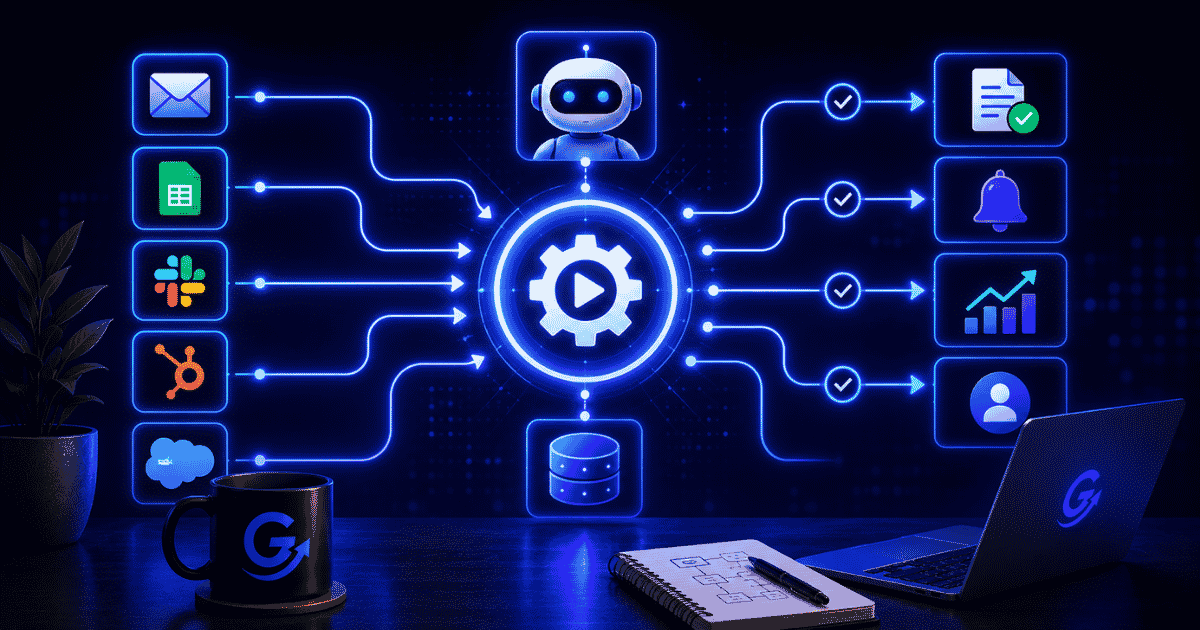
A workflow usually contains three basic parts:
- Trigger: Something happens.
- Logic: The system determines what should happen next.
- Action: One or more tasks are completed automatically.
For example:
A visitor downloads a guide.
An automated workflow could then:
- Add the person to a CRM
- Apply a lead-source tag
- Start an email sequence
- Alert the sales team
- Create a follow-up task
- Record the event in a reporting system
The goal is not simply to make software do more things.
The goal is to make a repeatable process more efficient, reliable, and measurable.
Workflow automation sits within the broader world of marketing automation, business operations, and increasingly AI automation.
How Does Workflow Automation Work?
Workflow automation platforms connect applications, evaluate rules, and move information among systems.
The exact setup varies by platform, but most workflows rely on the same core building blocks.
Triggers
A trigger starts the workflow.
Examples include:
- A form is submitted
- A customer makes a purchase
- A meeting is booked
- A spreadsheet row is added
- An email arrives
- A deal changes status
- A file is uploaded
- A deadline is approaching
- A support ticket is created
The trigger is the event that tells the workflow, “Start now.”
Actions
Actions are the tasks performed after the trigger.
Examples include:
- Send an email
- Create a contact
- Update a database
- Assign a task
- Generate a document
- Post a notification
- Add someone to a campaign
- Move a file
- Update a CRM record
- Create a calendar event
A workflow can contain one action or dozens.
More actions don’t automatically make it better.
Conditions and Filters
Conditions determine whether a workflow should continue or follow a particular branch.
For example:
- Continue only if the lead is located in the United States.
- Send enterprise leads to one sales team and small-business leads to another.
- Skip customers who already purchased.
- Wait three days before the next step.
- Notify a manager only if the purchase exceeds a certain amount.
This is where automation moves beyond simple “if this, then that” behavior.
Integrations
Integrations allow different software systems to exchange data.
Common workflow automation connections include tools such as:
- CRM platforms
- Email systems
- Spreadsheets
- Ecommerce platforms
- Project-management tools
- Content-management systems
- Databases
- Messaging platforms
- Calendar tools
- Analytics systems
Without integrations, people become the bridge between systems.
People are capable bridges, but they usually have better things to do.
What Is a Workflow Trigger?
A workflow trigger is the event that starts an automated process.
Triggers can be:
- User-driven: Someone submits a form.
- System-driven: A record changes status.
- Time-driven: A scheduled date arrives.
- Data-driven: A value reaches a threshold.
- External: Another platform sends an event.
A well-designed trigger should be clear, reliable, and connected to a business event that actually matters.
If a workflow starts too often, starts from noisy data, or starts from the wrong condition, the rest of the automation inherits that problem.
What Are Workflow Actions?
Workflow actions are the tasks the automation performs after a trigger occurs.
Common actions include:
- Creating records
- Updating fields
- Sending messages
- Assigning owners
- Moving files
- Creating tasks
- Adding tags
- Starting campaigns
- Generating reports
- Logging events
Actions can also feed data into another workflow.
That makes complex systems possible, but it also increases the need for documentation and monitoring.
A workflow that nobody understands after the original builder leaves the company is not particularly automated.
It’s just mysterious.
What Are Common Workflow Automation Examples?
Workflow automation can support almost every business function.
| Area | Example Automations |
|---|---|
| Marketing | Lead routing, email enrollment, campaign alerts |
| Sales | Lead assignment, follow-up tasks, deal-stage updates |
| Content | Approvals, task creation, publishing handoffs |
| Ecommerce | Order messages, review requests, customer tagging |
| Operations | Onboarding, approvals, reminders, document routing |
| Support | Ticket routing, escalation, status notifications |
Marketing Workflow Automation
Marketing teams often automate:
- Lead capture
- Lead routing
- Email enrollment
- Webinar registration
- Campaign notifications
- Customer segmentation
- Reporting updates
- Social publishing
- Content approvals
This overlaps closely with marketing automation, but workflow automation is broader because it can connect marketing with sales, operations, finance, support, and other teams.
Sales Workflow Automation
Sales teams may automate:
- Lead assignment
- Follow-up reminders
- CRM data entry
- Proposal generation
- Meeting preparation
- Deal-stage updates
- Internal alerts
The biggest value often comes from reducing administrative work around selling rather than trying to automate the sales conversation itself.
Content Workflow Automation
Content teams can automate parts of the publishing process.
Examples include:
- Turning approved ideas into project tasks
- Assigning writers or editors
- Sending review notifications
- Moving approved drafts into publishing queues
- Recording publication dates
- Distributing finished content
Workflow automation can support content marketing by making the production process more consistent without replacing the editorial judgment that determines what should be published.
Ecommerce Workflow Automation
Ecommerce businesses can automate:
- Order confirmations
- Inventory alerts
- Abandoned-cart messages
- Review requests
- Customer tagging
- Refund notifications
- Loyalty campaigns
- Shipping updates
Many of these workflows combine customer data with email, SMS, ecommerce, and CRM systems.
Internal Operations
Operational workflows can include:
- Employee onboarding
- Expense approvals
- Support ticket routing
- Document storage
- Recurring reminders
- Status reporting
- Access requests
- Procurement steps
These are often some of the best automation opportunities because the work is repetitive and rules-based.
Workflow Automation vs. Marketing Automation
Workflow automation and marketing automation overlap, but they are not the same thing.
Workflow automation is the broader concept. It can connect tasks, tools, and data across the business.
Marketing automation focuses specifically on marketing activity such as campaigns, leads, segmentation, nurturing, and customer communication.
| Workflow Automation | Marketing Automation |
|---|---|
| Works across many departments | Focuses on marketing and customer journeys |
| Connects multiple software systems | Often operates within CRM or campaign platforms |
| Automates internal and external processes | Automates campaigns and audience communication |
| Can include data movement and task creation | Often includes lead scoring and nurture |
| Example: sync a form lead to CRM and project tool | Example: enroll a lead in a nurture sequence |
A platform such as Zapier can connect many business systems.
A marketing automation platform can automate sophisticated customer journeys.
The categories overlap, but the intent is different.
Workflow Automation vs. AI Automation
Workflow automation usually follows predefined rules.
AI automation can add systems that interpret, classify, summarize, generate, or make probabilistic decisions within the workflow.
A traditional workflow might say:
If a form says “Enterprise,” send the lead to Team A.
An AI-assisted workflow might analyze an open-text inquiry, determine likely intent, summarize the request, assign a category, and then route the lead.
| Workflow Automation | AI Automation |
|---|---|
| Primarily follows explicit rules | Can interpret less-structured inputs |
| Predictable logic | Can use probabilistic model outputs |
| Best for stable processes | Useful when judgment-like tasks are involved |
| Often relies on fields and conditions | Can analyze text, images, or documents |
| Easier to test deterministically | Requires stronger monitoring and guardrails |
The distinction matters because adding AI also adds uncertainty.
If a normal rule is wrong, you fix the rule.
If an AI model occasionally classifies something incorrectly, you need to account for that behavior in the workflow design.
For the deeper distinction, see what AI automation is.
Workflow Automation vs. AI Agents
AI agents are another related concept.
A workflow follows a relatively defined sequence.
An AI agent can potentially evaluate a goal, decide what actions to take, use tools, and adapt its next step based on the result.
That doesn’t make agents automatically better.
For many business processes, a predictable workflow is exactly what you want.
If an invoice should always go through the same approval steps, creativity is not a feature.
Use deterministic workflows for predictable processes. Use more adaptive systems only when the task genuinely benefits from them.
What Are the Benefits of Workflow Automation?
Less Manual Work
Automation reduces repetitive copying, updating, notifying, and assigning.
That gives people more time for work requiring:
- Judgment
- Strategy
- Communication
- Creativity
- Problem-solving
The best automation removes low-value effort without removing useful human involvement.
Fewer Errors
Manual processes create opportunities for:
- Missed steps
- Incorrect data
- Forgotten follow-ups
- Duplicate records
- Inconsistent handling
A properly designed automation performs the same process consistently.
That doesn’t mean it can’t make mistakes.
It means the mistakes become system problems you can identify and correct rather than random human omissions.
Faster Response Times
Automated workflows can act immediately.
That matters when speed affects the outcome.
For example:
- Lead routing
- Customer notifications
- Support escalation
- Order communication
- Internal approvals
Reducing unnecessary delay can improve both customer experience and internal efficiency.
Better Visibility
Automated workflows create a clearer record of what happened.
That can make it easier to determine:
- What happened
- When it happened
- Which system acted
- Which condition was met
- Where the workflow failed
- Which step took too long
That visibility is useful for troubleshooting and process improvement.
Easier Scaling
A manual workflow may function perfectly with ten transactions per month and collapse at a thousand.
Automation allows businesses to increase volume without increasing administrative effort at the same rate.
That is one of the strongest arguments for automating stable repetitive work.
Better Consistency
A well-designed workflow applies the same rules every time.
That is useful for processes involving:
- Lead handling
- Approvals
- Data management
- Customer onboarding
- Internal routing
Consistency matters when different employees might otherwise handle the same situation differently.
What Workflow Automation Cannot Fix
Workflow automation works best when the underlying process is already clear.
It cannot reliably fix:
- Unclear ownership
- Bad customer data
- Contradictory business rules
- Unnecessary approval layers
- Poor messaging
- Broken software
- A process nobody understands
- A strategy that keeps changing
- Missing accountability
This is one of the most important principles in automation:
Simplify first. Automate second.
If the current process has 11 unnecessary steps, don’t proudly automate all 11.
Remove six first.
Otherwise, you’ve created a very efficient system for doing unnecessary work.
What Should You Automate First?
The best first workflow is usually boring.
Look for work that is:
- Repetitive
- Frequent
- Rules-based
- Time-consuming
- Easy to verify
- Low risk
- Stable
Good first candidates include:
- Moving leads into a CRM
- Assigning tasks
- Sending internal notifications
- Updating routine reports
- Recording form submissions
- Creating standard follow-ups
- Moving approved content between systems
Avoid beginning with a process that requires subjective judgment, contains unclear exceptions, or changes every week.
You want the first automation to prove the value of automation, not prove that automation can become another full-time job.
How Do You Build a Workflow Automation?
A practical implementation process starts with understanding the work before choosing the software.
1. Choose One Recurring Process
Identify a repeatable task with a clear beginning and end.
Avoid trying to automate an entire department in the first project.
2. Document the Current Workflow
List:
- Trigger
- Inputs
- Decisions
- Actions
- Owners
- Systems
- Exceptions
- Output
If the process can’t be explained clearly, it probably isn’t ready to automate.
3. Remove Unnecessary Steps
Ask:
- Does this step need to exist?
- Does someone actually use this data?
- Is this approval necessary?
- Is information being entered twice?
- Could two steps become one?
Automation should follow simplification.
4. Decide What Must Stay Human
Not every step should be automated.
Keep humans involved where the process requires:
- Judgment
- Sensitive decisions
- Creative input
- Negotiation
- High-stakes approval
- Exception handling
The objective isn’t zero human involvement.
It’s better human involvement.
5. Choose the Right Platform
Different platforms fit different needs.
Common choices include:
- Zapier
- Make
- n8n
- Microsoft Power Automate
- CRM-native automation
- Marketing automation platforms
- Custom integrations
If you’re comparing software, my guide to the best workflow automation tools covers that decision separately.
Growth Gary also has a dedicated Zapier review for teams considering one of the most common no-code options.
6. Build the Workflow
Create the trigger, logic, conditions, and actions.
Keep the first version as simple as possible.
Complexity should be earned.
7. Test Common Cases and Exceptions
Test:
- Normal inputs
- Missing data
- Duplicate records
- Failed actions
- Incorrect branches
- Permission problems
- Authentication failures
- Unexpected usage costs
Testing only the happy path is how broken automations reach production.
8. Monitor After Launch
Automation is not “set it and forget it.”
Applications change.
Fields are renamed.
Permissions expire.
APIs change.
Someone deletes the spreadsheet that apparently supported half the company.
Important workflows should be monitored and periodically reviewed.
How Do You Choose a Workflow Automation Tool?
The best platform depends on the systems you already use and the complexity of the processes you need to automate.
Evaluate:
- Available integrations
- Ease of use
- Trigger and action depth
- Conditional logic
- Data transformation
- Error handling
- Monitoring
- Collaboration
- Security
- API capabilities
- AI features
- Usage limits
- Pricing
- Scalability
You should also consider who will maintain the workflow.
A highly flexible platform is not useful if nobody on the team can safely change it.
For broader comparisons, see the best workflow automation tools.
No-Code vs. Low-Code Workflow Automation
No-code platforms allow users to build workflows through visual interfaces without writing traditional software code.
Low-code platforms allow more advanced customization through scripts, APIs, or other developer-oriented features.
| No-Code Automation | Low-Code Automation |
|---|---|
| Easier for nondevelopers | More technical flexibility |
| Faster setup | Better for unusual requirements |
| Visual workflow builders | Can include scripts and APIs |
| Good for common integrations | Better for advanced data logic |
| Lower barrier to entry | More technical maintenance |
Many businesses begin with no-code tools and only introduce custom development when the standard connectors or logic no longer meet their needs.
That’s usually a sensible progression.
Does Workflow Automation Require Coding?
No.
Many workflow automation platforms allow nontechnical users to build workflows visually.
However, more advanced automations may require:
- APIs
- Webhooks
- JSON
- Data transformation
- Scripts
- Authentication configuration
- Custom applications
The more systems and exceptions a workflow involves, the more technical knowledge can become useful.
The important thing is not whether the workflow contains code.
It’s whether the person maintaining it understands how it works.
What Are the Risks of Workflow Automation?
Workflow automation introduces its own operational risks.
Broken Integrations
Connections can fail because of:
- API changes
- Expired credentials
- Field changes
- Permission updates
- Software outages
Critical workflows need monitoring.
Duplicate or Bad Data
Poor logic can create:
- Duplicate records
- Incorrect updates
- Lost information
- Conflicting values
Automation doesn’t improve bad data simply because it moves it faster.
Hidden Failures
Some workflows fail quietly.
A visible human mistake is annoying.
An automation that silently fails for three weeks can be much worse.
Unexpected Costs
Many platforms charge based on:
- Tasks
- Operations
- Usage
- Premium applications
- Team members
A workflow that scales successfully can also scale its bill successfully.
Over-Automation
Not every interaction should be automated.
Excessive automation can make customer experiences feel impersonal and make internal processes difficult to understand.
Automation should remove unnecessary human work.
It shouldn’t remove humans from situations where they provide value.
How Should Workflow Automation Be Measured?
The right metric depends on what the workflow is supposed to improve.
Useful measures include:
- Time saved
- Workflow completion rate
- Failure rate
- Cost per automated process
- Error reduction
- Response time
- Lead-processing speed
- Conversion rate
- Employee adoption
- Revenue influenced
- Manual steps removed
For example:
A reporting automation might primarily be judged on hours saved.
A lead-routing workflow should also be evaluated on response time and qualified lead outcomes.
A content workflow may be measured by cycle time and missed handoffs.
The point is to measure the business result, not simply count how many automations exist.
How Does Workflow Automation Fit Into a Marketing Stack?
Workflow automation often sits between other tools rather than replacing them.
A marketing stack might include:
- CRM
- Email marketing
- Analytics
- Website
- Advertising platforms
- Project management
- Content systems
- Workflow automation
The automation layer can connect those systems so information moves without constant manual work.
That can also reduce the temptation to replace several good tools with one giant platform simply because integration is inconvenient.
Growth Gary’s recommended marketing stack looks at the broader question of how marketing software should fit together.
The best stack is not the one with the most platforms.
It’s the one where the necessary platforms actually work together.
Workflow Automation and AI
AI is expanding what workflows can automate.
Traditional automation works best with structured inputs and explicit rules.
AI can help with tasks involving less-structured information, including:
- Classification
- Summarization
- Information extraction
- Draft generation
- Sentiment analysis
- Routing
- Document interpretation
For example, instead of routing an email based only on a subject line, an AI-assisted workflow could read the message, identify the topic, summarize the request, and route it to the right person.
This is where AI automation extends traditional workflow automation.
The same rule still applies:
Use AI where it solves a real problem.
Don’t add an LLM to a process that already works perfectly with one simple condition.
Gary’s Take
If I were introducing workflow automation into a business today, I’d start with something boring.
That’s not as exciting as building an autonomous company with twelve agents and a motivational Slack bot.
It’s usually much more useful.
I’d automate repetitive lead entry, reporting, notifications, task creation, or information syncing before tackling processes that require significant judgment.
My rule is:
Automate repetition. Keep judgment visible.
The best workflows quietly remove friction.
They don’t require a full-time employee to explain why the automation platform is currently automating nothing.
Pros and Cons of Workflow Automation
| Advantages | Limitations |
|---|---|
| Saves time | Requires planning and testing |
| Reduces repetitive work | Integrations can break |
| Improves consistency | Bad data causes failures |
| Speeds up handoffs | Complex workflows are harder to troubleshoot |
| Helps businesses scale | Usage costs can grow |
| Creates measurable processes | Requires ongoing maintenance |
| Reduces manual data entry | Over-automation can reduce useful oversight |
| Can connect existing software | Poor processes remain poor processes |
The central tradeoff is simple.
Automation reduces manual effort, but it creates systems that need to be designed and maintained responsibly.
Is Workflow Automation Worth It?
Yes, especially when a business has recurring, rules-based processes that cross multiple systems or teams.
Workflow automation is particularly valuable when:
- Tasks happen frequently
- Information is being copied manually
- Handoffs create delays
- Missed steps create problems
- Volume is increasing
- Processes are already reasonably stable
It is less useful when:
- The process changes constantly
- Decisions are highly subjective
- Ownership is unclear
- Data quality is poor
- The workflow hasn’t been documented
Start with one clear workflow.
Measure the result.
Then expand.
The goal is not to automate everything.
It’s to remove the work people shouldn’t have to keep doing manually.
Frequently Asked Questions
What is workflow automation in simple terms?
Workflow automation uses software to complete recurring tasks, move information between systems, and trigger actions automatically based on predefined rules or events.
What is an example of workflow automation?
A form submission could automatically create a CRM contact, assign the lead to a salesperson, start an email sequence, create a follow-up task, and notify the team.
What is the difference between workflow automation and marketing automation?
Workflow automation can support processes across an entire business. Marketing automation focuses more specifically on leads, campaigns, segmentation, customer journeys, and marketing communication.
What is the difference between workflow automation and AI automation?
Workflow automation usually follows explicit triggers and predefined rules. AI automation can add capabilities such as classification, summarization, extraction, generation, and more adaptive decision-making.
What tools are used for workflow automation?
Common options include Zapier, Make, n8n, Microsoft Power Automate, CRM-native workflow tools, and other automation platforms. The best option depends on the systems, complexity, technical requirements, and volume involved.
Does workflow automation require coding?
Not always. Many platforms provide visual no-code builders. Advanced workflows may use APIs, webhooks, scripts, or custom code.
What should be automated first?
Start with a frequent, repetitive, rules-based process that has a clear outcome, involves relatively low risk, and is easy to measure.
What are the risks of workflow automation?
Common risks include broken integrations, duplicate or incorrect data, hidden failures, escalating usage costs, poor documentation, and automating a flawed process.
Can workflow automation use AI?
Yes. AI can be added to workflows for tasks such as classification, summarization, extraction, content generation, and routing. AI should be used when those capabilities improve the process rather than simply making the workflow more complicated.
Related Growth Gary Content
Explore This Topic
- What Is Workflow Automation?
- Best Workflow Automation Tools
- What Is Marketing Automation?
- What Is AI Automation?
- What Are AI Agents?
- Zapier Review
- How to Build a Workflow Automation
- Zapier vs. Make
- No-Code Automation vs. AI Automation
- Workflow Automation Examples for Marketing
The changes actually worth knowing
A short briefing that filters the noise into useful AI, marketing, technology, tools, and ideas for marketers and businesses.