
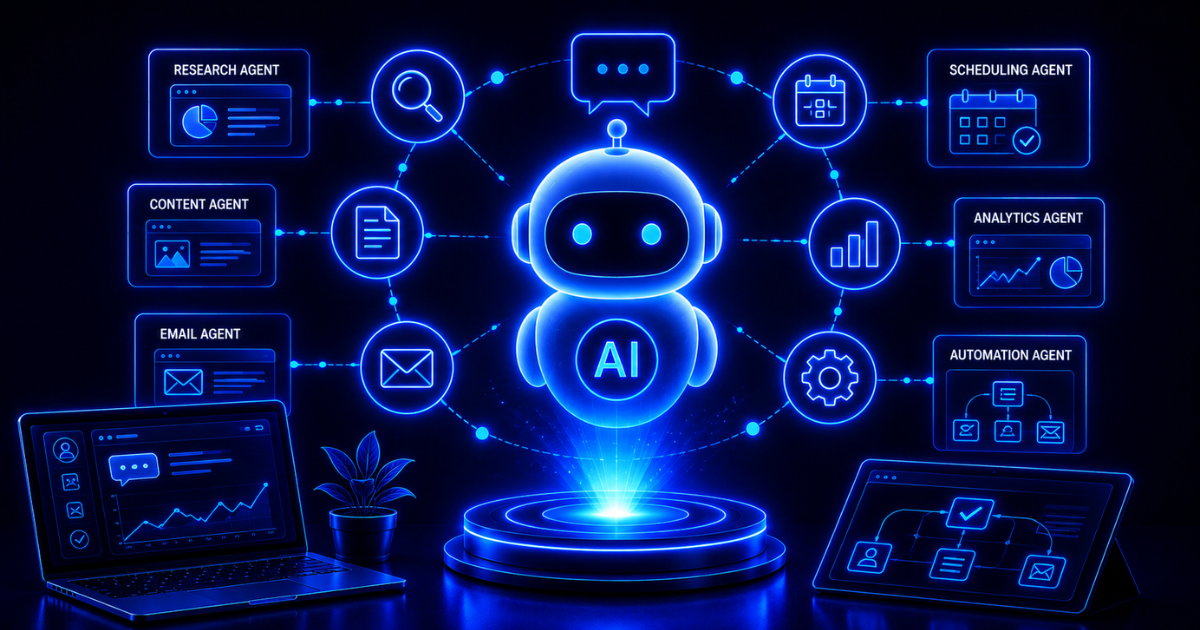
AI agents are artificial intelligence systems designed to pursue a goal by deciding what actions to take, using available tools or information, evaluating the results, and continuing until the task is completed or requires human input.
That’s a little different from the AI most people are used to.
With a typical AI assistant, the interaction might look like:
You ask → AI responds
With an AI agent, it can look more like:
You give a goal → AI determines steps → uses tools → evaluates results → takes additional actions → completes the task
For example, instead of asking AI:
Write a follow-up email to this sales lead.
you might give an AI agent the objective:
Follow up with qualified leads from yesterday.
Depending on its permissions and tools, the agent could potentially:
- Find yesterday’s leads.
- Review their information.
- Determine which ones are qualified.
- Check previous interactions.
- Draft an appropriate message.
- Send or queue the email.
- Update the CRM.
- Schedule the next follow-up.
That’s the basic idea behind agentic AI.
AI is moving from simply generating information toward systems capable of taking actions to accomplish objectives.
But AI agents aren’t digital employees that can safely run your company while everyone goes to lunch.
The amount of independence they have varies considerably, and in many business applications, the most useful agents still operate within carefully defined boundaries.
What Is an AI Agent?
An AI agent is an AI system that can pursue a defined goal by interpreting information, deciding what to do next, using tools or software, and taking actions with some degree of autonomy.
The key concept is agency.
A standard generative AI interaction typically produces an output.
You ask:
Summarize this report.
The AI summarizes the report.
An agent can potentially determine and execute multiple steps needed to accomplish a broader objective.
You might instead say:
Review our latest marketing report and identify anything the team should investigate.
An agent could potentially:
Access report → analyze results → compare data → identify anomaly → retrieve supporting information → summarize findings → create task
The user defines the destination.
The agent has some ability to determine the route.
How Do AI Agents Work?
Most AI agents combine several capabilities.
At a simplified level, an agent needs to understand a goal, determine an action, execute that action, observe what happened, and decide what to do next.
A basic agent loop might look like:
Goal → Plan → Act → Observe → Evaluate → Act Again → Complete
Imagine an agent is given this goal:
Research three competitors and summarize their pricing.
The process might look like:
- Interpret the objective.
- Identify the competitors.
- Search for their websites.
- Visit pricing pages.
- Extract pricing information.
- Compare the results.
- Notice that one price is missing.
- Search for additional information.
- Create a comparison.
- Return the completed research.
That ability to respond to what happens during the process is an important difference between an agent and a simple predefined automation.
What Are the Main Parts of an AI Agent?
AI agents can vary substantially, but several components commonly appear.
AI Model
The underlying AI model provides language understanding and reasoning capabilities.
It helps the agent interpret:
- Goals
- Instructions
- Information
- Tool outputs
- Previous actions
Large language models can provide this reasoning layer for many modern agents.
Instructions or Goal
The agent needs to know what it’s trying to accomplish.
That might be narrow:
Categorize incoming support tickets.
Or broader:
Research potential topics for next month’s content calendar.
The broader the objective, the more decisions the agent may need to make.
Tools
Tools allow the agent to interact with systems beyond the AI model itself.
An agent might be able to:
- Search the web
- Read files
- Send email
- Update a CRM
- Query a database
- Create documents
- Update spreadsheets
- Use APIs
- Create calendar events
- Run code
Without tools, an AI system can primarily generate information.
Tools allow it to do things.
Memory and Context
An agent may need information from earlier steps.
That can include:
- Previous messages
- Customer information
- Task history
- Tool results
- Preferences
- Prior decisions
Memory helps the agent avoid treating every action as completely independent.
Planning
Some agents can break larger objectives into smaller tasks.
For example:
Goal: Research a competitor
could become:
Identify company → find products → find pricing → review positioning → find customer reviews → summarize findings
The plan may also change as new information becomes available.
Feedback
Agents need to understand whether an action succeeded.
For example:
Attempt action → receive result → evaluate result → decide next step
This feedback loop allows an agent to continue working instead of simply generating one response.
AI Agents vs. Generative AI
Generative AI and AI agents aren’t the same thing.
Generative AI creates content or information. AI agents use AI to pursue goals and take actions.
| Generative AI | AI Agents |
|---|---|
| Responds to prompts | Pursues objectives |
| Usually generates an output | Can perform multiple actions |
| Often one interaction at a time | Can operate through multiple steps |
| User directs individual tasks | Agent can determine intermediate tasks |
| Creates text, images, code, etc. | Can use tools and software |
| Primarily produces | Can produce and act |
Generative AI can still be part of an agent.
In fact, it often is.
An agent might use generative AI to write an email during one step of a much larger workflow.
AI Agents vs. AI Automation
This is probably the most important distinction.
AI automation follows a defined workflow containing AI capabilities. AI agents have more freedom to determine which actions should be taken to accomplish a goal.
For example:
AI Automation
Lead submitted → AI analyzes lead → CRM updated → email drafted → salesperson notified
The workflow is already mapped.
The AI performs particular tasks inside it.
AI Agent
Goal: Qualify and follow up with new leads.
The agent might:
- Retrieve new leads.
- Review each lead.
- Research the company.
- Check previous interactions.
- Determine qualification.
- Select an appropriate follow-up.
- Update the CRM.
- Create a task for sales where necessary.
The agent determines more of the process itself.
That’s why I’d understand what AI automation is before getting too deep into agents.
AI automation gives you the foundation.
Agents add autonomy.
AI Agents vs. Workflow Automation
Traditional workflow automation is even more structured.
A workflow might be:
Form submitted → create CRM record → send confirmation email
Every step is predetermined.
An AI agent might receive:
Process this new customer inquiry.
Then determine what processing the inquiry actually requires.
Here’s the progression:
| Approach | How It Works | Autonomy |
|---|---|---|
| Workflow automation | Follows predefined rules | Low |
| AI automation | Adds AI inside predefined workflows | Moderate |
| AI agent | Determines actions based on a goal | Higher |
That doesn’t mean the bottom row is automatically better.
Sometimes you want predictability.
If someone submits an order, you probably don’t need an AI agent creatively deciding whether the order should be entered into your database.
Regular automation is often better for predictable processes.
Growth Gary’s guide to what workflow automation is covers that foundation in more detail.
What Can AI Agents Do?
AI agents can potentially support any process where software needs to interpret information and take multiple actions.
Common applications include research, marketing, sales, customer service, software development, and operations.
Research Agents
A research agent might:
Receive topic → search sources → read information → compare findings → identify gaps → conduct additional searches → summarize results
This can be useful when research requires multiple steps rather than one search.
Marketing Agents
A marketing agent might:
- Research competitors
- Analyze campaign performance
- Identify content opportunities
- Draft campaign assets
- Review customer feedback
- Recommend next actions
- Update marketing systems
For example:
Goal: Find content opportunities around AI visibility
An agent could potentially:
- Review existing content.
- Research competing websites.
- Identify missing topics.
- analyze search questions.
- Recommend articles.
- Create preliminary briefs.
That doesn’t mean you should publish whatever it produces.
It means the agent can perform more of the repetitive research process.
Sales Agents
Sales agents can potentially:
- Research prospects
- Qualify leads
- Summarize accounts
- Draft outreach
- Update CRM records
- Schedule follow-ups
- Prepare sales representatives for meetings
A useful agent might prepare the salesperson rather than trying to replace the salesperson.
Customer Service Agents
Customer service is another obvious application.
An agent could:
- Receive a customer question.
- Determine what the customer needs.
- Search the knowledge base.
- Check account information.
- Generate a response.
- Perform an allowed action.
- Escalate when necessary.
The important part is step seven.
Good agents need to know when not to continue autonomously.
Coding Agents
Software development has become one of the most visible applications of agentic AI.
Coding agents can potentially:
- Inspect codebases
- Write code
- Find bugs
- Run tests
- Interpret errors
- Modify files
- Test again
Instead of merely generating a code snippet, the agent can interact with the development environment and iterate toward an objective.
What Are Marketing AI Agents?
Marketing AI agents are agents designed to accomplish marketing-related goals.
They might operate across:
- Content
- SEO
- Social media
- Advertising
- CRM
- Analytics
- Research
Imagine giving an agent:
Prepare this week’s newsletter.
It could potentially:
Review recent content → identify best stories → summarize articles → draft newsletter → select links → prepare subject lines → place draft in email platform
Compare that with simply asking ChatGPT:
Write a newsletter.
The second request generates content.
The first describes a process.
That’s the difference.
For the content-generation part specifically, Growth Gary’s guide to what AI writing is explains how generative AI can help create written marketing content.
Can AI Agents Create Content?
Yes.
Content creation can be one action within an agent workflow.
For example:
Research topic → identify audience questions → create outline → draft article → generate social posts → prepare newsletter summary
The agent might use AI writing during several of those steps.
Similarly, agents could incorporate AI-generated:
- Images
- Video
- Audio
- Emails
- Social content
Growth Gary’s guides to AI design and AI video explain those individual generation technologies.
An agent can potentially connect them into a larger production workflow.
That’s an important distinction:
AI tools create assets.
AI agents can coordinate tasks around those assets.
Can AI Agents Send Emails?
Potentially, yes.
If an agent has access to an email platform, it could potentially:
- Read incoming messages
- Categorize emails
- Draft responses
- Retrieve customer information
- Send messages
- Schedule follow-ups
But giving an agent permission to draft an email and giving it permission to send an email are two different risk levels.
That’s where human approval becomes useful.
For example:
Lead received → agent researches lead → agent drafts response → human approves → email sends
Once that process is reliable, some businesses may choose to automate lower-risk messages further.
If email is a major part of the workflow, understanding what email marketing is and how AI is used in email marketing provides useful context.
Are AI Agents the Same as Chatbots?
No.
A chatbot primarily communicates with users through conversation.
An AI agent can potentially take actions.
A basic chatbot might answer:
Your order is expected Tuesday.
An agent might:
Check order → discover delay → check replacement options → update shipment → notify customer
The line is becoming less obvious because modern AI assistants increasingly include tools and agentic capabilities.
But conversational ability alone doesn’t make something an agent.
The key question is:
Can the system act toward a goal, or does it only respond?
Are AI Agents Autonomous?
Somewhat.
“Autonomous” can be misleading because AI agents exist on a spectrum.
An agent might be allowed to:
Suggest only
or:
Draft but require approval
or:
Take predefined low-risk actions
or:
Operate independently across several tools
The amount of autonomy should depend on the consequences of getting something wrong.
I wouldn’t think about agents as either:
autonomous / not autonomous
I’d think about:
How much autonomy should this particular task receive?
That’s a much more useful business question.
What Are the Benefits of AI Agents?
The potential advantage of agents is that they can automate outcomes rather than individual tasks.
Agents Can Handle Multi-Step Work
Traditional AI tools usually require the user to repeatedly direct the next step.
Agents can potentially continue through a process.
Agents Can Reduce Tool Switching
A person might normally:
Open email → copy information → open CRM → search website → open spreadsheet → update record → send message
An agent connected to those systems can potentially coordinate several of those actions.
Agents Can Respond to Changing Information
Unlike a rigid automation, an agent may be able to change its approach based on what it discovers.
Agents Can Scale Knowledge Work
Tasks involving research, classification, summarization, and communication become easier to process at larger volumes.
Agents Can Work With Existing Software
Agents become particularly useful when they can interact with the systems businesses already use.
That’s where agentic AI starts becoming more than an interesting chatbot demo.
What Are the Risks of AI Agents?
The same thing that makes agents interesting makes them risky.
They can act.
Agents Can Make Bad Decisions
AI isn’t perfectly reliable.
An agent can misunderstand information or select an inappropriate action.
Agents Can Compound Errors
If an incorrect assumption affects the next five steps, the final result can become increasingly wrong.
Tool Access Creates Risk
An AI that can draft an email has limited power.
An AI that can:
- Send emails
- Delete files
- Modify databases
- Make purchases
- Change customer records
has considerably more.
Permissions matter.
Agents Can Be Difficult to Debug
If a traditional workflow breaks at step four, you inspect step four.
If an agent independently chose six different actions based on its interpretation of a situation, understanding exactly why it failed can be more difficult.
Security Becomes More Important
Agents may interact with external content and internal systems.
That creates risks involving:
- Data exposure
- Malicious instructions
- Unauthorized actions
- Incorrect permissions
- Prompt injection
- Sensitive information
More autonomy should come with more controls.
What Is Human-in-the-Loop AI?
Human-in-the-loop means requiring human review or approval at important points in an AI process.
For example:
Agent researches lead → drafts email → HUMAN APPROVES → email sends
Or:
Agent reviews refund request → recommends refund → HUMAN APPROVES → transaction processed
This can be one of the best ways to introduce agents into a business.
Let AI do the time-consuming preparation.
Let people retain control over consequential decisions.
As reliability improves, lower-risk steps can potentially become more autonomous.
What Tools Can AI Agents Use?
Agents become more useful when they can interact with other systems.
Depending on the platform, an agent might connect to:
- Calendars
- CRMs
- Spreadsheets
- Databases
- Browsers
- Search engines
- Project management tools
- Marketing platforms
- Ecommerce platforms
- APIs
- Internal knowledge bases
Workflow platforms can also become part of the infrastructure connecting AI with business applications.
That’s one reason tools such as Zapier, Make, and n8n increasingly overlap with the agent ecosystem.
Growth Gary’s best workflow automation tools guide covers that layer separately.
Do AI Agents Need APIs?
Not necessarily, but APIs are one common way agents interact with software.
An API allows one system to request information or perform an action in another system.
For example, an agent could use an API to:
Retrieve customer → update CRM → create task
Modern agent platforms may hide much of this complexity behind prebuilt integrations.
So a marketer doesn’t necessarily need to understand API programming to use AI agents.
But the underlying connections still matter.
Do AI Agents Need Coding?
Not always.
Some agents can be configured using natural-language instructions, visual workflow builders, and prebuilt integrations.
More sophisticated agents may require:
- APIs
- Code
- Databases
- Custom tools
- Authentication
- Infrastructure
The technical requirements depend entirely on what you’re trying to accomplish.
Don’t start by asking:
How do I build an AI agent?
Start with:
What process am I trying to improve?
Then decide whether an agent is actually necessary.
How Do You Build an AI Agent?
The safest way to start is narrow.
1. Define One Goal
Bad:
Handle our marketing.
Better:
Research incoming leads and prepare a qualification summary.
Specific objectives are easier to test.
2. Define What Information the Agent Needs
What does it need access to?
Perhaps:
- Lead form
- Website
- CRM
- Company information
- Qualification criteria
Give it the minimum information necessary.
3. Define the Tools It Can Use
Maybe it needs:
- Web search
- CRM read access
- CRM update access
It probably doesn’t need access to your accounting software.
Use minimum necessary permissions.
4. Define What It Can Do
Separate actions into categories.
Allowed automatically:
- Research
- Summarize
- Classify
- Draft
Requires approval:
- Send email
- Modify important records
- Make purchases
- Delete information
This creates guardrails.
5. Test the Agent
Use realistic scenarios.
Test:
- Normal cases
- Missing information
- Contradictory information
- Strange requests
- Failed tools
- Edge cases
Don’t only test the example you designed it around.
6. Measure Performance
Track:
- Accuracy
- Completion rate
- Time saved
- Error rate
- Human review time
- Business outcomes
Then expand autonomy only when the results justify it.
Should Small Businesses Use AI Agents?
Potentially.
But most small businesses probably shouldn’t start by building elaborate autonomous agent systems.
Start with a real repetitive problem.
For example:
Every lead requires 10 minutes of research before a sales call.
That’s a strong candidate.
An agent might prepare:
- Company overview
- Website summary
- Relevant products
- Potential needs
- Recent news
- Suggested questions
The salesperson still conducts the conversation.
The agent removes preparation work.
That’s useful.
Building a 14-agent “AI workforce” because somebody on YouTube said businesses without one will disappear by Thursday is probably less useful.
Gary’s Take: Give AI a Job Before You Give It a Job Title
We’re entering the phase of AI where everything is becoming an “agent.”
Research agent.
SEO agent.
Marketing agent.
Sales agent.
Content agent.
Customer success agent.
Sometimes that’s accurate.
Sometimes it’s a chatbot wearing a little digital name badge.
The question I care about isn’t:
Is this technically an AI agent?
It’s:
What useful work can it reliably complete?
Start there.
Give AI one clearly defined job.
Give it the information it needs.
Give it limited tools.
Measure whether it performs the job reliably.
Then increase responsibility.
That’s how you’d onboard a person.
It’s not a terrible model for software either.
Are AI Agents the Future of Automation?
They’re likely to become an important part of it.
Traditional automation is excellent when processes are predictable.
AI automation expands that to processes requiring interpretation.
Agents go another step by allowing software to determine more of the path toward an objective.
So the progression looks something like:
Manual work → Workflow automation → AI automation → AI agents
But those stages aren’t replacements.
Businesses will continue using all four.
Sometimes a person should do the work.
Sometimes a simple rule is enough.
Sometimes AI should interpret something.
And sometimes an agent can handle a broader objective.
The real skill will be knowing which one to use.
FAQs About AI Agents
What is an AI agent in simple terms?
An AI agent is a system that can pursue a goal by interpreting information, deciding what to do, using available tools, taking actions, and evaluating the results with some degree of independence.
What is an example of an AI agent?
A sales research agent could receive a new lead, research the company, review CRM history, evaluate qualification criteria, prepare a summary, draft a follow-up email, and update the CRM.
What’s the difference between AI and AI agents?
AI is the broader technology. An AI model may generate or analyze information, while an AI agent uses AI capabilities to take multiple actions toward completing a goal.
What’s the difference between AI agents and AI automation?
AI automation typically places AI inside a predefined workflow. AI agents have greater autonomy to determine which steps and actions are needed to accomplish an objective.
What’s the difference between an AI agent and a chatbot?
A chatbot primarily communicates through conversation. An AI agent can potentially interact with tools and take actions beyond the conversation.
Are AI agents fully autonomous?
Not necessarily. Agents can operate at different levels of autonomy, from recommending actions to independently performing approved tasks. Higher-risk activities should generally have stronger controls and human oversight.
Can AI agents send emails?
Yes, if they’re connected to an email system and have permission. Businesses may choose to require human approval before external messages are sent, particularly for sensitive or high-value interactions.
Can small businesses use AI agents?
Yes. Small businesses can use agents for activities such as research, lead preparation, meeting summaries, customer support triage, content workflows, and other repetitive knowledge work.
Do AI agents require coding?
Not always. Some platforms provide visual builders, natural-language configuration, and prebuilt integrations. More complex agents may require APIs, custom code, databases, or other technical infrastructure.
Related Growth Gary Content
Explore This Topic
- AI Agents vs. AI Automation
- AI Agents vs. Chatbots
- AI Agents vs. Copilots
- AI Agents vs. Agentic AI
- AI Agents for Marketing
- AI Agents for Small Businesses
- AI Agent Examples
- How to Build an AI Agent
- Best AI Agent Platforms
- Multi-Agent Systems
AI agents are interesting because they shift AI from answering:
“What should I do?”
toward helping with:
“Go do this.”
The useful future probably isn’t one where AI does everything.
It’s one where we get much better at deciding exactly what we should—and shouldn’t—let it do.
— Gary
The changes actually worth knowing
A short briefing that filters the noise into useful AI, marketing, technology, tools, and ideas for marketers and businesses.