
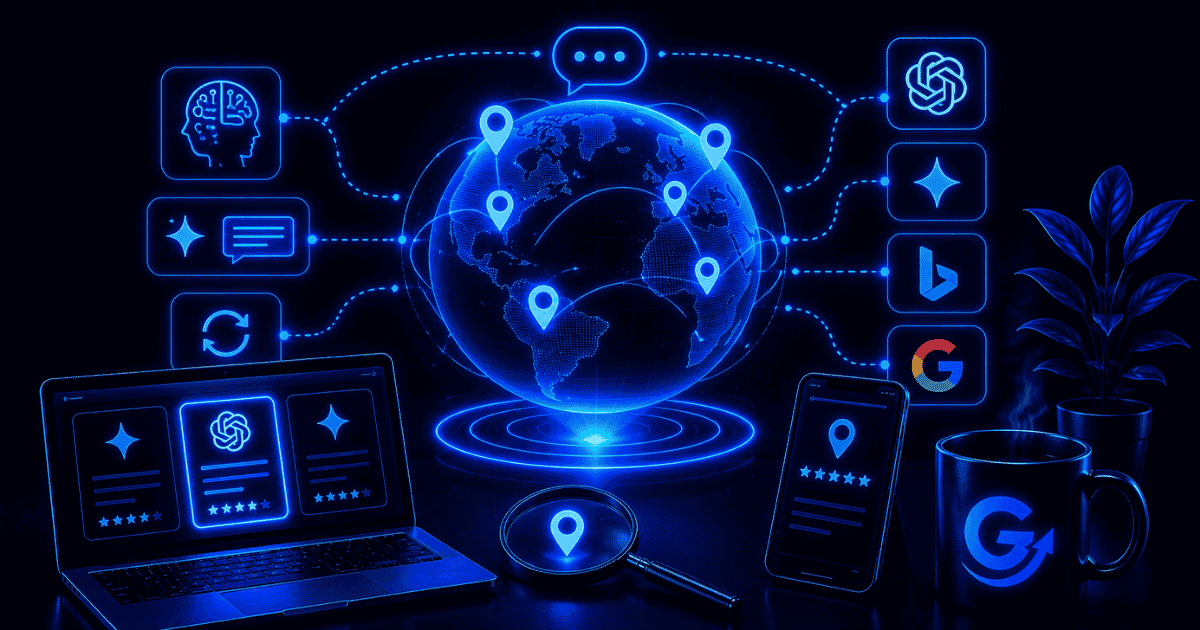
If you’ve spent any time around SEO lately, you’ve probably seen another acronym added to the pile: GEO.
GEO stands for Generative Engine Optimization. It’s the practice of improving how often and how prominently a brand, website, product, or piece of content appears in answers generated by AI systems such as ChatGPT, Google AI Overviews and AI Mode, Perplexity, Gemini, Claude, and Microsoft Copilot.
Traditional SEO asks:
How do I get my page to rank in search results?
GEO asks:
How do I get my information or brand included in the AI-generated answer?
That distinction matters because AI search doesn’t always give users a traditional list of ten blue links. Generative systems can retrieve information from multiple sources, synthesize it, and give the user an answer directly. The original academic work that introduced GEO described generative engines as systems that gather and summarize information from multiple sources using large language models.
But GEO isn’t a replacement for SEO, and it definitely isn’t a collection of secret tricks for manipulating ChatGPT.
The useful way to think about it is this:
SEO helps make your content discoverable. GEO helps make your information usable, credible, and visible inside AI-generated answers.
And increasingly, good search strategy needs both.
What Does GEO Mean?
GEO means Generative Engine Optimization: optimizing your content and broader digital presence to increase the likelihood that generative AI systems retrieve, understand, cite, mention, or recommend your information.
The term was introduced in a 2023 research paper titled GEO: Generative Engine Optimization by researchers from Princeton University, Georgia Tech, the Allen Institute for AI, and IIT Delhi. The researchers proposed GEO as a framework for helping content creators improve visibility within responses generated by generative engines.
That definition has since expanded in marketing.
Today, GEO generally includes efforts to improve visibility across AI-driven discovery experiences such as:
- ChatGPT
- Google AI Overviews
- Google AI Mode
- Perplexity
- Gemini
- Claude
- Microsoft Copilot
- Other AI-powered search and answer systems
The desired outcome isn’t always a clickable citation.
A brand might appear as:
- A cited source
- A linked recommendation
- A named product
- A company mention
- A summarized expert source
- Part of a comparison
- A factual reference
- An uncited brand recommendation
That’s why GEO ultimately connects to a broader concept: AI visibility.
If you’re unfamiliar with that measurement layer, Growth Gary’s guide to what AI visibility is explains it in more detail.
Why Does GEO Matter?
GEO matters because the way people find information is expanding beyond conventional search results.
Someone researching marketing software might still search Google for:
best CRM software for marketing
But they can also ask ChatGPT:
What are the best CRMs for a small marketing agency?
Or Perplexity:
Compare HubSpot, Pipedrive, and ActiveCampaign for a 10-person marketing team.
Or Gemini:
Which CRM is easiest to integrate with Google Workspace?
The user intent isn’t dramatically different.
The interface is.
Instead of reviewing several search results independently, the user may receive a synthesized response containing products, explanations, comparisons, recommendations, and sources.
That changes what visibility means.
A company can theoretically rank well in conventional Google results while being rarely mentioned in AI answers. Conversely, AI systems can surface sources and brands that don’t occupy the exact same traditional search positions.
Recent research comparing Google Search, AI Overviews, and Gemini found substantial differences between the sources retrieved by traditional and generative search experiences. The researchers also found variability between AI responses and even between slightly modified versions of the same query.
That’s important.
GEO isn’t simply “rank #1 in Google and you’ll automatically win AI search.”
There is overlap, but the systems aren’t identical.
How Does GEO Work?
GEO works by improving the signals and information AI systems may use when retrieving sources and constructing answers.
At a simplified level, an AI-powered search experience may:
- Interpret the user’s question.
- Determine whether external information is needed.
- Search or retrieve potentially relevant information.
- Evaluate and select sources.
- Extract useful passages or facts.
- Synthesize information into an answer.
- Cite or link to some of the sources used.
Different platforms handle those steps differently.
Some AI systems rely heavily on live web retrieval. Others combine retrieval with information already represented in models or other systems. Search activation, source selection, reranking, citation behavior, and answer generation can all vary by platform and query. Recent GEO research argues that this complexity is precisely why GEO shouldn’t be treated as one simple ranking algorithm.
From a marketer’s perspective, the practical goal is much simpler:
Make your information easy to find, understand, trust, extract, and use.
If you want the deeper technical explanation of the retrieval and synthesis process, Growth Gary’s guide to how AI search works covers that separately.
What Is the Difference Between GEO and SEO?
GEO and SEO overlap significantly, but they optimize for different forms of visibility.
| Traditional SEO | GEO |
|---|---|
| Search Engine Optimization | Generative Engine Optimization |
| Targets traditional search visibility | Targets AI-generated answer visibility |
| Primary goal is ranking webpages | Primary goal is inclusion in AI answers |
| Measures rankings and organic traffic | Measures citations, mentions and AI visibility |
| Often targets keywords | Often evaluates prompts/topics/questions |
| Optimizes pages for search discovery | Optimizes information for retrieval and reuse |
| Backlinks are important | Third-party mentions and source authority can matter |
| Click usually follows discovery | User may receive answer without clicking |
| Google/Bing are primary environments | ChatGPT, Google AI, Perplexity, Gemini, Copilot and others matter |
The mistake would be looking at that table and concluding that you now need to choose between SEO and GEO.
You don’t.
A lot of what helps GEO is simply good search and content strategy:
- Crawlable websites
- Strong topical relevance
- Helpful content
- Clear information architecture
- Credible sourcing
- Useful original information
- Strong brand authority
- Descriptive headings
- Accurate facts
- Third-party recognition
AI systems still need information to retrieve.
The web is a pretty good place to find it.
That’s why I think the more productive conversation is SEO + GEO, not SEO versus GEO. Growth Gary’s comparison of traditional SEO and AI search goes deeper into where the two approaches diverge.
GEO vs. AEO: What’s the Difference?
GEO and AEO are related terms with fuzzy boundaries.
AEO stands for Answer Engine Optimization. Traditionally, AEO focuses on structuring information so search and answer systems can provide concise answers to user questions.
That can include:
- Featured snippets
- Voice search
- Knowledge panels
- Direct answers
- FAQ-style responses
- AI-generated answers
GEO focuses specifically on generative systems that synthesize answers using AI.
A simple distinction is:
SEO → visibility in search results
AEO → visibility as an answer
GEO → visibility within generative AI answers
In practice, there’s substantial overlap.
Clear definitions, direct answers, structured information, useful examples, strong sourcing, and understandable content can support all three.
I wouldn’t spend too much energy debating whether one paragraph is “AEO optimized” or “GEO optimized.”
I’d spend that energy making the paragraph genuinely useful.
GEO vs. AI Visibility: What’s the Difference?
This distinction is more useful.
GEO is the optimization process. AI visibility is the outcome you’re trying to improve.
Think about traditional SEO:
SEO activity → search visibility
The AI equivalent is:
GEO activity → AI visibility
AI visibility can include how frequently a brand appears, where it appears, how prominently it appears, what prompts trigger the appearance, whether it’s cited, and how it’s characterized.
For example, suppose you monitor 100 relevant AI prompts.
Your company appears in:
- ChatGPT: 32 responses
- Perplexity: 41 responses
- Google AI: 27 responses
- Gemini: 18 responses
Those appearances are measurements of AI visibility.
The content, authority, technical, citation, and brand-building work you perform to improve those results is part of GEO.
What Does GEO Optimize?
GEO isn’t simply about optimizing a webpage.
That’s one of the biggest differences in how I think marketers should approach it.
Generative systems can draw information from a broader ecosystem of sources.
That means GEO can involve several layers.
Your Website
Your owned content remains important.
Useful GEO-oriented content tends to provide clear information that can stand on its own when extracted from the surrounding page.
That can include:
- Definitions
- Direct answers
- Statistics
- Comparisons
- Step-by-step processes
- Examples
- Tables
- Expert explanations
- Original research
- Product information
- FAQs where genuinely useful
The objective isn’t to write like a robot because you’re hoping another robot likes it.
It’s to remove ambiguity.
Your Brand and Entities
AI systems need to understand who and what you’re talking about.
Clear entity information can help establish relationships between:
- Companies
- Products
- People
- Services
- Categories
- Locations
- Topics
If your website describes your company five different ways, third-party websites describe it another three ways, and nobody can clearly determine what you actually do, that’s not ideal for humans or machines.
Consistency helps.
Third-Party Sources
This is where GEO expands beyond on-page optimization.
AI systems may use information from:
- News publications
- Industry websites
- Review sites
- Forums
- YouTube
- Academic sources
- Professional organizations
- Product directories
- Comparison websites
- Other authoritative publishers
You don’t control those sources.
But they can influence how your brand is represented across the information ecosystem.
This is one reason digital PR, thought leadership, reviews, citations, partnerships, and genuine industry recognition can become relevant to GEO.
Technical Accessibility
A brilliant resource isn’t very useful to a retrieval system if the system can’t access it.
Technical considerations can include:
- Crawlability
- Indexability
- Internal linking
- Site architecture
- Page performance
- Renderability
- Structured data
- Canonicalization
- Robots directives
This is where traditional technical SEO remains foundational.
GEO didn’t suddenly make technical SEO obsolete.
If anything, adding more discovery systems makes clean technical foundations more useful.
What Makes Content Good for GEO?
There isn’t a universal “GEO formula.”
Anyone promising one should make you slightly nervous.
Generative engines differ, change frequently, and don’t expose a single ranking algorithm marketers can reverse engineer.
Research published in 2026 also cautions against assuming that isolated GEO tactics produce stable, cross-platform gains. The evidence is still developing, and performance can vary significantly by platform, query, domain, and retrieval context.
That said, several principles make sense because they improve the underlying information.
Answer Questions Directly
If the heading asks:
What is generative engine optimization?
Don’t spend four paragraphs warming up.
Answer it.
Generative engine optimization is the practice of improving content and digital presence to increase visibility in AI-generated answers.
Then explain.
Clear answers help readers and make individual passages easier for retrieval systems to interpret.
Create Self-Contained Sections
AI systems may retrieve a passage rather than evaluate your article exactly as a human reads it from beginning to end.
That makes context important.
Compare:
Weak:
This is why it matters so much.
With:
Better:
GEO matters because AI search systems can answer questions directly, reducing the user’s need to visit traditional search results.
The second sentence survives extraction.
The first doesn’t.
Support Claims With Evidence
Specific, attributable information is more useful than vague claims.
That can include:
- Original research
- Industry studies
- Government data
- Academic research
- First-party datasets
- Expert sources
- Clearly attributed statistics
Don’t add random statistics just because someone told you “AI loves numbers.”
Use evidence when evidence improves the answer.
Make Comparisons Explicit
AI users frequently ask comparative questions:
- X vs. Y
- Best tool for X
- Difference between X and Y
- Advantages of X
- Alternatives to X
Clear comparison tables and structured explanations make those relationships easier to understand.
Demonstrate Real Expertise
Generic content is easy to produce.
Actual expertise is harder.
Useful differentiators include:
- Original research
- Firsthand experience
- Expert commentary
- Proprietary data
- Unique examples
- Detailed methodology
- Specific analysis
AI can generate another generic definition of SEO in about five seconds.
The web doesn’t desperately need the 40 millionth version.
Give the information ecosystem something worth retrieving.
Do Keywords Matter for GEO?
Yes—but not in exactly the same way they matter in conventional keyword-driven SEO.
People interacting with AI systems often use longer, conversational prompts.
Instead of:
CRM software
they might ask:
What’s the best CRM for a five-person marketing agency that uses Gmail and doesn’t need enterprise sales features?
That’s a much richer expression of intent.
For GEO, marketers should think beyond individual keywords toward:
- Topics
- Questions
- Entities
- Problems
- Use cases
- Comparisons
- Attributes
- Buying criteria
- Follow-up questions
Keywords are still useful because they reveal demand and language.
They just aren’t the entire map.
What Are AI Citations and Why Do They Matter for GEO?
An AI citation is a source reference used or displayed alongside an AI-generated response.
Citations can help users understand where information came from and provide a path to the original source.
For marketers, citations are particularly valuable because they create measurable evidence that content is being surfaced by an AI system.
But citation isn’t the only form of visibility.
Imagine an AI answer says:
Popular options include HubSpot, Salesforce, and Pipedrive.
Pipedrive received a valuable brand mention even if the response didn’t cite Pipedrive’s website.
That’s why GEO measurement should include both:
Citations + mentions
Recent research has gone even further, distinguishing between whether a source gets selected for citation and how much its information actually influences or is “absorbed” into the generated answer.
Growth Gary’s guide to what AI citations are covers that specific part of AI visibility in more detail.
How Do You Measure GEO?
GEO measurement is still developing.
There isn’t one equivalent of “Google position #3” that tells the entire story.
Useful metrics can include:
| GEO Metric | What It Measures |
|---|---|
| AI visibility | Overall presence across tracked AI responses |
| Mention rate | Percentage of responses mentioning your brand |
| Citation rate | Percentage citing your website |
| Share of voice | Your visibility relative to competitors |
| Prompt coverage | Topics/questions where you appear |
| Citation sources | Websites AI systems use when discussing your topic |
| Brand position | How prominently your brand appears |
| Sentiment/context | How your brand is characterized |
| Referral traffic | Visits originating from AI platforms |
| Conversions | Business outcomes from AI-driven discovery |
Measurement also needs repetition.
Generative answers aren’t necessarily deterministic.
Ask the same system the same question multiple times and you may get different sources, recommendations, wording, or ordering. Research into AI Overviews and Gemini has documented this variability as well.
So don’t celebrate because ChatGPT mentioned your company once on Tuesday afternoon.
Track patterns.
Can GEO Guarantee AI Citations?
No.
Nobody can guarantee that ChatGPT, Google AI Overviews, Perplexity, Gemini, or another generative system will cite your content.
There are too many variables:
- The user’s prompt
- Search activation
- Retrieval systems
- Available sources
- Model behavior
- Platform changes
- Competitors
- Personalization
- Location
- Freshness
- Query interpretation
GEO should improve the conditions that make visibility possible.
It doesn’t give marketers control over the final answer.
That’s an important distinction because this industry is currently experiencing the predictable phase where every new marketing discipline acquires a small army of people selling certainty.
Be skeptical of certainty.
What Are Common GEO Mistakes?
GEO is new enough that marketers are already finding creative ways to overcomplicate it.
Treating GEO as a Replacement for SEO
This is probably the biggest mistake.
If your website has poor architecture, weak content, no authority, indexing problems, and little relevance to the topic, adding “GEO optimization” isn’t going to magically fix the foundation.
Start with good search fundamentals.
Writing for AI Instead of People
Don’t turn every paragraph into a sterile 47-word answer block because someone told you ChatGPT likes “chunks.”
Clear structure is useful.
Awkward writing isn’t.
Your primary audience is still human.
Creating Generic AI Content at Scale
Producing 10,000 mediocre pages with AI isn’t automatically a GEO strategy.
If every competitor can produce essentially the same information, you’ve created very little reason for your version to become a preferred source.
Focusing Only on Your Website
Your owned website matters, but your broader presence matters too.
Brand mentions, reviews, discussions, expert contributions, third-party articles, videos, community conversations, and other sources can all contribute to the information AI systems encounter.
Obsessing Over Unproven Technical Hacks
You’ll hear about special files, magic schemas, prompt injection tricks, AI-specific metadata, and various methods supposedly guaranteed to unlock LLM visibility.
Be careful.
Some technical practices may become useful as the ecosystem develops. Others may turn out to have little practical impact.
Don’t prioritize speculative tricks over content quality, accessibility, authority, and actual brand recognition.
Trying to Manipulate Recommendations
GEO shouldn’t mean flooding the web with fake recommendations designed to convince AI systems your product is the “best.”
Besides being terrible marketing, manipulative tactics aimed at altering generative search results can run directly into platform spam policies. Google, for example, has expanded its spam framework to explicitly address attempts to manipulate generative AI features.
Build real evidence.
It’s slower.
It’s also considerably harder for competitors to fake.
Gary’s Take: GEO Is Mostly About Becoming a Better Source
Here’s where I think marketers can make GEO much simpler.
Don’t start with:
How do I manipulate ChatGPT into mentioning my company?
Start with:
What would make my company one of the best sources available for this question?
That’s a much better marketing problem.
Maybe the answer is:
- Better content
- Original research
- Better product information
- More expert participation
- Stronger third-party coverage
- Clearer comparisons
- Better technical accessibility
- More customer reviews
- Stronger brand authority
Then measure whether those improvements increase AI visibility.
GEO is going to evolve quickly because the systems themselves are evolving quickly.
The durable strategy isn’t chasing every rumored AI ranking factor.
It’s building an information footprint that deserves to be retrieved.
How Do You Start With GEO?
If you’re starting from scratch, don’t rebuild your entire marketing strategy around AI search.
Start with a focused process.
1. Identify Important Topics
Determine the questions and buying decisions where visibility matters to your business.
Don’t track random prompts just because a tool gives you a big dashboard.
Track commercially and strategically meaningful questions.
2. Establish Your Current AI Visibility
Test how your brand appears across relevant AI platforms.
Look for:
- Mentions
- Citations
- Competitors
- Source domains
- Missing topics
- Incorrect information
This gives you a baseline.
3. Analyze Which Sources AI Systems Use
If competitors consistently appear and you don’t, investigate why.
Which websites are being cited?
What information do those pages contain?
Are third-party sources repeatedly recommending certain brands?
This is often more useful than staring exclusively at your own site.
4. Improve Your Existing Content
Before publishing 200 new pages, improve important existing ones.
Make sure they provide:
- Direct answers
- Clear definitions
- Useful comparisons
- Credible evidence
- Logical headings
- Strong topical coverage
- Accurate information
5. Strengthen Your Broader Brand Presence
Look beyond your domain.
Identify the publications, communities, directories, review platforms, experts, and other sources that matter within your market.
The goal isn’t to manufacture mentions.
It’s to become worth mentioning.
6. Measure Again
Repeat the original prompt set.
Compare:
Before → after
Then keep doing what appears to work and stop doing what doesn’t.
That’s marketing.
The acronym is new. The discipline isn’t.
Is GEO Worth Doing?
Yes, but I wouldn’t treat GEO as a completely separate marketing universe.
If customers are increasingly using AI systems to research products, compare vendors, understand problems, or make decisions, then being visible in those environments has business value.
That makes GEO worth paying attention to.
But the best GEO strategies will probably look surprisingly familiar:
Strong technical foundations + useful content + expertise + authority + third-party recognition + measurement.
The destination changed.
A lot of the fundamentals didn’t.
FAQs About GEO
What does GEO stand for in marketing?
GEO stands for Generative Engine Optimization. It refers to optimizing content and digital presence to improve visibility within answers generated by AI-powered search engines and assistants.
What is generative engine optimization?
Generative engine optimization is the practice of improving the likelihood that AI systems retrieve, cite, mention, summarize, or recommend your content or brand when generating answers.
Is GEO the same as SEO?
No. SEO primarily focuses on visibility in conventional search results, while GEO focuses on visibility within generative AI responses. However, the two overlap significantly, and strong SEO foundations can support GEO.
Is GEO replacing SEO?
No. Generative AI creates another discovery environment rather than eliminating the need for traditional search optimization. Websites still need to be accessible, understandable, authoritative, and discoverable.
What platforms does GEO target?
GEO can apply to AI-powered discovery systems including ChatGPT, Google AI Overviews and AI Mode, Perplexity, Gemini, Claude, Microsoft Copilot, and other generative search or answer systems.
How long does GEO take to work?
There isn’t a standard timeline. AI visibility depends on factors such as the platform, query, content, source availability, website authority, third-party mentions, and how frequently information is refreshed or retrieved. GEO should be measured over repeated observations rather than a single response.
Do I need special GEO software?
No. You can manually test important prompts and citations when you’re starting. Dedicated AI visibility tools become more useful when you need to monitor larger prompt sets, competitors, platforms, citations, and changes over time. Growth Gary’s best AI visibility tools can help when manual tracking becomes impractical.
Related Growth Gary Content
Explore This Topic
- How Generative Engine Optimization Works
- GEO vs. SEO
- GEO vs. AEO
- How to Build a GEO Strategy
- How to Measure GEO Performance
- GEO Content Optimization
- GEO for Small Businesses
- GEO for Ecommerce
- GEO Tools
- How to Improve AI Visibility
GEO is worth learning, but don’t let the new acronym distract you from the goal. Make your brand useful, credible, discoverable, and easy to understand wherever people go looking for answers.
That’s the kind of optimization that tends to survive the next acronym.
— Gary
The changes actually worth knowing
A short briefing that filters the noise into useful AI, marketing, technology, tools, and ideas for marketers and businesses.