
Most marketers don’t need another app.
They need their existing apps to actually talk to each other.
Leads come in through one platform. Emails live somewhere else. The CRM sits in another system. Analytics, Slack, project management, and reporting all exist in separate silos.
Without automation, someone becomes the integration.
That’s where Zapier has built its reputation.
For years, Zapier has been the go-to no-code automation platform for connecting thousands of applications without writing code. But the automation market has become much more competitive, with platforms like Make, n8n, HubSpot, and AI agents changing what automation can do.
So, is Zapier still worth paying for?
TL;DR
What it is: Zapier is a no-code automation platform that connects thousands of applications so they can automatically share information and trigger workflows.
Who it’s for: Marketers, agencies, small businesses, creators, operations teams, and anyone tired of repetitive manual work.
Biggest takeaway: Zapier remains the easiest automation platform to learn, but it’s no longer the cheapest or most powerful option for every use case.
Gary’s opinion: If you want to automate marketing quickly without becoming an automation engineer, Zapier is still one of the best places to start.
Zapier at a Glance
| Category | Assessment |
|---|---|
| Best for | No-code business automation |
| Pricing | Free plan available; paid plans begin around $19.99/month (annual billing) |
| Primary strength | Massive app ecosystem and ease of use |
| Primary weakness | Costs can increase quickly with task volume |
| Main alternatives | Make, n8n, Microsoft Power Automate |
What Is Zapier?
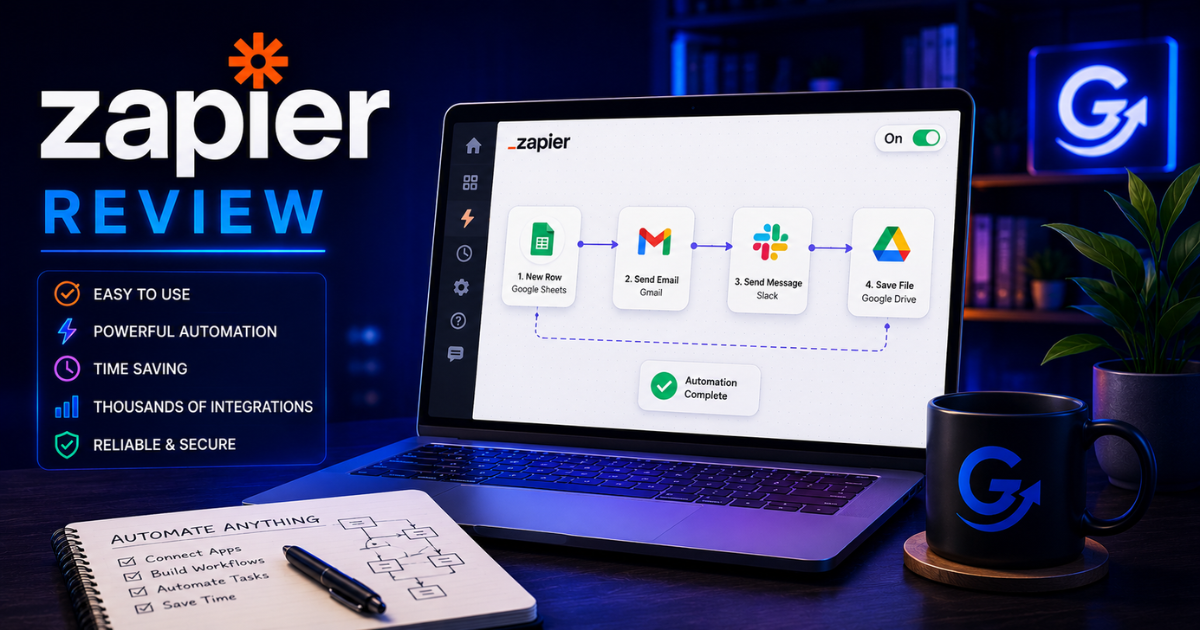
Zapier is a workflow automation platform.
Instead of manually moving information between applications, Zapier allows software to communicate automatically.
A typical workflow—called a Zap—consists of:
- A trigger
- One or more actions
Example:
Someone fills out a website form.
Zapier automatically:
- Creates a HubSpot contact
- Sends a Slack notification
- Adds the lead to Kit
- Creates an Asana task
- Logs the information in Google Sheets
No copying.
No pasting.
No forgetting.
That’s where Zapier delivers its biggest value.
How Zapier Works
Every automation starts with a trigger.
Examples include:
- New lead submitted
- New purchase
- New email
- Calendar booking
- New spreadsheet row
- Form completion
The trigger launches one or more actions.
Those actions can happen across thousands of connected applications.
Modern Zapier workflows can also include:
- Filters
- Delays
- Branching logic
- AI-powered text generation
- Webhooks
- Code steps
- Database lookups
- Conditional workflows
For most marketing teams, those capabilities cover almost everything needed.
Key Features
Massive App Library
This is still Zapier’s biggest competitive advantage.
The platform connects with thousands of applications including:
- HubSpot
- Salesforce
- Gmail
- Slack
- Notion
- Airtable
- Google Workspace
- Microsoft 365
- Shopify
- WooCommerce
- Stripe
- Kit
- Beehiiv
- Canva
- OpenAI
- Claude
- Dropbox
- Trello
- Monday.com
If two platforms don’t natively integrate, Zapier often fills the gap.
AI-Powered Automation
Zapier has expanded beyond traditional workflow automation.
Today it includes AI capabilities that can:
- summarize emails
- classify leads
- rewrite text
- generate responses
- extract information
- categorize support requests
Instead of automating only data movement, Zapier can now automate portions of decision-making.
That significantly expands what marketers can automate.
Multi-Step Workflows
Early automation platforms handled simple tasks.
Modern Zapier workflows can include dozens of steps.
For example:
Lead Form
↓
AI Lead Qualification
↓
CRM Update
↓
Slack Notification
↓
Email Sequence
↓
Calendar Reminder
↓
Google Sheet Update
↓
Management Dashboard
↓
Sales Notification
↓
Follow-up Task
One trigger can initiate an entire marketing process.
Templates
Zapier includes thousands of pre-built automation templates.
These help beginners launch workflows without building everything from scratch.
Common examples include:
- Lead routing
- Email notifications
- CRM updates
- Social publishing
- Ecommerce notifications
- Marketing reports
Templates dramatically reduce setup time.
What Zapier Does Well
Extremely easy to learn
Among automation platforms, Zapier remains one of the easiest to understand.
Most marketers can build useful automations within an hour.
That low learning curve matters.
Huge integration ecosystem
Zapier supports more business software than almost any competitor.
The chances are good your favorite application is already supported.
Reliable
For mature marketing teams, reliability matters more than flashy features.
Once properly configured, Zapier workflows tend to require little maintenance.
Excellent for marketing
Typical marketing automations include:
- Lead routing
- CRM updates
- Email nurturing
- Webinar registrations
- Content publishing
- Reporting
- Internal notifications
- Customer onboarding
These repetitive tasks are exactly what automation should handle.
Where Zapier Falls Short
Pricing scales with usage
Zapier charges based largely on tasks.
As workflows become larger, costs can increase quickly.
Businesses running thousands of automations each month should monitor usage carefully.
Complex workflows become expensive
Multi-step automations consume more tasks.
Large organizations may eventually find platforms like Make or self-hosted n8n more economical.
Visual workflow design
Zapier is simple.
Make offers more visual control over complicated automation scenarios.
Developers often prefer n8n because it provides greater customization.
Zapier vs the Competition
| Platform | Better choice when… |
|---|---|
| Zapier | Ease of use is the priority |
| Make | Complex visual workflows matter |
| n8n | You want maximum flexibility and self-hosting |
| Microsoft Power Automate | Your organization lives inside Microsoft 365 |
| HubSpot | Most automation happens inside marketing and CRM |
Each platform has strengths.
Zapier remains the easiest recommendation for beginners.
Gary’s Take
If I were helping a small business automate marketing tomorrow, I’d probably recommend Zapier first.
Not because it’s the most powerful.
Because it’s the easiest platform to implement successfully.
I’ve seen plenty of businesses buy sophisticated automation software only to build three workflows and never touch it again.
Automation should remove complexity—not create it.
Once your automations become highly sophisticated, I’d start evaluating Make or n8n.
But for 80% of marketing teams, Zapier can automate nearly everything they need.
Pros and Cons
Pros
- Extremely beginner friendly
- Thousands of integrations
- Reliable platform
- Excellent template library
- Strong AI automation features
- Quick setup
Cons
- Costs increase with usage
- Multi-step workflows consume tasks quickly
- Less visual than Make
- Less customizable than n8n
- Advanced enterprise automation may require another platform
Verdict
Best For
- Marketing teams
- Agencies
- Small businesses
- Creators
- Sales teams
- Operations
Probably Not For
- Developers wanting full customization
- Organizations running extremely high-volume automation
- Businesses needing on-premise deployment
Overall Recommendation
Zapier remains one of the best automation platforms available because it solves a common problem exceptionally well: connecting the software you already use.
If your goal is to eliminate repetitive marketing work without learning to code, Zapier is still one of the easiest and safest recommendations I can make.
Frequently Asked Questions
Is Zapier worth paying for?
Yes, if it saves enough manual work to justify the subscription cost. For many businesses, even one well-designed workflow can pay for itself through time savings.
Is Zapier easy to learn?
Yes. Zapier is widely regarded as one of the most beginner-friendly automation platforms thanks to its guided workflow builder and large library of templates.
What is Zapier used for?
Zapier automates repetitive tasks between applications, such as routing leads, updating CRMs, sending notifications, creating tasks, syncing spreadsheets, and triggering email campaigns.
Is Zapier better than Make?
Zapier is generally easier to learn and deploy. Make offers greater flexibility and more advanced visual workflow design for complex automations.
Can Zapier replace HubSpot workflows?
Not entirely. Zapier complements HubSpot by connecting it with external applications. HubSpot’s native workflows are often better for CRM-based marketing automation.
Does Zapier use AI?
Yes. Zapier includes AI-powered actions that can summarize content, classify information, generate text, extract data, and assist with workflow automation.
Is Zapier good for small businesses?
Absolutely. Small businesses often see the biggest return because Zapier automates repetitive administrative tasks without requiring custom development.
Related Articles
- What Is Marketing Automation?
- Best Marketing Automation Software
- Make Review
- Zapier vs Make
- Best Workflow Automation Tools
Building a smarter marketing stack isn’t about buying more tools—it’s about choosing the right ones.
That’s the kind of growth I like.
— Gary