
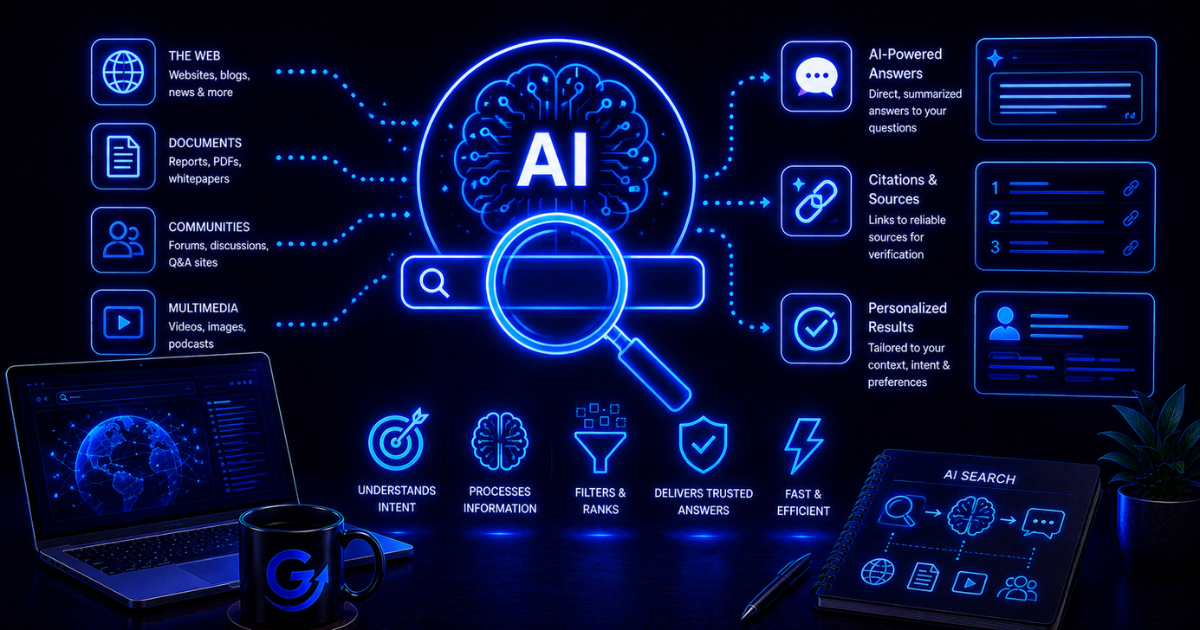
AI Search is changing how people discover information online. Instead of returning a page full of blue links, AI-powered search engines generate direct answers, summarize information from multiple sources, and recommend the most relevant content in a conversational format.
For businesses and marketers, this changes the goal. Ranking #1 on Google is no longer enough—you also want your content to become one of the sources AI systems trust enough to reference in their answers.
If you’re wondering whether AI Search is just another marketing buzzword, the short answer is no. It’s already reshaping SEO.
TL;DR
What is it?
AI Search uses large language models (LLMs) to answer questions directly instead of simply listing webpages.
Who is it for?
Marketers, business owners, content creators, SEO professionals, and anyone who relies on search traffic.
Biggest takeaway
Success is shifting from ranking webpages to becoming a trusted source that AI systems understand and cite.
Gary’s Quick Take
If I were starting an SEO strategy today, I’d optimize for both Google and AI search from day one. They’re quickly becoming two sides of the same coin.
What Makes AI Search Different?
Traditional search engines organize information.
AI search engines interpret information.
That sounds like a subtle difference, but it’s massive.
Instead of asking:
“Which webpage has the best answer?”
AI asks:
“Can I confidently answer this question using everything I know?”
That’s why platforms like ChatGPT, Perplexity, Gemini, Claude, and Google’s AI Mode feel more like conversations than search engines.
| Traditional Search | AI Search |
|---|---|
| Returns webpages | Generates answers |
| User researches | AI summarizes |
| Ranking is primary | Authority and citations matter |
| Clicks drive traffic | Citations build visibility |
How Does AI Search Work?
At a high level, AI Search combines several technologies:
- Large Language Models (LLMs)
- Traditional search indexes
- Retrieval-Augmented Generation (RAG)
- Entity understanding
- Semantic search
- Real-time web retrieval (depending on the platform)
Rather than matching keywords, AI attempts to understand intent and context before generating a response.
That means content needs to be clear, accurate, well-structured, and easy to interpret.
Why AI Search Matters for Businesses
The biggest shift isn’t technical.
It’s behavioral.
Users increasingly expect immediate answers rather than lists of links.
For businesses, that means visibility depends on whether AI trusts your content enough to incorporate it into an answer.
The companies that adapt early have an opportunity to establish authority before this space becomes crowded.
How to Optimize for AI Search
Fortunately, many AI optimization best practices also improve traditional SEO.
Focus on:
- Clear heading hierarchy
- Direct answers to common questions
- Strong topical authority
- Schema markup
- Internal linking
- Original research
- Expert insights
- Trustworthy citations
- Fresh, updated content
AI systems reward clarity more than cleverness.
Common Misconceptions
“AI Search is replacing Google.”
Not exactly.
Google itself is becoming an AI-powered search engine.
“SEO is dead.”
SEO is evolving.
Search engines still need high-quality content to learn from.
“Keywords don’t matter anymore.”
They do—but context, entities, and topical authority matter much more than exact-match phrases.
Gary’s Take
One mistake I see businesses make is treating AI Search like it’s a completely separate marketing channel.
It isn’t.
Good SEO has always been about answering questions better than anyone else.
AI Search simply raises the bar.
If your content demonstrates real expertise, provides original insights, and solves problems clearly, you’re already moving in the right direction.
If you’re still chasing keyword density or pumping out dozens of shallow AI-written articles, I’d rethink that strategy. AI systems are getting much better at recognizing genuinely helpful content.
Pros & Cons of AI Search
Pros
- Faster answers
- Better understanding of context
- More conversational experience
- Stronger personalization
- Improved research efficiency
Cons
- May reduce website clicks
- Can occasionally hallucinate facts
- Source attribution varies by platform
- Rapidly evolving technology
Gary’s Score
| Category | Score |
|---|---|
| Ease of Understanding | 9.5/10 |
| Business Impact | 10/10 |
| Long-Term Importance | 10/10 |
| Learning Curve | 8/10 |
| Overall | 9.4/10 |
Verdict
AI Search isn’t replacing SEO.
It’s expanding it.
Businesses that create trustworthy, well-organized, expert-driven content will continue to perform well in both traditional search and AI-powered search experiences.
The sooner you begin optimizing for both, the larger your long-term advantage becomes.
Frequently Asked Questions
Is AI Search the same as Google Search?
No. AI Search generates direct answers using language models, while traditional Google Search primarily returns webpages. Google now blends both approaches through AI-powered search features.
Which AI search engines are most popular?
ChatGPT, Perplexity, Google AI Mode, Gemini, Claude, Microsoft Copilot, and Bing AI are among the leading AI-powered search experiences.
Does AI Search replace SEO?
No. It expands SEO by placing greater emphasis on authority, content quality, and structured information.
What is AEO?
Answer Engine Optimization (AEO) is the practice of creating content that AI systems can easily understand, summarize, and reference.
What is GEO?
Generative Engine Optimization (GEO) focuses on increasing the likelihood that AI-generated answers cite or reference your content.
Can AI Search drive website traffic?
Yes. While some searches end with an AI-generated answer, many still lead users to trusted sources for deeper information.
Related Articles
- AI Search vs Traditional Search
- What Is Answer Engine Optimization (AEO)?
- What Is Generative Engine Optimization (GEO)?
- How AI Search Is Changing SEO
- The Best AI Search Tools Compared
Building a smarter marketing stack isn’t about buying more tools—it’s about choosing the right ones.
That’s the kind of growth I like.
— Gary
The changes actually worth knowing
A short briefing that filters the noise into useful AI, marketing, technology, tools, and ideas for marketers and businesses.