
Search used to be fairly straightforward.
Someone typed a question into Google, Google returned a list of webpages, and SEO helped your page compete for one of those positions.
Now people increasingly ask the question and expect the answer itself.
They might get that answer from a Google featured snippet, an AI Overview, ChatGPT, Perplexity, Gemini, Claude, Copilot, or another system designed to answer questions rather than simply return links.
That’s where AEO comes in.
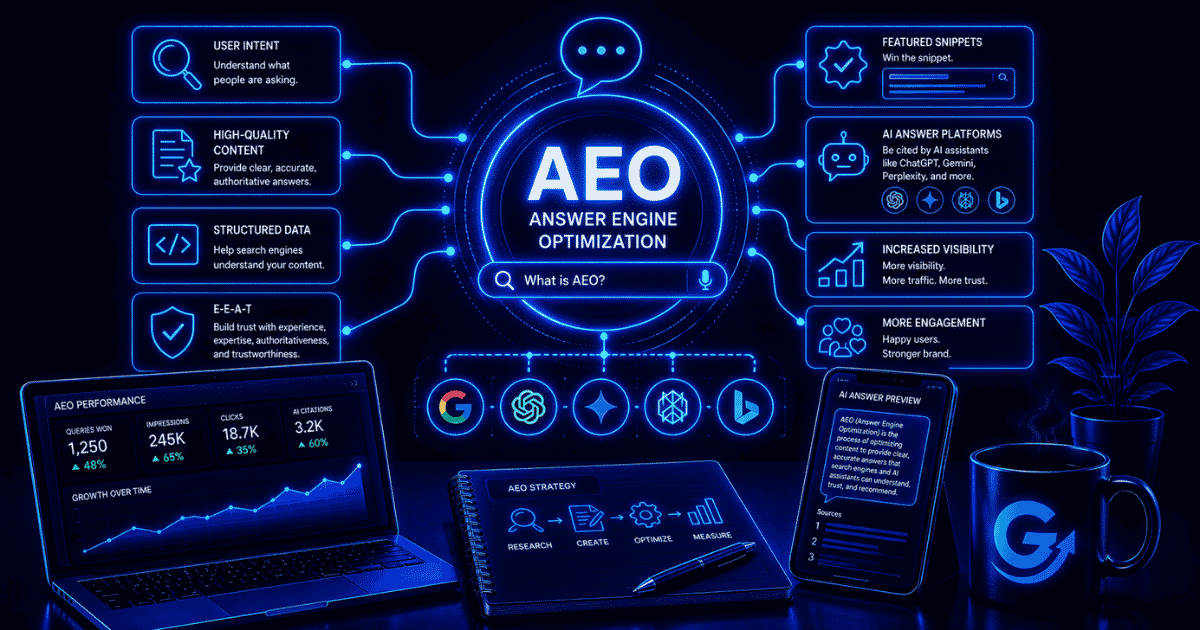
AEO stands for Answer Engine Optimization. It’s the practice of making content easier for search engines and AI-powered answer systems to understand, extract, trust, and use when answering a user’s question.
Traditional SEO primarily asks:
How do I get my webpage to rank?
AEO asks:
How do I make my information a useful answer?
That can mean appearing in a featured snippet, being cited in an AI-generated response, supplying information used in an AI answer, or simply making your content structured enough for an answer engine to understand what you’re saying.
AEO isn’t a replacement for SEO. And despite how the term is increasingly used, it isn’t exclusively about ChatGPT.
It’s better understood as an evolution of search optimization toward a world where users increasingly receive answers instead of—or before—lists of webpages. Research into generative AI and traditional web search supports the broader point that these systems represent meaningfully different information-retrieval environments, even though they overlap.
What Does AEO Mean?
AEO means Answer Engine Optimization: optimizing information so answer-oriented search and AI systems can identify it as a useful response to a user’s question.
The concept predates the current generative AI boom.
Search engines have been moving toward direct answers for years through features such as:
- Featured snippets
- Knowledge panels
- People Also Ask
- Voice assistants
- Local results
- Calculators
- Weather answers
- Definition boxes
- Other zero-click search features
Generative AI dramatically expanded the concept.
Instead of extracting one paragraph and displaying it above conventional search results, modern answer engines can retrieve information from multiple sources, synthesize it, and construct a new response.
That means AEO now increasingly overlaps with AI search optimization.
The underlying objective, however, hasn’t changed much:
Understand the question. Provide the best possible answer. Make that answer easy for machines and people to understand.
What Is an Answer Engine?
An answer engine is a system designed to respond directly to a user’s question rather than simply provide a list of resources that might contain the answer.
Traditional search:
Query → ranked webpages → user finds answer
Answer engine:
Question → information retrieval → direct answer
That second model can take several forms.
Google might display a featured snippet.
A voice assistant might speak a single answer.
Perplexity might generate an explanation with several citations.
ChatGPT might search the web, synthesize several sources, and answer a follow-up question conversationally.
These aren’t technically identical systems, which is important.
Marketers sometimes lump every nontraditional search experience into “AI search.” In reality, answer retrieval, generative AI, search indexes, large language models, knowledge graphs, retrieval-augmented generation, and traditional ranking systems can all play different roles.
If you want the deeper technical side, Growth Gary’s guide to how AI search works explains the retrieval and generation process separately.
How Does AEO Work?
AEO works by improving the likelihood that an answer system can find, understand, extract, evaluate, and use your information.
A simplified process looks like this:
- A user asks a question.
- The system interprets what the user wants.
- It identifies potentially useful information.
- It evaluates available sources or passages.
- It extracts relevant information.
- It constructs or presents an answer.
- Depending on the system, it may cite or link to the source.
AEO attempts to improve your position within that process.
That doesn’t mean adding an “AEO tag” to your website.
There isn’t one.
It means improving things such as:
- Content clarity
- Question-to-answer alignment
- Information structure
- Source credibility
- Entity clarity
- Technical accessibility
- Topical authority
- Supporting evidence
- Structured data where appropriate
- Broader brand authority
The exact signals vary considerably between systems.
And that’s one reason I’m cautious whenever someone presents AEO as a fixed checklist guaranteed to get ChatGPT citations.
We’re optimizing for multiple systems that don’t all retrieve, evaluate, or present information the same way.
What Is the Difference Between AEO and SEO?
The biggest difference between SEO and AEO is the desired search outcome.
SEO primarily optimizes webpages for discovery and ranking. AEO optimizes information for direct answers.
| SEO | AEO |
|---|---|
| Search Engine Optimization | Answer Engine Optimization |
| Optimizes for search visibility | Optimizes for answer visibility |
| Page is often the primary unit | Answer/passages can become important units |
| Keywords are important | Questions and intent are especially important |
| Goal often includes rankings and clicks | Goal includes answer inclusion and citations |
| User visits page to get information | User may get information before visiting |
| SERPs are primary environment | Answer experiences span search and AI |
| Measures rankings, clicks and traffic | Can measure answer appearances, citations and mentions |
But that table can make SEO and AEO look more separate than they actually are.
A well-optimized SEO page can also be excellent AEO content.
If a page:
- Directly answers the query
- Uses descriptive headings
- Is technically accessible
- Demonstrates expertise
- Provides credible evidence
- Covers the topic comprehensively
- Uses understandable language
…you’re already doing quite a bit that helps both.
That’s why I wouldn’t create separate “SEO content” and “AEO content.”
I’d create excellent content that works across multiple discovery environments.
Growth Gary’s guide to traditional SEO versus AI search explores the broader shift from ranked search results toward AI-generated discovery.
What Is the Difference Between AEO and GEO?
This is where the terminology gets messy.
AEO stands for Answer Engine Optimization. GEO stands for Generative Engine Optimization.
The two overlap substantially, and the industry doesn’t currently use the terms with perfect consistency. Some practitioners essentially treat them as synonyms, while others use AEO as the broader answer-focused discipline and GEO specifically for generative AI systems. Current industry definitions reflect both interpretations.
I find this distinction the most useful:
AEO
Focuses on making information suitable for direct answers.
It can apply to:
- Featured snippets
- Voice search
- Search answer boxes
- AI Overviews
- AI assistants
- Other answer-oriented experiences
GEO
Focuses specifically on visibility within generative AI responses.
It deals more directly with environments such as:
- ChatGPT
- Perplexity
- Gemini
- Claude
- Google AI Mode
- AI Overviews
- Copilot
Put another way:
AEO asks: “Can this information become the answer?”
GEO asks: “Can this information or brand become part of a generative AI answer?”
There is obviously a large area in the middle.
And I wouldn’t spend three weeks arguing about which acronym owns it.
For marketers, the practical work is more important than the terminology.
AEO vs. GEO vs. SEO
Here’s how I would organize the three concepts.
| Discipline | Primary Objective | Typical Visibility |
|---|---|---|
| SEO | Get webpages discovered and ranked | Organic search results |
| AEO | Make information usable as a direct answer | Featured answers, voice, AI answers |
| GEO | Increase visibility within generative AI responses | AI citations, mentions and recommendations |
Think of them as overlapping layers rather than competing marketing disciplines.
A single well-designed resource might perform all three jobs.
For example, an article answering “What is conversion rate optimization?” could:
- Rank organically for the query through SEO.
- Supply a concise definition for a direct-answer experience through AEO.
- Be retrieved or cited when an AI assistant explains CRO through GEO.
Same page.
Different discovery surfaces.
AEO vs. AI Visibility: What’s the Difference?
AEO is something you do.
AI visibility is something you measure.
For example, suppose Growth Gary wants to appear when users ask AI platforms:
- What are the best AI visibility tools?
- How do I measure AI citations?
- What’s the difference between GEO and SEO?
- How can I improve ChatGPT visibility?
Improving the content, authority, structure, and supporting signals around those topics could be part of AEO or GEO.
Tracking how often Growth Gary actually appears would be measuring AI visibility.
Growth Gary’s guide to what AI visibility is covers that measurement concept in more detail.
Why Is AEO Important?
AEO matters because search behavior is no longer limited to clicking through a list of results.
Users increasingly expect systems to do some of the information processing for them.
Instead of searching:
best marketing automation software
and opening five results, someone might ask:
What’s the best marketing automation software for a 10-person B2B company that already uses HubSpot CRM?
The second query contains much more context.
An answer engine can potentially interpret those requirements, compare alternatives, explain tradeoffs, and provide a recommendation in one response.
That creates a different visibility opportunity.
Your brand doesn’t necessarily need to be the page the user clicks first.
It may need to become one of the sources, entities, products, or experts included in the answer.
Search Is Becoming More Conversational
People can ask complete questions instead of reducing their intent to a few keywords.
And they can continue the conversation:
What’s the best CRM for a small business?
Then:
Which of those integrates with Gmail?
Then:
Remove anything over $50 per user.
Then:
Which would you choose for a marketing agency?
That’s different from executing four independent Google searches.
AEO needs to consider the broader question space around a topic, not just one exact keyword.
Zero-Click Answers Change the Value of Visibility
Sometimes users get what they need without visiting the source.
That’s not entirely new.
Google has provided weather, calculations, definitions, sports scores, knowledge panels, and featured snippets directly in search results for years.
Generative AI expands the range and sophistication of questions that can potentially be answered without a traditional click.
That means marketers may increasingly need to measure more than website traffic.
Visibility itself can matter.
AI Systems Can Influence Buying Decisions
The stakes get higher when the question isn’t informational.
Someone might ask:
What’s the best email marketing platform for a small ecommerce company?
Now the answer can contain actual products and recommendations.
If your company sells one of those products, being included—or absent—has obvious commercial implications.
That’s where AEO begins overlapping heavily with GEO, AI visibility, brand authority, digital PR, reviews, and product marketing.
What Makes Content Good for AEO?
Good AEO content makes the answer easy to identify without making the page unpleasant for humans.
That’s a surprisingly important qualification.
You don’t need to transform every article into a giant FAQ.
Answer the Question Immediately
If the heading is:
What is Answer Engine Optimization?
The first sentence should answer it:
Answer Engine Optimization is the practice of optimizing information so answer systems can understand and use it when responding to user questions.
Then elaborate.
Don’t write:
The digital marketing ecosystem has undergone a remarkable transformation over the past several years…
Nobody came for the throat-clearing.
Use Descriptive Headings
Headings establish relationships between questions and answers.
Compare:
Weak heading:
More Information
Better heading:
How Does Answer Engine Optimization Work?
The second heading gives both the reader and a machine meaningful context.
Make Important Passages Self-Contained
Individual passages may be retrieved without the rest of your article.
So write important explanations with enough context to survive on their own.
Weak:
This makes it especially important.
Better:
AEO becomes particularly important when users receive direct answers without visiting traditional search results.
The second sentence still makes sense if extracted.
Use Natural Questions
AEO lends itself naturally to the questions people actually ask.
Examples include:
- What is AEO?
- How does AEO work?
- What’s the difference between AEO and SEO?
- Does AEO help with ChatGPT?
- How do you measure AEO?
- Is schema important for AEO?
Don’t turn every heading into a question purely for optimization.
But if users genuinely ask the question, answering it explicitly makes sense.
Provide Evidence for Claims
Answer engines need trustworthy information.
Support meaningful factual claims with credible sources when appropriate.
Useful evidence might include:
- Academic research
- Government data
- Original research
- Industry studies
- Primary sources
- Expert commentary
- Product documentation
Evidence makes content better for people too.
Funny how often good “AI optimization” turns out to be good publishing.
Use Tables When Relationships Matter
Tables work well when the user needs to understand:
- X vs. Y
- Features
- Definitions
- Processes
- Pricing
- Advantages and disadvantages
- Tool differences
They’re not magic AEO formatting.
They’re simply a good way to organize certain kinds of information.
Keep Information Accurate and Current
A beautifully structured wrong answer is still wrong.
Freshness matters particularly for:
- Product features
- Pricing
- Statistics
- Laws and regulations
- Current events
- Software
- AI platforms
- Market information
Evergreen content isn’t content you publish once and abandon forever.
Does Schema Help AEO?
Structured data can help search engines understand the meaning and relationships of information on a webpage.
Common schema types include:
- Organization
- Person
- Article
- Product
- SoftwareApplication
- LocalBusiness
- FAQPage
- HowTo
- BreadcrumbList
That can support machine understanding.
But here’s the important part:
Schema doesn’t make bad content authoritative.
Adding 14 schema types to a weak article doesn’t turn it into the best answer.
Structured data should accurately describe what’s actually on the page.
I’d treat schema as a supporting layer, not an AEO shortcut.
Do FAQs Help AEO?
They can.
But only when the questions are useful.
FAQ-style content naturally creates clear question-and-answer relationships, which can make information easy to understand and extract.
That doesn’t mean every page needs 25 FAQs.
If you’ve already answered the question comprehensively in the article, repeating the same answer at the bottom doesn’t create additional value.
Use FAQs for genuine follow-up questions.
Not SEO decoration.
Do Keywords Matter for AEO?
Yes.
But AEO requires thinking beyond individual keywords.
Traditional keyword research might identify:
marketing automation software
AEO-oriented research should also explore the questions around that topic:
- What is marketing automation?
- What can marketing automation software do?
- What’s the best platform for small businesses?
- Does marketing automation replace a CRM?
- How much does marketing automation cost?
- Which platforms integrate with Shopify?
- Is HubSpot worth it for a small company?
The keyword identifies the subject.
The questions reveal the information needs surrounding it.
That’s why topic coverage becomes so important.
Do Backlinks Matter for AEO?
Authority still matters, but the relationship isn’t as simple as:
More backlinks = more answers.
Traditional links can help establish website authority and improve discovery.
But answer engines may also encounter a brand through:
- News coverage
- Industry publications
- Reviews
- YouTube
- Product directories
- Forums
- Academic sources
- Social discussions
- Expert references
- Other third-party websites
This is especially relevant for generative AI.
Your website isn’t the only place the internet talks about you.
If dozens of credible sources consistently describe a company as a leader in a category, that creates a very different information environment than a company whose own website is the only place making that claim.
Can AEO Help You Get Cited by ChatGPT?
Potentially, yes.
But no optimization tactic can guarantee a ChatGPT citation.
AI systems can vary in:
- Whether they search the web
- Which sources they retrieve
- Which passages they select
- How they interpret a prompt
- Whether they display citations
- How they construct the final answer
Even identical prompts can produce different responses.
Research into AEO is growing, but the evidence base is still young. One 2026 field study found suggestive improvement in ChatGPT referral traffic after a bundle of AEO interventions, while also emphasizing that rapidly growing platform usage can exaggerate apparent gains and that its causal evidence was not conclusive.
So be skeptical of:
“Do these seven things and ChatGPT will cite you.”
Nobody controls the final answer.
You can improve your odds.
That’s different.
What Are AI Citations?
An AI citation is a reference or link an AI system provides to a source associated with information in its response.
For example, Perplexity may generate an explanation and attach citations to several sources.
Google AI Overviews can display supporting links.
ChatGPT can cite web sources when search is involved.
From an AEO perspective, citations matter because they provide measurable evidence that your information is being surfaced.
But citations aren’t the entire picture.
A system might recommend your brand without citing your website.
That’s still visibility.
Growth Gary’s guide to what AI citations are explains that distinction in greater depth.
How Do You Measure AEO?
AEO doesn’t have one universal metric.
The measurement depends partly on the answer environment you’re targeting.
Useful metrics can include:
| Metric | What It Tells You |
|---|---|
| Featured snippet ownership | Whether Google uses your content for direct answers |
| AI citations | Whether AI systems cite your content |
| Brand mentions | Whether your brand appears in answers |
| Answer visibility | How frequently you appear for tracked questions |
| Share of voice | How often you appear compared with competitors |
| Prompt coverage | Which questions produce your brand/content |
| AI referral traffic | Visits coming from AI platforms |
| Conversion rate | Whether those visits produce business outcomes |
| Organic visibility | Whether traditional search performance also improves |
The most important measurement principle is consistency.
Don’t ask ChatGPT one question, see your brand mentioned once, and declare the AEO project successful.
Track a meaningful set of questions repeatedly.
Look for trends.
How Do You Start With AEO?
AEO doesn’t require rebuilding your entire website.
Start with the questions that actually matter to your business.
1. Identify Important Questions
Begin with your existing keyword and customer research.
Look at:
- Search queries
- Sales questions
- Customer support questions
- People Also Ask
- Community discussions
- Product comparisons
- Search suggestions
- AI conversations
- Competitor content
Build a list of the questions your audience genuinely needs answered.
2. Map Questions to Existing Pages
Don’t immediately create a new page for every question.
Ask:
Do we already have a page that should answer this?
If yes, improve it.
This prevents the classic SEO problem of creating 37 pages that all vaguely compete for the same topic.
3. Improve the Answers
Review important pages for:
- Direct definitions
- Clear headings
- Concise answers
- Useful examples
- Supporting evidence
- Accurate terminology
- Tables where helpful
- Relevant FAQs
- Logical structure
Make the page easier to understand.
4. Strengthen the Source
Ask why an answer engine should trust your information.
Can you add:
- Original research?
- Expert authorship?
- Firsthand examples?
- Better sources?
- Product documentation?
- Transparent methodology?
- Current statistics?
AEO isn’t just formatting.
Authority matters.
5. Strengthen the Broader Brand Presence
Look beyond your website.
Where do trusted sources discuss your category?
Where are competitors mentioned?
Where do customers leave reviews?
Which publications, communities, creators, or experts shape the conversation?
You shouldn’t manufacture fake recommendations.
You should build enough genuine presence that your own website isn’t the only source claiming you’re important.
6. Measure the Answers
Establish a repeatable set of questions.
Track:
Before → optimization → after
Then look for meaningful changes across multiple observations.
That’s a much better methodology than relying on screenshots of one favorable ChatGPT answer.
Common AEO Mistakes
AEO is developing quickly enough that there’s already plenty of questionable advice surrounding it.
Treating AEO as a Completely New Marketing Discipline
A lot of good AEO looks suspiciously like good SEO, content strategy, technical SEO, PR, and brand building.
That’s because it is.
The interface changed.
Marketing fundamentals didn’t disappear.
Stuffing Pages With Questions
A page containing 75 awkward question headings isn’t automatically answer-engine optimized.
Structure should improve comprehension.
Not make the page look like a deposition transcript.
Publishing Hundreds of Thin AI Answers
Generating a page for every conceivable question sounds efficient.
Until you realize you’ve created thousands of nearly identical pages nobody needs.
Answer comprehensively where it makes sense.
Assuming Schema Guarantees Visibility
Schema can help machines understand information.
It doesn’t guarantee selection.
Optimizing Only Your Website
AI systems can retrieve information from across the web.
Your broader brand footprint matters.
Measuring One Prompt
AI answers can vary.
One answer isn’t a trend.
Chasing Every New AEO Trick
Every emerging marketing category eventually attracts tactics that supposedly “hack” the system.
Some may eventually prove useful.
Many won’t.
Prioritize durable improvements:
Clarity + usefulness + authority + accessibility + evidence.
Gary’s Take: AEO Is Mostly Good Information Architecture With a New Destination
Here’s where I think marketers are making AEO harder than it needs to be.
Imagine somebody asks you a question and you have five seconds to point them toward the best paragraph on your website.
Could you?
If your answer is:
“Well, they need to read these first eight paragraphs and infer what we mean…”
you probably have an answer problem.
If you can point directly to a clearly labeled section that provides an accurate answer, explains it, supports it, and gives the reader somewhere logical to go next, you’re in much better shape.
That’s useful for Google.
It’s useful for AI.
And, inconveniently for anyone selling secret AEO formulas, it’s also useful for humans.
AEO deserves attention because answer-driven discovery is growing.
But I wouldn’t create an entirely separate content strategy for robots.
I’d create better information.
Is AEO Worth Doing?
Yes—especially if your customers use search or AI systems to research questions related to your business.
But I’d incorporate AEO into your broader search and content strategy rather than treating it as a standalone marketing universe.
Start with strong SEO foundations.
Make important information clear.
Answer real questions.
Build credible authority.
Structure content logically.
Strengthen your presence beyond your own website.
Then measure whether you’re increasingly appearing where answers are being generated.
The acronym is new enough to feel like a new discipline.
Much of the work is simply making your expertise easier to find and easier to use.
FAQs About AEO
What does AEO stand for?
AEO stands for Answer Engine Optimization. It refers to optimizing content so answer-oriented search systems and AI platforms can more easily understand, extract, and use the information when responding to user questions.
What is AEO in SEO?
In SEO, AEO extends optimization beyond traditional webpage rankings toward direct-answer visibility. It can include optimizing for featured snippets, AI-generated answers, voice assistants, citations, and other search experiences where the system provides the answer directly.
Is AEO the same as GEO?
Not exactly, although the terms overlap and aren’t used consistently across the industry. AEO is commonly used for optimizing information for direct-answer experiences, while GEO specifically refers to Generative Engine Optimization and focuses on visibility within generative AI responses.
Is AEO replacing SEO?
No. AEO builds on many SEO fundamentals, including crawlability, content quality, topical relevance, authority, and clear site structure. Traditional search also remains an important discovery channel. AEO adds another optimization layer rather than eliminating SEO.
Does AEO work for ChatGPT?
AEO practices can improve the clarity, accessibility, and authority of information that AI systems may retrieve, but they cannot guarantee inclusion or citations in ChatGPT. Retrieval and answer generation vary by platform and query.
What’s the difference between AEO and AI visibility?
AEO is an optimization practice. AI visibility is a measurable outcome describing how often and how prominently a brand or source appears within AI-generated responses.
Do I need AEO software?
Not necessarily. You can begin by identifying important questions, improving existing content, manually testing AI responses, and monitoring analytics. Dedicated tools become more useful when you need to track large numbers of prompts, platforms, competitors, mentions, and citations.
Related Growth Gary Content
Explore This Topic
- How Answer Engine Optimization Works
- AEO vs. SEO
- AEO vs. GEO
- How to Build an AEO Strategy
- How to Measure AEO
- AEO Content Optimization
- AEO for Small Businesses
- AEO for Ecommerce
- What Are AI Citations?
- Best AI Visibility Tools
AEO isn’t really about finding a new way to write for machines. It’s about making good information easier to recognize as an answer.
Do that well, and you’re improving the experience for the machines and the people they’re trying to help.
— Gary
The changes actually worth knowing
A short briefing that filters the noise into useful AI, marketing, technology, tools, and ideas for marketers and businesses.