
Marketing gets complicated surprisingly fast.
A business starts with a website and a few emails. Then someone adds a newsletter. Leads start coming in. Sales wants to know which ones are qualified. Customers need follow-ups. Someone wants abandoned-cart emails. Another person wants leads from a webinar sent to the CRM.
Before long, marketers are manually moving information between systems and sending messages that software could have handled automatically.
That’s the problem marketing automation is designed to solve.
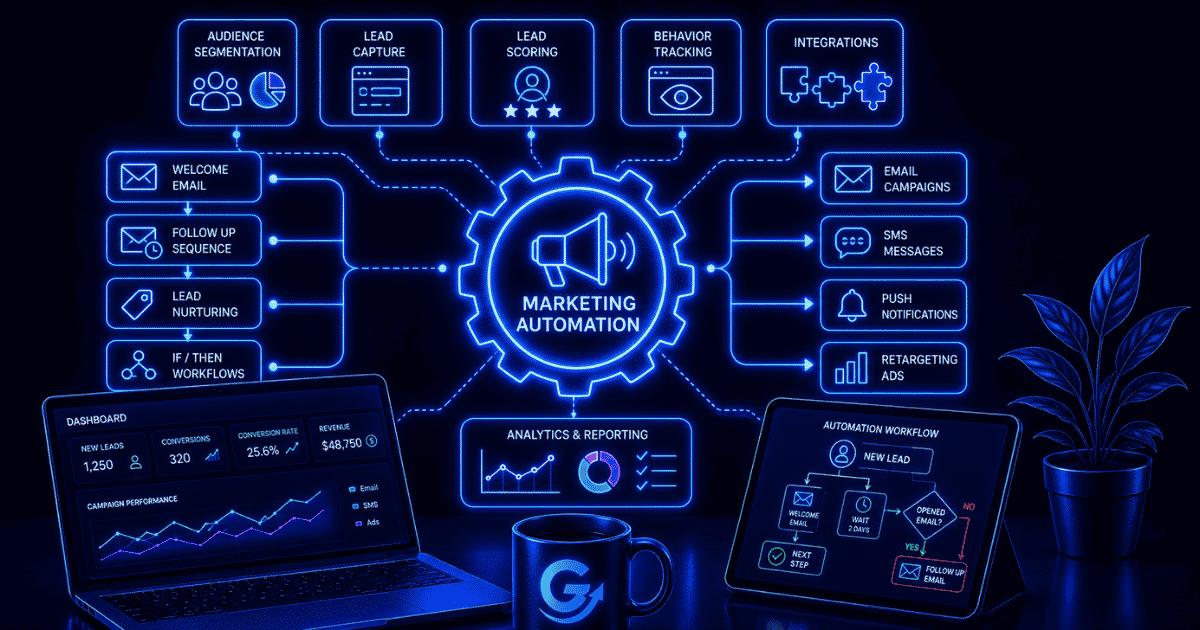
Marketing automation is the use of software and predefined workflows to automatically perform, coordinate, and personalize repetitive marketing activities based on customer data, behaviors, schedules, or other triggers.
Common examples include:
- Sending a welcome email after someone subscribes
- Nurturing a lead after a content download
- Following up after an abandoned shopping cart
- Segmenting contacts based on behavior
- Assigning leads to sales representatives
- Sending reminders before an event
- Updating CRM records
- Triggering messages based on customer actions
- Re-engaging inactive customers
- Measuring how leads move through a marketing funnel
The important word isn’t really automation.
It’s system.
Good marketing automation creates a repeatable system for moving people through relevant marketing experiences without requiring someone on your team to manually push every button.
Bad marketing automation just helps you annoy people more efficiently.
Here’s how to tell the difference.
How Does Marketing Automation Work?
Marketing automation works by using triggers, rules, customer data, and predefined actions to determine what should happen next in a marketing process.
A simple automation might look like this:
Visitor downloads guide → contact added to database → welcome email sent → wait two days → educational email sent → contact clicks pricing page → lead score increases → sales team notified
Nobody needs to manually send those emails or monitor every individual website visit.
The automation platform watches for the conditions you’ve defined and executes the appropriate actions.
Most marketing automation workflows contain four basic elements:
| Element | What It Does | Example |
|---|---|---|
| Trigger | Starts the automation | User submits a form |
| Condition | Determines what happens next | Is the contact already a customer? |
| Action | Performs a task | Send an email |
| Data | Provides context | Industry, purchase history, page activity |
More sophisticated automations can contain multiple branches, delays, scoring rules, integrations, and decision points.
But the basic logic remains surprisingly simple:
When X happens, evaluate Y, then do Z.
What Can Marketing Automation Do?
Marketing automation can support activities across the customer lifecycle, from initial lead capture through retention.
The exact capabilities depend on the software being used.
Email Marketing Automation
Email is probably the most familiar form of marketing automation.
Examples include:
- Welcome sequences
- Lead nurture campaigns
- Abandoned-cart emails
- Product recommendations
- Event reminders
- Re-engagement campaigns
- Post-purchase emails
- Renewal reminders
- Birthday or anniversary messages
Instead of manually choosing recipients and scheduling every message, marketers define the conditions that determine when each email should be sent.
Lead Capture and Nurturing
Not every person who fills out a form is ready to buy.
Marketing automation can keep that relationship moving.
For example, someone downloads a report about marketing automation.
Instead of immediately receiving:
Hi Sarah, would you like a 30-minute demo?
the person could enter a nurture sequence that provides additional educational material first.
Their later behavior can help determine whether stronger buying intent develops.
Audience Segmentation
Automation platforms can group contacts according to characteristics or behaviors.
Segments might include:
- New subscribers
- Existing customers
- Prospects
- High-value customers
- Inactive customers
- People interested in a particular product
- Customers in a specific location
- Contacts who attended an event
- People who visited a pricing page
Those segments allow marketers to send more relevant messages instead of blasting the same campaign to everybody.
Lead Scoring
Lead scoring assigns values to contacts based on characteristics or behaviors associated with purchase intent.
For example:
| Behavior | Example Score |
|---|---|
| Opens an email | +1 |
| Downloads a guide | +5 |
| Attends a webinar | +10 |
| Visits pricing page | +15 |
| Requests a demo | +30 |
A contact reaching a particular threshold could automatically become a marketing-qualified lead or be sent to sales.
The exact scoring system should reflect your actual buying process.
Assigning 17 points to somebody because they opened Tuesday’s newsletter doesn’t make the system sophisticated if those points don’t predict anything useful.
CRM Updates
Marketing automation can keep customer information synchronized with a CRM.
For example:
Lead submits form → CRM contact created → source recorded → sales representative assigned → follow-up task generated
That reduces manual data entry and makes marketing and sales systems more connected.
Personalization
Automation can change messaging based on information about the recipient.
An ecommerce customer might receive recommendations based on previous purchases.
A B2B prospect might receive different content based on company size.
An existing customer shouldn’t necessarily receive the same “Become a Customer” campaign as somebody who has never purchased.
Good personalization uses automation to increase relevance.
Bad personalization is putting someone’s first name in a subject line and calling it a strategy.
Customer Retention
Marketing automation isn’t only for acquiring customers.
It can also support:
- Onboarding
- Product education
- Renewal reminders
- Upselling
- Cross-selling
- Loyalty campaigns
- Review requests
- Customer feedback
- Win-back campaigns
For subscription businesses in particular, automation can become an important part of the post-purchase customer experience.
What Is a Marketing Automation Workflow?
A marketing automation workflow is a predefined sequence of triggers, conditions, and actions that automatically executes a marketing process.
For example:
Trigger: Someone subscribes to a newsletter.
Action: Send welcome email.
Wait: Two days.
Condition: Did the subscriber click the featured article?
If yes: Send related resource.
If no: Continue normal welcome sequence.
Condition: Did the subscriber visit a product page?
If yes: Add the contact to a higher-intent segment.
That is a workflow.
Workflows can be extremely simple or extremely complex.
Growth Gary’s guide to what workflow automation is covers the broader concept beyond marketing-specific use cases.
The distinction is useful because marketing automation is a type of workflow automation, but not all workflow automation is marketing automation.
Marketing Automation vs. Workflow Automation
Marketing automation and workflow automation overlap, but they aren’t identical.
| Marketing Automation | Workflow Automation |
|---|---|
| Focuses primarily on marketing and customer journeys | Can automate processes across an entire organization |
| Email campaigns | File management |
| Lead nurturing | Employee onboarding |
| Customer segmentation | Project management |
| Lead scoring | Data synchronization |
| Campaign triggers | Approval workflows |
| CRM marketing activity | Operations processes |
A marketing team might use ActiveCampaign to automate lead nurturing while using Zapier or Make to move information between several business applications.
Both involve automation.
They’re solving different problems.
Marketing Automation vs. Email Marketing
Email marketing and marketing automation are closely related, but marketing automation is broader.
Email marketing focuses primarily on communicating through email. Marketing automation coordinates actions across customer data, channels, workflows, and systems.
A basic email platform might let you:
- Build newsletters
- Maintain subscriber lists
- Schedule campaigns
- Track opens and clicks
A marketing automation platform might additionally:
- Track website behavior
- Score leads
- Trigger workflows
- Update CRM records
- Create audience segments
- Coordinate SMS
- Personalize journeys
- Route leads
- Connect advertising audiences
- Trigger sales activity
Modern email platforms increasingly include automation features, so the line isn’t always clean.
For a small business, an email platform with good automation may be all that’s necessary.
You don’t automatically need enterprise marketing automation software because someone drew a complicated funnel on LinkedIn.
Marketing Automation vs. CRM
A CRM manages customer and prospect relationships and data. Marketing automation uses that data and behavior to execute marketing activities automatically.
The two frequently work together.
Imagine someone named Maria downloads an ebook.
The CRM might store:
- Maria’s name
- Company
- Job title
- Lead source
- Sales owner
- Interaction history
The marketing automation system might then:
- Send Maria a nurture sequence
- Track whether she engages
- Increase her lead score
- Add her to a segment
- Notify sales when buying signals appear
Some platforms combine both capabilities.
HubSpot is a well-known example of a platform that brings CRM and marketing automation into the same broader ecosystem.
Others specialize more heavily in one side and integrate with separate systems.
What Are the Benefits of Marketing Automation?
Marketing automation can create meaningful efficiency, but saving time isn’t its only benefit.
Marketing Automation Saves Repetitive Work
Software is very good at repetitive tasks.
If the same action happens 500 times according to predictable rules, there’s usually little value in having a marketer manually repeat it.
Automation frees people to work on activities requiring judgment, creativity, strategy, and human interaction.
Marketing Automation Creates Consistency
Humans forget things.
Software generally doesn’t forget to send email number three because Friday got busy.
A well-built workflow helps ensure that leads and customers receive consistent follow-up.
Marketing Automation Can Improve Relevance
Automation allows marketing to respond to behavior.
Someone researching a particular service can receive information about that service instead of an unrelated generic campaign.
That’s more useful for the customer and potentially more effective for the business.
Marketing Automation Helps Marketing Scale
Manual processes become harder as volume increases.
Following up with 20 leads manually may be manageable.
Following up with 20,000 isn’t.
Automation allows a marketing system to support larger audiences without increasing manual workload at the same rate.
Marketing Automation Connects Systems
Marketing stacks often contain many applications:
Website → forms → email → CRM → advertising → analytics → sales
Automation can move information between them.
This becomes particularly useful when no single platform handles everything.
Marketing Automation Can Improve Measurement
Automated systems create structured events.
You can potentially measure:
- Which workflows generate conversions
- Which campaigns produce qualified leads
- Where leads disengage
- How long conversions take
- Which segments respond
- Which messages perform
- Which channels contribute to outcomes
That gives marketers something better than “I think the campaign went pretty well.”
What Are the Limitations of Marketing Automation?
Marketing automation isn’t automatically good marketing.
It can scale good processes.
It can also scale bad ones.
Automation Can’t Fix a Bad Strategy
If the offer isn’t compelling, automating it doesn’t make the offer better.
If the content isn’t useful, sending it automatically doesn’t make it useful.
If the audience is wrong, automation just reaches the wrong people more consistently.
Complex Workflows Become Difficult to Manage
Automation platforms make it tempting to build elaborate systems.
A workflow starts with three steps.
Six months later it has:
- 37 branches
- 19 tags
- Eight integrations
- Four lead scores
- Two forgotten webhooks
- A mysterious condition named “DO NOT DELETE”
Nobody remembers why.
Complexity has a maintenance cost.
Bad Data Creates Bad Automation
Automation depends on data.
If customer information is incomplete, duplicated, inaccurate, or outdated, workflows can make poor decisions.
A customer receiving an aggressive acquisition campaign three days after buying the product isn’t impressed by your martech stack.
Over-Automation Can Feel Impersonal
Customers can usually tell when automation has gone too far.
Not every interaction should be automated.
High-value sales conversations, sensitive customer problems, complex questions, and relationship-building often benefit from actual humans.
Automation Requires Maintenance
Workflows aren’t “set it and forget it.”
Products change.
Teams change.
Offers expire.
Integrations break.
Messaging becomes outdated.
Automation needs periodic review.
What Are Common Marketing Automation Examples?
Here are several practical examples.
Newsletter Welcome Sequence
Trigger: User subscribes.
Automation:
- Send welcome email immediately.
- Send best resources two days later.
- Introduce newsletter topics.
- Recommend relevant content.
- Move subscriber into regular newsletter list.
Ecommerce Abandoned Cart
Trigger: Customer adds product to cart but doesn’t purchase.
Automation:
- Wait several hours.
- Send cart reminder.
- Check whether purchase occurred.
- If no, send follow-up.
- Stop sequence immediately after purchase.
B2B Lead Nurturing
Trigger: Prospect downloads an industry report.
Automation:
- Deliver report.
- Send related educational content.
- Track engagement.
- Increase lead score for high-intent actions.
- Notify sales after qualification threshold.
Webinar Follow-Up
Trigger: Webinar ends.
Automation branches:
Attended → send recording + related offer.
Registered but didn’t attend → send recording + alternate session.
Highly engaged attendee → notify sales.
Customer Onboarding
Trigger: Purchase completed.
Automation:
- Welcome customer.
- Provide setup instructions.
- Send educational content.
- Check adoption milestones.
- Request feedback.
- Introduce relevant advanced features.
Re-Engagement Campaign
Trigger: Subscriber hasn’t engaged for 90 days.
Automation:
- Send re-engagement message.
- Offer preference update.
- Check response.
- Retain engaged subscribers.
- Suppress or remove consistently inactive contacts where appropriate.
Automation should make the customer journey more relevant, not simply produce more messages.
What Are Marketing Automation Tools?
Marketing automation tools are software platforms that build, manage, and measure automated marketing workflows.
Capabilities vary widely.
Some platforms specialize in email.
Others combine:
- CRM
- SMS
- Lead scoring
- Forms
- Landing pages
- Advertising
- Analytics
- Customer journeys
- Sales automation
Examples of well-known marketing automation platforms include HubSpot, ActiveCampaign, Brevo, Klaviyo, and Mailchimp.
Tools such as Zapier and Make approach automation from a broader workflow and application-integration perspective.
You don’t need all of them.
The right platform depends on the processes you actually need to automate.
Growth Gary’s guide to the best marketing automation software compares the tool-selection side in more detail rather than turning this foundational guide into another software roundup.
What Should You Look for in Marketing Automation Software?
The best platform isn’t necessarily the one with the most features.
Look at the system you’re actually trying to build.
Important considerations include:
| Factor | Question to Ask |
|---|---|
| Ease of use | Can the team actually build and maintain workflows? |
| Does it support the campaigns you need? | |
| CRM | Is one included, or does it integrate with yours? |
| Segmentation | Can audiences be grouped using useful criteria? |
| Workflow builder | Can it support your required logic? |
| Integrations | Does it connect with your existing stack? |
| Analytics | Can you measure meaningful outcomes? |
| Lead scoring | Do you actually need it? |
| Ecommerce | Does it understand purchase behavior? |
| AI features | Do they solve a real problem? |
| Scalability | Will pricing remain reasonable as you grow? |
| Support | Can you get help when workflows break? |
Don’t buy based on the demo.
The demo is designed to make everything look easy.
Map your requirements first.
Then evaluate the tool.
How Much Does Marketing Automation Cost?
Marketing automation software ranges from inexpensive email tools to enterprise platforms costing thousands of dollars per month or considerably more.
Pricing commonly depends on:
- Number of contacts
- Email volume
- Number of users
- Automation features
- CRM capabilities
- Sales features
- Analytics
- Integrations
- Support level
But software cost is only part of the equation.
There are also implementation costs:
- Strategy
- Workflow design
- Data cleanup
- Integrations
- Copywriting
- Creative
- Testing
- Reporting
- Maintenance
A $50 platform nobody understands can be more expensive than a $500 platform the team uses effectively.
And the reverse is also true.
Don’t pay $500 for functionality a $50 tool can handle.
How Do You Build a Marketing Automation Strategy?
Start with the process, not the software.
That’s probably the most important advice on this page.
1. Identify a Repetitive Marketing Process
Look for activities that happen frequently and follow predictable rules.
For example:
Every new subscriber receives the same introductory information.
That’s a strong automation candidate.
2. Define the Desired Outcome
What should the automation accomplish?
Examples:
- Activate subscriber
- Qualify lead
- Generate purchase
- Complete onboarding
- Increase retention
- Recover cart
- Book meeting
Without an outcome, you’re just automating activity.
3. Map the Customer Journey
Identify:
Trigger → messages → decisions → actions → outcome
Keep the first version simple.
You can always add sophistication later.
4. Determine What Data You Need
Don’t collect information just because software lets you.
Identify the data required to make useful decisions.
That might include:
- Lead source
- Product interest
- Purchase history
- Lifecycle stage
- Engagement
- Company size
5. Build the Minimum Useful Workflow
Don’t start with the 37-branch monster.
Build the smallest workflow capable of solving the problem.
Test it.
Then improve it.
6. Define Exit Conditions
This gets overlooked surprisingly often.
Every automation should know when to stop.
If somebody buys the product, stop sending abandoned-cart emails.
If a prospect books a demo, remove them from the “Book a Demo” nurture campaign.
If somebody unsubscribes, respect it.
Automation needs exits as much as entrances.
7. Measure the Outcome
Track what the automation was built to accomplish.
Don’t measure only:
Emails sent: 84,213
That’s an operational metric.
Measure what happened because those messages were sent.
How Do You Measure Marketing Automation?
The right metrics depend on the workflow’s objective.
| Objective | Useful Metrics |
|---|---|
| Email engagement | Click rate, unsubscribe rate |
| Lead generation | Leads, conversion rate, cost per lead |
| Lead nurturing | MQL rate, progression rate |
| Sales | Revenue, pipeline, conversion rate |
| Ecommerce | Cart recovery, revenue, average order value |
| Retention | Renewal rate, churn, repeat purchases |
| Workflow efficiency | Completion rate, errors, time saved |
Be careful with attribution.
Marketing automation often operates across a longer customer journey.
Someone may read five emails, visit through organic search, return through direct traffic, and eventually convert after speaking with sales.
The automation can contribute without receiving neat last-click credit.
Where Does AI Fit Into Marketing Automation?
AI is increasingly being added to marketing automation platforms.
Potential uses include:
- Generating email drafts
- Predicting audience segments
- Recommending send times
- Lead scoring
- Personalizing content
- Summarizing customer activity
- Selecting next-best actions
- Creating campaign variations
- Analyzing performance
- Supporting conversational workflows
AI can make automation more adaptive.
Traditional automation often follows explicit logic:
IF X → THEN Y
AI can potentially help evaluate less structured information and make probabilistic decisions.
But that doesn’t mean every workflow needs AI.
If the requirement is:
When someone submits this form, send this email
you don’t need a language model involved.
Simple automation is usually easier to understand, troubleshoot, and maintain.
If you’re exploring the broader role of AI across marketing rather than automation specifically, Growth Gary’s guide to what AI marketing is covers that territory.
Marketing Automation and the Customer Journey
The best automation isn’t built around what software can do.
It’s built around what the customer needs next.
Consider a simple journey:
Awareness → Consideration → Decision → Customer → Retention
Different automations can support each stage.
Awareness
- Newsletter welcome
- Content recommendations
- Educational sequences
Consideration
- Lead nurturing
- Product education
- Webinar invitations
- Comparison content
Decision
- Demo follow-up
- Cart recovery
- Sales notifications
- Trial reminders
Customer
- Onboarding
- Product education
- Review requests
Retention
- Renewal reminders
- Loyalty campaigns
- Upsell recommendations
- Re-engagement
That’s where automation becomes useful strategically.
You’re not asking:
What can ActiveCampaign automate?
You’re asking:
Where does the customer need a consistent next step?
Then you determine whether automation is the appropriate way to provide it.
Common Marketing Automation Mistakes
The technology isn’t usually the hardest part.
The logic is.
Automating a Broken Process
If a manual process doesn’t make sense, automating it won’t fix the underlying problem.
Map the process first.
Starting Too Complex
Build one useful workflow.
Get it working.
Then build another.
Automation maturity comes from working systems, not the number of boxes in your workflow diagram.
Sending Too Much
Automation makes sending easy.
That doesn’t mean recipients want more communication.
Frequency still matters.
Ignoring Exit Conditions
Nothing says “our systems don’t talk to each other” like receiving six sales emails after you’ve already purchased.
Using Bad Data
Automations make decisions based on the information available.
Garbage in, automated garbage out.
Buying Too Much Software
Small businesses are particularly vulnerable to this.
You may not need:
- A separate CRM
- A separate email platform
- A separate automation platform
- A separate SMS platform
- A separate lead-scoring platform
One good system might handle most of it.
Add tools when a real requirement justifies them.
Never Auditing Workflows
Automations can quietly run for years.
Schedule periodic reviews.
Check:
- Is the workflow still needed?
- Are the messages current?
- Are integrations working?
- Are people entering correctly?
- Are exit conditions working?
- Is it producing the desired result?
Old automation is still automation.
It just becomes automated technical debt.
Gary’s Take: Automate Repetition, Not Relationships
Here’s the line I think marketers need to protect.
Automate the predictable parts of marketing. Keep humans involved where judgment and relationships matter.
I’d happily automate:
- Data entry
- Lead routing
- Welcome emails
- Reminders
- Segmentation
- Reporting
- Routine follow-ups
I’d be much more cautious about completely automating:
- High-value sales conversations
- Sensitive customer complaints
- Strategic decisions
- Complex customer questions
- Relationship-building
- Anything where context matters more than speed
The goal of marketing automation shouldn’t be removing humans from marketing.
It should be removing unnecessary work from humans so they can spend more time on the parts that actually require them.
That’s a much better use of automation.
Is Marketing Automation Worth It?
Marketing automation is worth it when you have repeatable marketing processes that consume time, need consistency, or become difficult to manage manually.
You probably don’t need sophisticated marketing automation if you have:
- 40 subscribers
- Two leads per month
- One simple newsletter
- No repeatable customer journey
A basic email platform may be enough.
Automation becomes increasingly valuable as:
- Lead volume increases
- Customer journeys become more complex
- Multiple channels need coordination
- Teams need better handoffs
- Personalization becomes important
- Manual processes consume significant time
- Customer data lives across multiple systems
Start with the problem.
Then automate it.
Don’t buy an automation platform and spend the next six months searching for something to automate.
FAQs About Marketing Automation
What is marketing automation in simple terms?
Marketing automation uses software to automatically perform repetitive marketing tasks based on predefined triggers, rules, customer data, or behaviors. Examples include welcome emails, lead nurturing, segmentation, cart recovery, and CRM updates.
What is an example of marketing automation?
A common example is a welcome sequence. When someone joins an email list, software automatically sends a welcome message, waits a specified period, sends additional useful content, and moves the subscriber through the sequence without manual intervention.
Is marketing automation the same as email marketing?
No. Email marketing focuses primarily on email communication. Marketing automation can coordinate email along with CRM data, lead scoring, segmentation, website activity, SMS, sales notifications, customer journeys, and other systems.
Is marketing automation the same as a CRM?
No. A CRM primarily stores and manages customer and prospect relationships and data. Marketing automation uses customer information and behaviors to automatically execute marketing activities. Many modern platforms combine both.
What businesses should use marketing automation?
Marketing automation is particularly useful for businesses with repeatable customer journeys, growing lead volumes, ecommerce activity, subscription models, longer sales cycles, or repetitive marketing processes. Very small businesses with simple marketing needs may not need sophisticated automation software.
Can small businesses use marketing automation?
Yes. Small businesses can automate basic processes such as newsletter welcomes, appointment reminders, lead follow-ups, customer onboarding, review requests, and abandoned carts. The key is choosing software appropriate to the business’s actual complexity.
Does marketing automation use AI?
Some marketing automation platforms use AI for tasks such as content generation, predictive scoring, personalization, segmentation, analytics, and recommendations. However, many useful marketing automations rely on straightforward rule-based workflows and don’t require AI.
Related Growth Gary Content
Explore This Topic
- Best Marketing Automation Software
- What Is Workflow Automation?
- Marketing Automation Strategy
- Marketing Automation for Small Businesses
- Marketing Automation Examples
- Marketing Automation vs. CRM
- Marketing Automation vs. Email Marketing
- How to Build a Marketing Automation Workflow
- AI Marketing Automation
- How to Measure Marketing Automation ROI
Marketing automation works best when you barely notice the automation itself.
The right message reaches the right person. Information moves where it’s supposed to go. The team doesn’t waste time repeating predictable tasks. And a human can step in when being human actually matters.
That’s the system worth building.
— Gary
The changes actually worth knowing
A short briefing that filters the noise into useful AI, marketing, technology, tools, and ideas for marketers and businesses.