
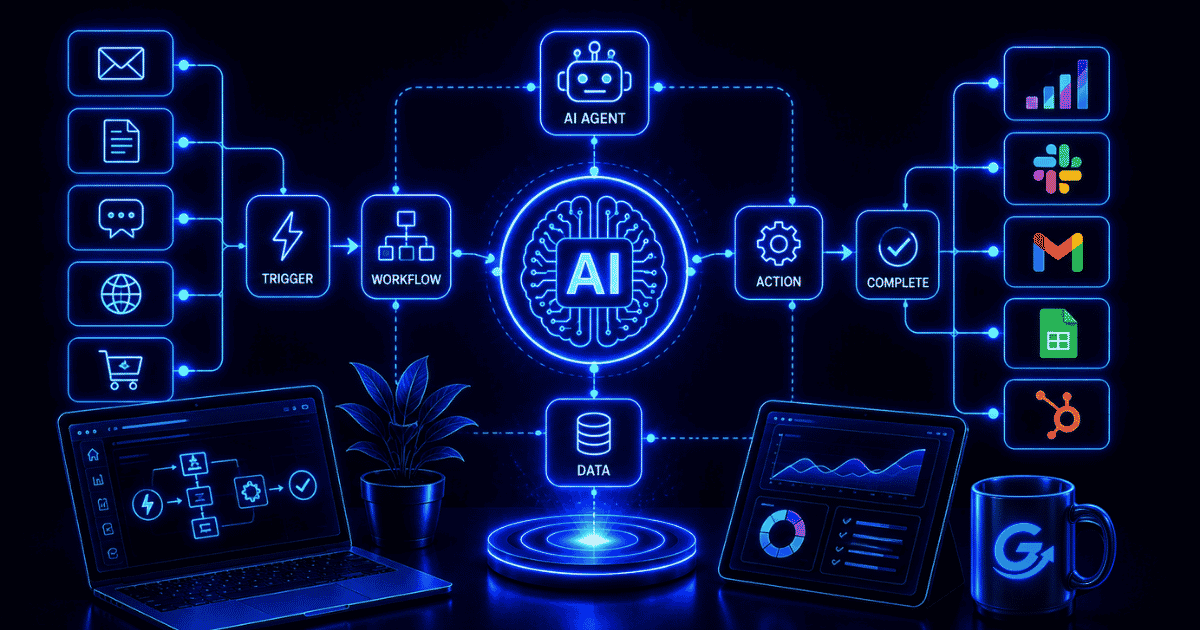
AI automation is the use of artificial intelligence inside automated workflows so software can do more than simply follow fixed rules.
Traditional automation usually works like this:
If X happens, do Y.
AI automation adds interpretation, generation, classification, or decision-making into the process.
That means a workflow can potentially:
- Read an incoming email and determine what it means
- Summarize a customer conversation
- Classify a support request
- Draft a response
- Extract information from a document
- Prioritize a lead
- Generate content
- Analyze data
- Decide which workflow branch should run next
- Trigger actions across multiple software tools
The simplest definition is:
AI automation combines artificial intelligence with automated workflows so systems can interpret information, make decisions, generate outputs, and take actions with less manual involvement.
AI automation is broader than just using ChatGPT or another AI assistant.
It’s what happens when AI becomes part of a repeatable process.
If you’re new to automation in general, start with Growth Gary’s guide to what workflow automation is. AI automation makes much more sense once the underlying workflow concept is clear.
How Does AI Automation Work?
AI automation usually combines four things:
- A trigger
- Information or data
- An AI step
- An automated action
For example:
New lead submitted → AI evaluates lead information → lead classified as high or low priority → CRM updated → sales rep notified
Without AI, the workflow might require rigid rules such as:
If company size > 100 and budget > $20,000, notify sales.
With AI, the system may also evaluate unstructured information such as:
- Job title
- Message content
- Purchase intent
- Company description
- Email language
- Notes from a sales call
That gives the workflow more flexibility.
The basic structure often looks like:
Trigger → AI interprets → rules or decision → action
The AI layer is what lets the system deal with information that isn’t perfectly structured.
What Is the Difference Between AI Automation and Traditional Automation?
The main difference is that traditional automation follows predefined rules, while AI automation can interpret and generate information within the workflow.
| Traditional Automation | AI Automation |
|---|---|
| Uses explicit rules | Can interpret context |
| Works best with structured data | Can handle unstructured data |
| Follows predictable paths | Can classify or recommend paths |
| Copies information | Can summarize or transform it |
| Sends predefined content | Can generate content dynamically |
| Requires exact conditions | Can work with more flexible inputs |
| Good for repetitive tasks | Good for repetitive tasks that also require interpretation |
A traditional automation might say:
When someone submits this form, add them to the CRM.
An AI automation might say:
When someone submits this form, analyze the inquiry, classify the lead, summarize the request, update the CRM, and route the lead to the correct salesperson.
Same trigger.
More intelligence in the middle.
What Can AI Automation Do?
AI automation can be used anywhere a repeatable process contains a step that normally requires reading, interpreting, generating, or categorizing information.
AI Automation Can Summarize Information
AI can automatically summarize:
- Meetings
- Emails
- Reports
- Customer conversations
- Research documents
- Support tickets
- CRM notes
For example:
Meeting ends → transcript generated → AI creates summary → action items extracted → summary added to project management system
Nobody needs to manually write the meeting recap.
AI Automation Can Classify Information
AI can categorize inputs automatically.
Examples include:
- Support request type
- Lead quality
- Customer sentiment
- Content topic
- Email priority
- Document category
- Sales inquiry type
That classification can determine what happens next.
For example:
Incoming support message → AI detects billing issue → billing team notified
AI Automation Can Generate Content
AI can create:
- Email drafts
- Social posts
- Reports
- Product descriptions
- Sales follow-ups
- Internal summaries
- Marketing copy
The important part is that generation happens automatically as part of a process.
For example:
New webinar registration → AI creates personalized follow-up draft → email platform sends approved message
That’s very different from manually opening an AI tool and asking it to write the email every time.
AI Automation Can Extract Data
AI can pull structured information out of messy inputs.
For example, it can extract:
- Name
- Company
- Invoice amount
- Product
- Date
- Request type
- Key points
from:
- Emails
- PDFs
- Forms
- Meeting transcripts
- Documents
That information can then be passed into another system.
AI Automation Can Help Make Decisions
AI can also help decide what should happen next.
For example:
New lead → AI evaluates context → lead score assigned → workflow routes accordingly
Or:
Customer feedback received → AI analyzes sentiment → negative feedback triggers support follow-up
This is where AI automation starts to feel more dynamic than traditional rule-based automation.
AI Automation vs. Workflow Automation
AI automation is best understood as a more advanced form of workflow automation.
Workflow automation moves work through a predefined process. AI automation adds AI-based interpretation, generation, or decision-making inside that process.
For example:
Workflow Automation
Form submitted → CRM updated → confirmation email sent
AI Automation
Form submitted → AI analyzes request → contact classified → CRM updated → personalized response generated → correct team notified
Not every workflow needs AI.
That’s important.
If the process is already simple and predictable, regular automation may be better.
The best workflow automation tools are useful when you need to connect systems and build these kinds of processes.
AI Automation vs. Marketing Automation
Marketing automation is specifically focused on marketing activities.
AI automation is broader.
Marketing automation might include:
- Email sequences
- Lead scoring
- Customer segmentation
- CRM updates
- Campaign triggers
AI automation can support those same activities, but it can also apply to:
- Operations
- Customer support
- Finance
- Recruiting
- Research
- Project management
- Administration
So:
Marketing automation = automated marketing processes
AI automation = automated processes that use AI
Growth Gary’s guide to what marketing automation is covers the marketing-specific side in more detail.
AI Automation vs. AI Agents
These terms are closely related, but they’re not identical.
AI automation usually follows a defined workflow. AI agents are designed to pursue a goal with more autonomy.
A basic AI automation might be:
Email arrives → summarize email → create CRM note
The sequence is predetermined.
An AI agent might receive a broader goal:
Research this company, determine whether it’s a qualified lead, find relevant information, update the CRM, and recommend a next step.
The agent may decide which tools to use and which actions to take.
That doesn’t mean agents are always better.
More autonomy also means:
- More complexity
- More opportunities for errors
- More difficult troubleshooting
- Greater need for safeguards
For many businesses, well-designed AI workflows are still more practical than fully autonomous agents.
What Are Common AI Automation Examples?
AI automation becomes easier to understand when you see the workflow.
AI Lead Qualification
Lead form submitted → AI analyzes inquiry → lead classified → CRM updated → salesperson notified
Useful for businesses receiving enough inquiries that manual qualification becomes time-consuming.
AI Customer Support Routing
Support ticket arrives → AI identifies issue → sentiment analyzed → ticket routed → suggested response generated
This reduces manual triage.
AI Meeting Follow-Up
Meeting ends → transcript generated → AI summary created → action items identified → tasks created → team notified
This is one of the clearest AI productivity use cases.
AI Content Repurposing
New blog published → AI summarizes article → social posts generated → newsletter draft created → assets sent for approval
The marketer still reviews the output, but repetitive repurposing work is reduced.
AI Sales Follow-Up
Sales call completed → transcript analyzed → key objections extracted → follow-up email drafted → CRM updated
The workflow keeps important information from disappearing inside meeting notes.
AI Document Processing
Document uploaded → AI extracts relevant data → information validated → database updated → team notified
Useful for contracts, forms, invoices, reports, and other document-heavy processes.
What Are the Benefits of AI Automation?
AI automation becomes valuable when it reduces manual work without reducing quality.
Less Repetitive Work
Reading, categorizing, summarizing, copying, and rewriting information can consume large amounts of time.
AI can automate many of those steps.
Faster Workflows
A process that waits for someone to manually review an input can often move much faster when AI performs the first pass.
Better Handling of Unstructured Information
Traditional automation prefers neat inputs.
AI can work with:
- Free-text emails
- Documents
- Conversations
- Images
- Transcripts
That dramatically expands what can be automated.
More Personalization
AI can create different outputs based on context instead of using one fixed template.
Better Scalability
A human may be able to manually review 20 requests.
Software can potentially handle thousands.
The important qualifier is that the process still needs appropriate quality controls.
What Are the Risks of AI Automation?
AI automation is powerful precisely because it can act at scale.
That also makes mistakes more dangerous.
AI Can Misinterpret Information
AI models can misunderstand context or make incorrect classifications.
An incorrect summary is inconvenient.
An incorrect payment decision is much more serious.
AI Can Generate Incorrect Information
Generative AI can hallucinate.
Any workflow producing external-facing or consequential content needs appropriate review.
Automation Can Scale Errors
A workflow mistake can affect thousands of records or customers quickly.
Build safeguards.
Sensitive Data Requires Care
AI automation may interact with:
- Customer information
- Internal documents
- Financial data
- Health information
- Proprietary data
Understand how each vendor handles data before connecting sensitive systems.
Complex AI Workflows Can Become Hard to Maintain
The more steps, models, applications, APIs, and conditions you add, the harder troubleshooting becomes.
Simple usually wins.
Does Every Automation Need AI?
No.
In fact, many automations are better without it.
Consider:
Form submitted → send confirmation email
There is nothing for AI to interpret.
Adding a language model would create extra cost and complexity without improving the result.
AI is most useful when a workflow contains a step such as:
- Read
- Interpret
- Classify
- Summarize
- Generate
- Compare
- Extract
- Recommend
If the process is purely deterministic, normal automation is usually enough.
What Tools Are Used for AI Automation?
AI automation often combines AI models with workflow platforms.
Common categories include:
Workflow Automation Platforms
Examples include:
- Zapier
- Make
- n8n
- Microsoft Power Automate
These platforms connect applications and trigger workflows.
AI Models and Assistants
Examples include:
- ChatGPT
- Claude
- Gemini
- Microsoft Copilot
These can provide the reasoning, language generation, summarization, or classification layer.
Business Software With Built-In AI
AI automation is increasingly being built directly into:
- CRMs
- Email platforms
- Project management tools
- Customer support systems
- Marketing platforms
In many cases, you won’t need to build a custom AI workflow because the software you’re already using may provide the capability.
Growth Gary’s best AI marketing tools covers some of the marketing-focused platforms where these capabilities are showing up.
How Do You Build an AI Automation?
Start with a simple process.
1. Identify a Repetitive Workflow
Look for something you do frequently.
Examples:
- Reviewing inquiries
- Summarizing meetings
- Writing follow-up emails
- Categorizing requests
- Repurposing content
2. Map the Workflow Without AI
Write down the process as it exists today.
For example:
Lead submitted → employee reads message → employee decides priority → employee updates CRM → employee sends response
3. Find the Judgment Step
Ask:
Which step requires someone to understand information rather than simply move it?
That’s usually where AI belongs.
In this example:
Employee decides priority
becomes:
AI classifies priority
4. Automate the Remaining Steps
Now connect the systems.
Lead submitted → AI classifies → CRM updated → response drafted → salesperson notified
5. Add Human Review Where Necessary
High-risk workflows need approval steps.
You might allow AI to draft an email but require a human to approve it before sending.
6. Test With Real Examples
Don’t test one perfect input.
Test:
- Normal cases
- Edge cases
- Missing information
- Strange wording
- Incorrect inputs
7. Measure Whether the Workflow Helps
Track:
- Time saved
- Accuracy
- Error rate
- Completion rate
- Review time
- Business outcome
If the AI step creates more review work than it eliminates, simplify the workflow.
How Do You Measure AI Automation?
The best metrics usually aren’t AI-specific.
Measure whether the business process improved.
| Metric | What It Tells You |
|---|---|
| Time per task | Whether automation saves time |
| Cost per task | Whether the workflow reduces cost |
| Completion rate | Whether workflows run successfully |
| Error rate | Whether automation creates mistakes |
| Human review time | How much work remains manual |
| Processing volume | Whether capacity increased |
| Response time | Whether work moves faster |
| Conversion rate | Whether business results improve |
Avoid vanity automation metrics such as:
AI processed 14,000 tasks.
Great.
Did any of those tasks become better, faster, or cheaper?
That’s the question that matters.
Where Does AI Automation Fit Into AI Marketing?
AI automation can become the connective tissue between different marketing systems.
For example:
Content published → AI creates summary → social posts drafted → email draft created → workflow routes assets for approval
Or:
Lead submitted → AI evaluates intent → CRM updated → nurture sequence selected → sales notified
That’s why AI automation is increasingly important to AI marketing.
But automation should support the marketing strategy, not replace it.
Growth Gary’s guide to what AI marketing is covers the broader use of AI across marketing.
Gary’s Take: Automate the Boring Middle
Here’s where I think AI automation is most useful.
Most business processes contain three parts:
Human input → repetitive middle work → human decision
The repetitive middle is where automation shines.
For example:
Customer asks question → someone reads, summarizes, categorizes, copies information around → expert responds
Let AI handle some of the middle:
Customer asks question → AI summarizes and categorizes → expert responds
You’ve reduced busywork without pretending the entire process should become autonomous.
That’s the model I’d start with.
Automate the boring middle.
Keep people where judgment matters.
Is AI Automation Worth It?
AI automation is worth using when a process is:
- Repetitive
- Frequent
- Time-consuming
- Information-heavy
- Easy to measure
- Safe enough to automate
It’s less attractive when:
- The task happens rarely
- Errors are extremely costly
- Human judgment is central
- The workflow is already simple
- The AI output requires constant correction
The best first AI automation usually isn’t something futuristic.
It’s often a boring process people already hate doing manually.
That’s good.
Boring problems are usually easier to measure.
FAQs About AI Automation
What is AI automation in simple terms?
AI automation is the use of artificial intelligence inside automated workflows so software can interpret information, generate outputs, make recommendations, or help decide what happens next.
What is an example of AI automation?
A common example is lead qualification: a form submission triggers an AI model to analyze the inquiry, classify the lead, update the CRM, and notify the appropriate salesperson.
Is AI automation the same as workflow automation?
No. Workflow automation follows predefined processes. AI automation adds AI capabilities such as interpretation, summarization, classification, or generation to those workflows.
Is AI automation the same as AI agents?
No. AI automation usually operates inside a defined workflow, while AI agents generally have more autonomy to decide which actions or tools to use in pursuit of a goal.
Does AI automation require coding?
Not always. Platforms such as Make, Zapier, n8n, and Power Automate allow many workflows to be built with little or no traditional programming. More advanced integrations may require APIs or custom code.
Can small businesses use AI automation?
Yes. Small businesses can automate tasks such as lead routing, email drafting, meeting summaries, customer-service classification, document processing, and content repurposing.
What should I automate first with AI?
Start with a repetitive process that requires someone to read, classify, summarize, or generate information. Choose something low-risk and measurable before attempting more complex workflows.
Related Growth Gary Content
Explore This Topic
- Best AI Automation Tools
- AI Automation Examples
- AI Automation for Small Businesses
- AI Automation for Marketing
- AI Automation vs. Workflow Automation
- AI Automation vs. AI Agents
- How to Build an AI Automation Workflow
- AI Automation With Zapier
- AI Automation With Make
- AI Automation With n8n
AI automation doesn’t need to mean handing your business over to an autonomous machine.
Most of the value comes from something much simpler: letting software handle repetitive information work so people can focus on the decisions that still deserve a person.
— Gary
The changes actually worth knowing
A short briefing that filters the noise into useful AI, marketing, technology, tools, and ideas for marketers and businesses.