
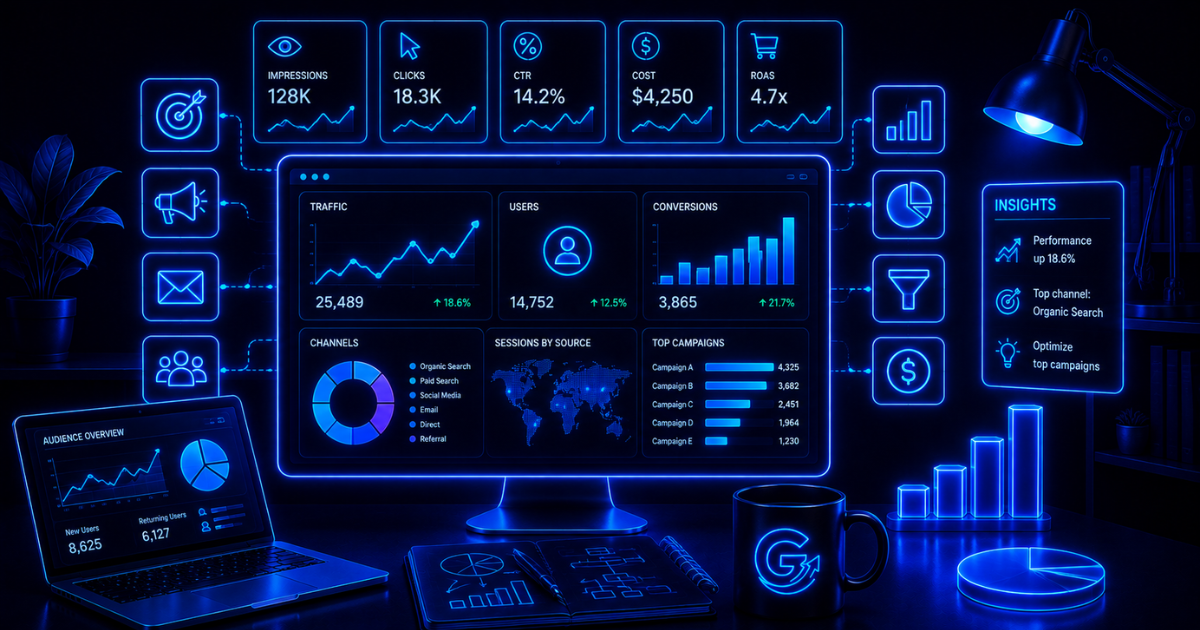
Marketing analytics is the process of collecting, measuring, analyzing, and interpreting marketing data to understand what’s working, what isn’t, and where marketing resources should go next.
At a basic level, marketing analytics helps answer questions like:
- Where are customers coming from?
- Which campaigns generate leads?
- Which channels drive sales?
- What content produces engagement?
- How much does it cost to acquire a customer?
- Which marketing activities actually contribute to revenue?
- Where are people dropping out of the funnel?
The simplest definition is:
Marketing analytics is the use of data to measure marketing performance and make better marketing decisions.
That sounds straightforward.
In practice, marketing analytics can get complicated quickly because customers rarely experience marketing one channel at a time.
Someone might:
See a LinkedIn post → search Google → read an article → subscribe to email → return through direct traffic → attend a webinar → talk to sales → become a customer
Which channel gets credit?
That’s where marketing analytics becomes more than looking at a dashboard.
The goal is to understand the customer journey well enough to make better decisions about marketing.
What Does Marketing Analytics Measure?
Marketing analytics can measure almost anything connected to marketing performance.
Common areas include:
- Website traffic
- Search performance
- Advertising
- Social media
- Content
- Leads
- Conversions
- Customer acquisition
- Revenue
- Retention
- Customer behavior
The useful metrics depend on the business objective.
If you’re trying to increase newsletter subscriptions, impressions aren’t your most important metric.
If you’re trying to generate ecommerce revenue, email opens aren’t the finish line.
Analytics should connect activity to an outcome.
How Does Marketing Analytics Work?
Marketing analytics generally follows a simple process:
Collect data → organize data → analyze performance → identify patterns → make decisions → measure again
1. Collect Marketing Data
Data may come from:
- Website analytics
- Search platforms
- Advertising platforms
- CRM software
- Email platforms
- Social networks
- Ecommerce systems
- Call tracking
- Customer surveys
- Sales systems
A business may have dozens of data sources.
That’s why one of the biggest analytics problems isn’t collecting data.
It’s connecting it.
2. Organize the Data
Raw data isn’t automatically useful.
Information may need to be grouped by:
- Channel
- Campaign
- Audience
- Product
- Location
- Customer stage
- Time period
For example:
Google Ads → Brand Campaign → Mobile → California → New Customers
That segmentation can reveal patterns that disappear inside an overall total.
3. Analyze Performance
Now you start asking questions.
For example:
- Which channel produces the most leads?
- Which channel produces the cheapest leads?
- Which leads actually become customers?
- Which campaign generates the highest-value customers?
- Which landing page converts best?
This is where reporting becomes analysis.
A report tells you what happened.
Analysis tries to explain why it happened and what to do next.
4. Make a Decision
Marketing analytics should eventually influence action.
Maybe you:
- Increase advertising budget
- Stop a campaign
- Improve a landing page
- Change an offer
- Create more content around a successful topic
- Adjust audience targeting
- Improve an email sequence
If analytics never changes a decision, you’re probably doing reporting rather than analytics.
Marketing Analytics vs. Marketing Metrics
A marketing metric is an individual measurement.
Marketing analytics is the process of using multiple measurements to understand performance.
For example:
Metric: Conversion rate = 3.2%
Analytics: Why did conversion rate fall from 4.1% to 3.2%, which audiences were affected, and what should we change?
That’s the difference.
Metrics are ingredients.
Analytics is what you do with them.
What Are the Most Important Marketing Analytics Metrics?
There is no single set of metrics every business should track.
The right metrics depend on the objective.
Still, several are widely useful.
| Metric | What It Measures |
|---|---|
| Traffic | Number of website visitors |
| Conversion rate | Percentage completing a desired action |
| Leads | Prospective customers generated |
| Cost per lead | Cost to generate one lead |
| Customer acquisition cost | Cost to acquire a customer |
| Revenue | Sales generated |
| ROAS | Revenue generated per advertising dollar |
| Marketing ROI | Return relative to marketing investment |
| Lifetime value | Value generated by a customer over time |
| Retention rate | Percentage of customers retained |
| Churn rate | Percentage of customers lost |
The mistake is tracking all of them just because you can.
Start with the business question.
Then choose the metric.
What Is Conversion Rate?
Conversion rate measures the percentage of users who complete a desired action.
The formula is:
Conversions ÷ Total Visitors × 100
If 100 people visit a page and five become leads, the conversion rate is 5%.
Conversions can include:
- Purchases
- Leads
- Demo requests
- Calls
- Newsletter signups
- Downloads
- Account registrations
Conversion analysis helps connect marketing traffic with actual outcomes.
Growth Gary’s guide to what conversion rate optimization is explains what to do once you’ve identified conversion problems.
What Is Customer Acquisition Cost?
Customer acquisition cost, or CAC, measures how much it costs to acquire a new customer.
A simplified formula is:
Sales and marketing costs ÷ New customers acquired
If a company spends $20,000 on sales and marketing and gains 100 customers:
CAC = $200
CAC becomes much more useful when compared with customer value.
Paying $200 to acquire a customer worth $5,000 may be excellent.
Paying $200 to acquire a customer worth $75 isn’t.
What Is Marketing ROI?
Marketing ROI attempts to determine whether marketing activity generates enough financial return to justify the cost.
A simplified version is:
(Return − Marketing Cost) ÷ Marketing Cost
Suppose a campaign costs $10,000 and generates $30,000 in attributable profit.
The marketing return can be compared with the investment.
Sounds easy.
Attribution is where things get messy.
What Is Marketing Attribution?
Marketing attribution is the process of determining which marketing interactions receive credit for a conversion.
Imagine this customer journey:
Facebook ad → Google search → blog article → email → direct visit → purchase
Which interaction caused the sale?
Possibilities include:
First-Touch Attribution
Gives credit to the first interaction.
Facebook gets the conversion.
Last-Touch Attribution
Gives credit to the final marketing interaction.
Email or direct gets the conversion.
Linear Attribution
Distributes credit across several touchpoints.
Position-Based Attribution
Gives more credit to particular stages, such as first and last interactions.
Data-Driven Attribution
Uses statistical or machine-learning models to estimate how different touchpoints contribute.
No attribution model perfectly describes human decision-making.
That’s worth remembering.
A customer doesn’t experience your business according to the columns in your analytics platform.
Attribution is a model.
Not reality.
Marketing Analytics vs. Web Analytics
Web analytics focuses primarily on activity occurring on a website.
Marketing analytics is broader.
| Web Analytics | Marketing Analytics |
|---|---|
| Website traffic | All marketing channels |
| Pages viewed | Campaign performance |
| User behavior | Lead generation |
| Website conversions | Customer acquisition |
| Traffic sources | Revenue contribution |
| Website engagement | Customer journey |
Google Analytics is primarily a web and app analytics platform.
Marketing analytics may combine Google Analytics data with:
- CRM data
- Advertising data
- Email data
- Sales data
- Social data
- Search data
The bigger goal is understanding marketing performance across the entire system.
Marketing Analytics vs. Business Analytics
Marketing analytics focuses on marketing decisions.
Business analytics covers the wider organization.
Business analytics might examine:
- Operations
- Finance
- Inventory
- Staffing
- Profitability
- Supply chain
Marketing analytics might examine:
- Campaigns
- Customer acquisition
- Traffic
- Leads
- Conversion
- Retention
They’re related, but marketing analytics has a narrower focus.
What Are Marketing Analytics Tools?
Marketing analytics tools collect, visualize, analyze, or connect marketing data.
Common categories include:
Web Analytics
Used to understand website behavior.
Examples include:
- Google Analytics
- Adobe Analytics
Search Analytics
Used to measure search visibility and organic performance.
Examples include:
- Google Search Console
- Semrush
- SE Ranking
Advertising Analytics
Platforms such as:
- Google Ads
- Meta Ads
- LinkedIn Ads
provide campaign-level reporting.
CRM Analytics
CRM systems help connect marketing activity with leads, opportunities, and customers.
Email Analytics
Email platforms track:
- Deliverability
- Clicks
- Conversions
- Subscriber behavior
- Campaign performance
Business Intelligence Tools
Platforms such as Looker Studio, Power BI, and Tableau can combine data from multiple sources into dashboards and reports.
The right tool depends on how much data you’re trying to connect.
Don’t build an enterprise analytics stack to answer a question Google Analytics already answers.
What Is a Marketing Dashboard?
A marketing dashboard displays important marketing metrics in one place.
A useful dashboard might include:
- Website traffic
- Organic traffic
- Leads
- Conversion rate
- Advertising spend
- Cost per lead
- Revenue
- Customer acquisition cost
A bad dashboard includes every metric because someone discovered the “Add Widget” button.
Dashboards should help people answer questions quickly.
If you need a 45-minute meeting to explain the dashboard, simplify it.
What Is a Marketing Funnel?
A marketing funnel represents the stages people move through before and after becoming customers.
A simple model is:
Awareness → Consideration → Conversion → Retention
Analytics can measure different outcomes at each stage.
Awareness
Possible metrics:
- Impressions
- Reach
- Search visibility
- Video views
Consideration
Possible metrics:
- Website visits
- Content engagement
- Email subscribers
- Product page views
Conversion
Possible metrics:
- Leads
- Sales
- Conversion rate
- Customer acquisition cost
Retention
Possible metrics:
- Repeat purchases
- Renewals
- Churn
- Customer lifetime value
The funnel helps avoid judging every channel using the same metric.
A YouTube video that introduces someone to a brand shouldn’t necessarily be evaluated the same way as a checkout page.
What Is Marketing Analytics Used For?
Marketing analytics should improve decisions.
Common use cases include:
Allocating Budget
If one channel consistently produces better customers at a lower cost, you may invest more there.
Evaluating Campaigns
Analytics can show whether a campaign delivered the intended outcome.
Improving Content
You can identify:
- Topics generating traffic
- Content producing leads
- Pages with weak engagement
- Content gaps
That connects closely with content marketing.
Improving Conversion Rates
Analytics can reveal where visitors abandon a funnel.
That information can inform CRO testing and landing-page improvements.
Understanding Customers
Marketing data can reveal:
- Which products attract particular audiences
- How long buying journeys take
- Which campaigns produce repeat customers
- Which customer segments have higher value
Forecasting
Historical data can help estimate future:
- Leads
- Sales
- Revenue
- Advertising needs
Forecasts aren’t guarantees.
They’re informed estimates.
What Is Predictive Marketing Analytics?
Predictive analytics uses historical data and statistical or machine-learning models to estimate future outcomes.
Potential applications include predicting:
- Purchase likelihood
- Customer churn
- Lifetime value
- Lead quality
- Campaign performance
For example, a CRM might identify leads whose behavior resembles previous customers who converted.
That doesn’t mean the software knows the future.
It means the model is identifying patterns.
How Is AI Used in Marketing Analytics?
AI can help marketers analyze larger datasets, identify patterns, summarize performance, and generate recommendations.
Possible uses include:
- Campaign summaries
- Anomaly detection
- Customer segmentation
- Forecasting
- Lead scoring
- Sentiment analysis
- Content performance analysis
- Predictive modeling
- Natural-language reporting
Instead of navigating ten dashboard filters, a marketer may increasingly be able to ask:
Why did leads decline last month?
and receive a summary of likely contributing factors.
That’s useful.
But AI still needs good data.
If your tracking is broken, artificial intelligence doesn’t magically repair reality.
Growth Gary’s guide to what AI marketing is covers the broader role of AI across marketing.
Marketing Analytics and Marketing Automation
Analytics tells you what’s happening.
Automation helps you respond.
Suppose analytics shows that people who attend a webinar are much more likely to purchase.
Marketing automation could then:
Webinar attendee → lead score increases → nurture sequence begins → sales notified
The analysis informs the workflow.
That’s where analytics becomes operational rather than merely informational.
If you want that side of the system, Growth Gary’s guide to what marketing automation is covers it separately.
What Are the Challenges of Marketing Analytics?
Marketing analytics isn’t just a technical problem.
Several challenges are common.
Data Lives Everywhere
Marketing data may exist in:
- Analytics platforms
- CRMs
- Advertising tools
- Email platforms
- Spreadsheets
- Sales systems
Connecting those systems can be difficult.
Attribution Is Imperfect
Customer journeys don’t fit neatly into one channel.
Don’t treat attribution models as objective truth.
Tracking Can Break
Changes to:
- Websites
- Tags
- Consent systems
- Analytics tools
- URLs
- Integrations
can disrupt data.
Privacy Matters
Marketers increasingly need to work within privacy rules, consent requirements, browser restrictions, and platform limitations.
Collecting data doesn’t automatically mean you should use it.
More Data Can Create Worse Decisions
This sounds backwards, but it’s common.
Teams collect hundreds of metrics.
Nobody knows which ones matter.
More information doesn’t automatically create more understanding.
How Do You Build a Marketing Analytics Strategy?
Start with the decision.
Not the dashboard.
1. Define the Business Goal
Examples:
- Generate leads
- Increase revenue
- Reduce acquisition cost
- Increase retention
2. Identify the Customer Journey
Understand how people reach the business and move toward conversion.
3. Define the Important Metrics
Choose metrics tied to the goal.
For lead generation:
- Qualified leads
- Cost per lead
- Conversion rate
- Customer acquisition cost
may matter more than social followers.
4. Identify Data Sources
Determine where the required information lives.
5. Make Tracking Reliable
Check:
- Analytics tags
- Conversion events
- UTM parameters
- CRM tracking
- Forms
- Advertising pixels
6. Build Simple Reporting
Start with a small number of useful views.
7. Analyze Regularly
Ask:
What changed?
Why?
What should we do?
Those three questions are more useful than staring at charts.
Gary’s Take: Measure Decisions, Not Everything
Modern marketing software makes it possible to track almost everything.
That’s not always a gift.
You can spend an impressive amount of time discussing:
- Impressions
- Engagement
- Views
- Sessions
- Rankings
- Opens
- Clicks
without answering:
Did marketing actually help the business?
I like working backward.
Start with the business outcome.
Then identify the marketing behavior that contributes to it.
Then identify the metrics that reveal whether the behavior is happening.
That produces a much shorter dashboard.
And usually a much better one.
The goal isn’t more data.
It’s fewer bad decisions.
Is Marketing Analytics Worth It?
Yes.
Any business investing meaningful time or money into marketing should have some way to measure whether that investment is working.
The sophistication can vary.
A small business may only need:
Traffic → leads → customers → revenue
A larger company might need:
- Multi-channel attribution
- Lifetime value
- Pipeline analysis
- Cohort reporting
- Predictive models
- Marketing mix analysis
Start with what you need to make decisions.
Then add sophistication when the questions justify it.
FAQs About Marketing Analytics
What is marketing analytics in simple terms?
Marketing analytics is the process of collecting and analyzing marketing data to understand performance and make better decisions about campaigns, channels, customers, and budgets.
What is an example of marketing analytics?
A business might compare how much it spends on Google Ads, Facebook Ads, and SEO with the leads, customers, and revenue generated by each channel.
What is the main purpose of marketing analytics?
The main purpose is to understand which marketing activities contribute to business outcomes and use that information to improve future decisions.
What’s the difference between marketing analytics and Google Analytics?
Google Analytics is a specific analytics platform primarily focused on website and app behavior. Marketing analytics is the broader practice of analyzing performance across website traffic, advertising, email, CRM, social media, sales, and other marketing channels.
What are the most important marketing analytics metrics?
Important metrics commonly include conversion rate, leads, cost per lead, customer acquisition cost, revenue, marketing ROI, retention, and customer lifetime value. The correct metrics depend on the business objective.
What is marketing attribution?
Marketing attribution is the process of assigning credit to the marketing interactions that contribute to a conversion or sale.
How is AI used in marketing analytics?
AI can help identify patterns, summarize performance, predict outcomes, segment customers, detect anomalies, and analyze large amounts of marketing data.
Do small businesses need marketing analytics?
Yes, but they don’t necessarily need sophisticated analytics software. Small businesses can start by tracking traffic, leads, customers, acquisition costs, and revenue.
Related Growth Gary Content
Explore This Topic
- Marketing Analytics for Small Businesses
- Marketing Analytics Metrics
- Marketing Analytics vs. Web Analytics
- Marketing Attribution Models
- How to Build a Marketing Dashboard
- How to Measure Marketing ROI
- Predictive Marketing Analytics
- AI Marketing Analytics
- Marketing Analytics Tools
- Marketing Analytics Strategy
Marketing analytics shouldn’t exist to prove that marketing is busy.
It should tell you where growth is coming from, where money is being wasted, and what deserves your attention next.
That’s the kind of dashboard worth opening.
— Gary
The changes actually worth knowing
A short briefing that filters the noise into useful AI, marketing, technology, tools, and ideas for marketers and businesses.