
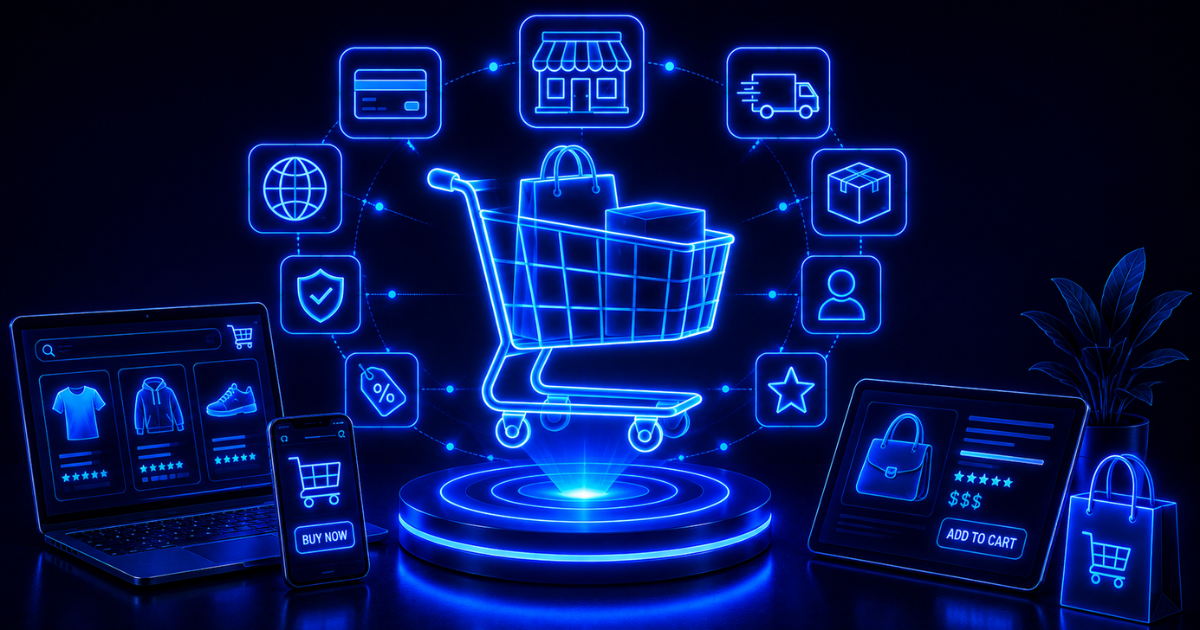
Ecommerce, short for electronic commerce, is the buying and selling of products or services through the internet. It includes everything from purchasing a pair of shoes from an online store to subscribing to software, ordering groceries through an app, or buying a digital course.
At its simplest, ecommerce replaces or supplements parts of a traditional transaction with a digital experience. Customers can discover products, compare options, make payments, and often receive products or services without ever interacting with a physical storefront.
But ecommerce isn’t just “a website that sells stuff.” A successful ecommerce business usually combines several systems:
- An online storefront
- Product or service listings
- Payment processing
- Inventory and order management
- Shipping or digital fulfillment
- Customer service
- Marketing and customer acquisition
- Analytics and optimization
That’s what makes ecommerce interesting from a marketing perspective. The store itself is only one part of the system. Getting the right people to the store and converting them into customers is where much of the work happens.
How Does Ecommerce Work?
Ecommerce connects a buyer with a seller through a digital transaction.
The exact process varies depending on whether you’re selling physical products, subscriptions, software, services, or digital products, but most ecommerce transactions follow roughly the same path.
| Stage | What Happens | Example |
|---|---|---|
| Discovery | Customer finds the business or product | Google, social media, AI search, paid ad |
| Evaluation | Customer researches the offer | Product page, reviews, comparison content |
| Purchase | Customer completes the transaction | Shopping cart and checkout |
| Payment | Payment is authorized and processed | Credit card, PayPal, digital wallet |
| Fulfillment | Customer receives the purchase | Shipping, download, account access |
| Retention | Business encourages another purchase | Email, loyalty program, remarketing |
For example, someone might search Google for a specific product, discover an online retailer, visit the product page, read reviews, add the item to a cart, pay through a digital wallet, and receive the product two days later.
Behind that seemingly simple experience are usually several interconnected technologies.
The ecommerce platform manages the storefront. A payment processor handles the transaction. Inventory software may update stock. A fulfillment system sends the order to a warehouse. Email software sends the confirmation. Analytics platforms record what happened.
Good ecommerce makes all of that complexity feel simple to the customer.
What Are the Main Types of Ecommerce?
Ecommerce businesses are often categorized according to who is selling and who is buying.
The four most common models are B2C, B2B, C2C, and C2B.
Business-to-Consumer (B2C)
B2C ecommerce occurs when a business sells directly to individual consumers.
This is probably what most people imagine when they hear “ecommerce.”
Examples include:
- Clothing retailers
- Electronics stores
- Beauty brands
- Furniture companies
- Online grocery stores
- Direct-to-consumer brands
A customer visits the store, purchases a product, and the business fulfills the order.
Business-to-Business (B2B)
B2B ecommerce occurs when one business sells products or services to another business online.
These transactions can be more complicated than consumer purchases because they may involve:
- Bulk pricing
- Purchase orders
- Multiple decision-makers
- Negotiated contracts
- Recurring orders
- Account-specific pricing
A restaurant ordering supplies through an online wholesale portal is an example of B2B ecommerce.
Consumer-to-Consumer (C2C)
C2C ecommerce allows individual consumers to sell products or services to other consumers, usually through a marketplace.
Online marketplaces made this model dramatically easier.
A person selling used furniture, collectibles, clothing, or electronics through an online marketplace is participating in C2C ecommerce.
Consumer-to-Business (C2B)
C2B ecommerce occurs when an individual provides something of value to a business.
This can include:
- Freelance services
- Photography
- Influencer partnerships
- Licensing
- User-generated content
It’s less commonly discussed than B2C or B2B, but it’s still part of the broader ecommerce ecosystem.
Ecommerce Business Models Compared
Another useful way to understand ecommerce is by looking at what is actually being sold and how it’s fulfilled.
| Ecommerce Model | What Is Sold | Fulfillment | Common Example |
|---|---|---|---|
| Traditional retail | Physical products | Seller ships inventory | Online clothing store |
| Marketplace | Third-party products | Seller or marketplace | Multi-seller marketplace |
| Dropshipping | Physical products | Supplier ships directly | Niche online store |
| Subscription | Recurring product/service | Recurring fulfillment | Subscription box |
| Digital products | Downloadable/access-based goods | Immediate digital delivery | Templates or courses |
| SaaS | Software access | Cloud-based | Marketing software |
| Print-on-demand | Custom physical products | Supplier produces after sale | Custom apparel |
These models can overlap.
A business might sell physical products normally, offer a monthly subscription, sell digital guides, and list some products on marketplaces at the same time.
The important distinction is that ecommerce describes the transaction environment, not one particular business model.
What Is an Ecommerce Platform?
An ecommerce platform is the software used to create and operate an online store.
It typically provides the infrastructure necessary to:
- Create product pages
- Organize product collections
- Manage inventory
- Accept payments
- Manage orders
- Configure shipping
- Apply taxes
- Offer discounts
- Manage customer accounts
- Integrate marketing tools
Popular ecommerce platforms include Shopify, WooCommerce, BigCommerce, Wix, and Adobe Commerce.
Different platforms solve different problems.
A small company selling 20 products doesn’t necessarily need the same infrastructure as a multinational retailer processing thousands of transactions every hour.
Hosted vs. Self-Hosted Ecommerce
One important distinction is between hosted and self-hosted ecommerce.
Hosted ecommerce platforms manage much of the technical infrastructure for you. The platform typically handles hosting, security updates, and much of the underlying software.
Self-hosted ecommerce gives the business greater control over the website and infrastructure but generally requires more technical management.
WooCommerce, for example, operates on WordPress and therefore gives site owners considerable flexibility over their website environment.
That flexibility comes with responsibility.
Hosting quality, plugins, themes, security, and site performance become much more directly connected to how the store is configured.
If you’re considering WordPress-based ecommerce, the underlying hosting environment matters considerably. I’ve covered some of the major options separately in my guide to the best web hosting providers for WordPress.
What Do You Need to Build an Ecommerce Website?
You don’t need dozens of tools to start an ecommerce store.
You do need several fundamental components.
A Domain and Storefront
Your domain is the web address customers use to reach the store.
The storefront is the actual customer-facing website where people browse products, read information, and make purchases.
Product Pages
Product pages explain what you’re selling.
A useful product page typically includes:
- Product name
- Images or video
- Description
- Price
- Variations
- Availability
- Shipping information
- Reviews or social proof
- Return information
- Clear purchase action
For organic search, product pages also need enough useful information for search engines to understand what is being sold.
Product Categories or Collections
Categories help users navigate larger product catalogs.
A clothing store might organize products by:
- Men’s
- Women’s
- Shoes
- Jackets
- Accessories
These pages can also become valuable organic-search landing pages when they’re properly structured and optimized.
Shopping Cart and Checkout
The cart stores products before purchase.
Checkout collects the information necessary to complete the transaction, such as:
- Customer details
- Shipping address
- Shipping method
- Payment information
- Discount codes
Checkout is one of the most important conversion points on an ecommerce website.
Making it unnecessarily complicated is a particularly expensive way to be creative.
Payment Processing
An ecommerce store needs a way to accept and process payments.
Depending on the platform and business, customers might pay through:
- Credit cards
- Debit cards
- PayPal
- Apple Pay
- Google Pay
- Buy-now-pay-later services
The payment processor communicates with financial institutions to authorize and complete the transaction.
Fulfillment
After someone pays, the business needs to deliver what was purchased.
For physical products, fulfillment might involve:
Order → warehouse → picking → packing → carrier → customer
Digital products can be simpler because delivery may happen automatically.
Ecommerce vs. Traditional Retail
Ecommerce and physical retail solve the same fundamental problem—connecting products with customers—but the operating environments are different.
| Area | Ecommerce | Traditional Retail |
|---|---|---|
| Store availability | Usually 24/7 | Limited by store hours |
| Geographic reach | Potentially global | Primarily local/regional |
| Customer interaction | Digital | Primarily in person |
| Product evaluation | Images, video, reviews, copy | Physical inspection |
| Checkout | Digital | Physical point of sale |
| Fulfillment | Shipping/digital delivery | Immediate physical possession |
| Customer acquisition | SEO, ads, email, social, AI search | Location, advertising, foot traffic |
| Analytics | Highly measurable | Often less complete |
| Overhead | Technology, fulfillment, marketing | Rent, staff, physical operations |
Neither model is automatically better.
Physical stores provide experiences ecommerce can’t perfectly reproduce. Customers can touch products, try them on, ask questions, and leave with the purchase immediately.
Ecommerce provides convenience, reach, and significantly more opportunities for digital measurement.
Many successful retailers combine both.
Ecommerce vs. Ecommerce Marketing
This distinction matters for the Growth Gary content structure.
Ecommerce is the system through which products and services are sold online. Ecommerce marketing is the process of attracting, converting, and retaining customers for an ecommerce business.
Ecommerce includes things such as:
- Store technology
- Product catalog
- Checkout
- Payments
- Inventory
- Fulfillment
Ecommerce marketing includes:
- SEO
- Content marketing
- Paid advertising
- Social media
- Conversion optimization
- Marketing automation
- Customer retention
They’re closely connected, but they’re not the same topic.
A store can have excellent technology and terrible marketing.
It can also have excellent marketing and a terrible store.
You generally need both.
How Do Ecommerce Businesses Get Customers?
Building the store doesn’t create demand.
Once the infrastructure exists, ecommerce companies need customer-acquisition channels.
Search Engine Optimization
SEO can generate demand from people already searching for products, categories, and information related to what a store sells.
An ecommerce SEO strategy may include:
- Product-page optimization
- Category-page optimization
- Keyword research
- Internal linking
- Technical SEO
- Structured data
- Content marketing
- Link acquisition
The fundamentals aren’t fundamentally different from traditional SEO, but ecommerce websites introduce additional complexity because of large catalogs, filters, faceted navigation, inventory changes, and duplicate or near-duplicate product pages.
Content Marketing
Ecommerce businesses can create content around the problems their products solve.
That might include:
- Buying guides
- Tutorials
- Product comparisons
- Educational articles
- Gift guides
- Videos
- Research
The goal isn’t to publish random blog posts.
Good content marketing connects useful information with the audience the business ultimately wants to reach.
Email Marketing
Email is particularly useful in ecommerce because customers often interact with a business repeatedly.
Email campaigns can support:
- Welcome sequences
- Abandoned carts
- Product recommendations
- Promotions
- New-product announcements
- Replenishment reminders
- Customer retention
Automation can make these programs substantially easier to operate at scale.
Social Media Marketing
Visual products can work particularly well on social platforms because customers can discover products before actively searching for them.
A good social media marketing strategy can support product discovery, community building, creator partnerships, customer service, and direct response.
Paid Media
Ecommerce businesses frequently use paid search and social advertising to acquire customers.
Paid media can scale quickly when the underlying economics work.
That’s the important part.
If acquiring a $40 customer costs $60 and that customer never buys again, increasing the advertising budget doesn’t solve the problem.
It scales the problem.
AI Search
Product discovery is also beginning to expand beyond traditional search engines.
Consumers can use AI systems to ask questions such as:
- What’s the best backpack for international travel?
- Which running shoes are good for flat feet?
- What’s a good laptop under $1,000?
- What are the differences between these two products?
That makes AI search increasingly relevant to ecommerce discovery, particularly for informational and comparison-driven purchases.
The exact influence of AI systems on ecommerce discovery is still evolving, so I’d be cautious about anyone claiming there’s already one established formula for “ecommerce AI SEO.”
What Is Conversion Rate Optimization in Ecommerce?
Conversion rate optimization, or CRO, is the process of improving the percentage of visitors who complete a desired action.
For ecommerce, the most obvious action is usually a purchase.
If 10,000 people visit an online store and 200 purchase, the purchase conversion rate is 2%.
But conversion optimization can also address earlier steps such as:
- Product views
- Add-to-cart actions
- Checkout starts
- Email signups
- Account creation
Ecommerce CRO might involve improving:
- Product photography
- Product descriptions
- Navigation
- Search
- Pricing presentation
- Shipping information
- Trust signals
- Checkout
- Mobile usability
- Website speed
My broader guide to conversion rate optimization explains the underlying discipline without turning this ecommerce article into a second CRO guide.
Why Is Website Speed Important for Ecommerce?
Website speed matters for any website, but ecommerce adds an important wrinkle: visitors may move through several pages before converting.
Someone could visit:
Category → Product → Cart → Checkout → Confirmation
Performance problems at any point introduce friction.
Heavy product imagery, tracking scripts, third-party apps, recommendation engines, reviews, personalization tools, and ecommerce plugins can all increase page weight and processing requirements.
This is why “just install another app” isn’t always harmless.
Every addition to the marketing stack should earn its place.
How Does Marketing Automation Work in Ecommerce?
Ecommerce generates a large number of repeatable customer events.
Someone:
- Views a product
- Joins the email list
- Abandons a cart
- Makes a purchase
- Purchases again
- Stops purchasing
Those behaviors can trigger automated workflows.
For example:
Customer abandons cart → wait → send reminder → customer purchases → stop reminder sequence
That’s a straightforward application of marketing automation.
More sophisticated systems can incorporate purchase history, customer value, browsing behavior, product availability, and predictive models.
But sophistication isn’t automatically better.
A reliable abandoned-cart workflow that generates sales is more valuable than an elaborate 47-step automation nobody understands.
What Role Does AI Play in Ecommerce?
AI can support ecommerce in several areas, but it’s useful to separate practical applications from the hype.
Product Content
Generative AI can help produce first drafts of:
- Product descriptions
- Category descriptions
- Ad variations
- Email copy
- Social content
That can be particularly useful for large catalogs.
It also creates an obvious risk: generating thousands of generic product descriptions doesn’t magically create useful content.
The same principle applies here as in AI writing: AI can accelerate production, but someone still needs to care about accuracy, differentiation, usefulness, and brand voice.
Product Recommendations
Recommendation systems can use customer and product data to suggest relevant products.
Examples include:
- Frequently bought together
- Similar products
- You may also like
- Recommended for you
Good recommendations reduce the effort required to find relevant products.
Bad recommendations just create more clutter.
Customer Service
AI assistants can answer common questions about:
- Products
- Shipping
- Returns
- Order status
- Store policies
The value is speed and scalability.
The danger is allowing an automated system to confidently give customers incorrect information.
Forecasting and Inventory
Machine learning can help businesses forecast demand, identify patterns, and make inventory decisions.
These applications are less visible to customers but can be extremely valuable operationally.
Marketing Optimization
AI can also support:
- Audience segmentation
- Ad optimization
- Email personalization
- Content creation
- Customer analysis
- Product recommendations
Growth Gary’s broader guide to AI marketing covers how those capabilities fit into marketing as a whole.
What Metrics Matter in Ecommerce?
Revenue matters, but revenue by itself doesn’t tell you whether an ecommerce business is healthy.
Several metrics help explain what’s actually happening.
Conversion Rate
Conversion rate measures the percentage of visitors who purchase.
Conversion Rate = Purchases ÷ Visitors × 100
Average Order Value
Average order value, or AOV, measures how much customers spend per transaction.
AOV = Revenue ÷ Number of Orders
Customer Acquisition Cost
Customer acquisition cost, or CAC, estimates how much it costs to acquire a new customer.
Customer Lifetime Value
Customer lifetime value estimates how much economic value a customer generates over the relationship.
Cart Abandonment Rate
Cart abandonment measures how often shoppers add products to their carts without completing the purchase.
Repeat Purchase Rate
Repeat purchase rate shows how often customers return to buy again.
The important point is not to collect every possible metric.
It’s to understand the economics of the system.
A store with fantastic traffic but poor conversion has one problem.
A store with strong conversion but prohibitively expensive customer acquisition has another.
A store with modest first-order margins but excellent repeat purchasing may have completely different economics.
Good marketing analytics should help you distinguish among those situations rather than simply produce another dashboard.
What Are the Benefits of Ecommerce?
Ecommerce can provide several advantages compared with businesses that depend entirely on physical transactions.
Greater Geographic Reach
An online store isn’t restricted to people who can physically visit a location.
Depending on fulfillment capabilities, businesses can sell regionally, nationally, or internationally.
24/7 Availability
Customers can shop outside normal business hours.
The storefront doesn’t need to close at 6 p.m.
Better Measurement
Digital transactions generate measurable customer behavior.
Businesses can analyze:
- Traffic sources
- Product views
- Conversion rates
- Cart behavior
- Purchases
- Repeat purchases
- Customer acquisition costs
Lower Barriers to Entry
Starting an online store can require significantly less upfront investment than opening a physical retail location.
That doesn’t mean ecommerce is cheap.
Inventory, advertising, fulfillment, software, returns, and customer acquisition can become expensive quickly.
Automation
Many repetitive processes can be automated, including:
- Order confirmations
- Inventory updates
- Email sequences
- Shipping notifications
- Customer segmentation
That can allow relatively small teams to manage surprisingly large transaction volumes.
What Are the Challenges of Ecommerce?
Ecommerce removes some traditional business constraints while introducing new ones.
Competition Is Easy to Find
Your competitor is one browser tab away.
Customers can compare:
- Price
- Reviews
- Shipping
- Features
- Alternatives
in seconds.
Customer Acquisition Can Be Expensive
Launching an online store is relatively easy.
Getting profitable traffic is not.
Paid advertising costs, competitive SEO markets, marketplace fees, and creator partnerships can all affect acquisition costs.
Customers Can’t Physically Examine Products
Photography, video, descriptions, reviews, sizing information, and return policies have to compensate for the lack of physical interaction.
Shipping Creates Complexity
Physical ecommerce introduces:
- Packaging
- Shipping costs
- Delivery times
- Lost packages
- Damaged products
- International customs
Those aren’t marketing problems, but they absolutely affect customer experience.
Returns Can Destroy Margins
A sale isn’t necessarily the end of the transaction.
Businesses selling products with high return rates need to account for reverse logistics and refund costs when evaluating profitability.
Technology Can Become Overcomplicated
It’s very easy to build an ecommerce technology stack containing:
- 17 apps
- Three analytics platforms
- Four email popups
- Two personalization systems
- A chatbot
- Six tracking pixels
and then wonder why the website takes forever to load.
More technology doesn’t automatically create a better store.
What Should You Look for in an Ecommerce Platform?
The “best” ecommerce platform depends on what you’re trying to build.
I’d evaluate at least these areas:
- Ease of use
- Product-management capabilities
- Payment options
- Transaction fees
- Shipping integrations
- Inventory management
- SEO capabilities
- Marketing integrations
- Analytics
- App ecosystem
- Design flexibility
- Scalability
- Security
- Total cost
The last one is especially important.
A platform that costs $39 per month can become considerably more expensive after adding apps, payment fees, premium themes, integrations, and other services.
Evaluate the system cost, not just the advertised subscription price.
Do You Need Shopify to Start an Ecommerce Business?
No.
Shopify is one of the best-known ecommerce platforms, but it isn’t the only way to sell online.
Other approaches include:
- WooCommerce
- BigCommerce
- Wix
- Squarespace
- Adobe Commerce
- Marketplace-only selling
- Custom ecommerce development
Shopify’s strength is that it packages much of the infrastructure into a relatively approachable system.
That convenience can be valuable.
It can also create recurring platform and app costs that aren’t appropriate for every business.
Choose the platform around the business rather than designing the business around whichever platform happens to be popular.
Gary’s Take: The Store Isn’t the Business
One of the easiest ecommerce mistakes is spending months obsessing over the store itself.
Logo.
Theme.
Button color.
Fancy animations.
Another Shopify app.
Meanwhile, nobody has figured out how customers are actually going to arrive.
An ecommerce business is a system:
Product + demand + acquisition + conversion + fulfillment + retention
The website connects those pieces.
If the product is weak, the website can’t save it.
If customer acquisition costs more than the economics can support, prettier product pages won’t save it.
And if fulfillment disappoints customers, no marketing automation sequence is going to turn that into a great customer experience.
I’d rather launch a simple store with a strong product and a clear acquisition strategy than spend six months building the world’s most beautiful website that nobody visits.
FAQs About Ecommerce
What does ecommerce mean?
Ecommerce means electronic commerce. It refers to buying and selling products or services through the internet, including physical products, digital goods, subscriptions, software, and services.
What is an example of ecommerce?
Buying a product from an online retailer is a basic example of ecommerce. Other examples include subscribing to software, purchasing a digital course, ordering groceries through an app, or buying from an online marketplace.
What are the four main types of ecommerce?
The four commonly discussed types are business-to-consumer (B2C), business-to-business (B2B), consumer-to-consumer (C2C), and consumer-to-business (C2B).
Is Amazon ecommerce?
Yes. Amazon operates one of the world’s largest ecommerce businesses and also functions as a marketplace where third-party sellers can sell products to customers.
Is Shopify ecommerce?
Shopify itself is an ecommerce platform rather than an ecommerce business model. Businesses use Shopify’s software and infrastructure to build and operate online stores.
Is ecommerce the same as digital marketing?
No. Ecommerce describes buying and selling online. Digital marketing encompasses the strategies businesses use to attract and engage customers through digital channels. Digital marketing can support an ecommerce business, but it also supports businesses that don’t sell products online.
What’s the difference between ecommerce and ecommerce marketing?
Ecommerce encompasses the online selling system, including the storefront, products, checkout, payments, and fulfillment. Ecommerce marketing focuses specifically on attracting customers, converting them, and encouraging repeat purchases.
Can a small business start an ecommerce store?
Yes. Hosted platforms and ecommerce software have lowered many of the technical barriers to launching an online store. However, businesses still need viable products, sustainable economics, customer acquisition, fulfillment, and customer service.
Related Growth Gary Content
Explore This Topic
- What Is Ecommerce Marketing?
- AI for Ecommerce Marketing
- Best Shopify Apps for Marketing
- Best AI Tools for Ecommerce
- Shopify Marketing Automation
- WordPress vs. Shopify
- Shopify Review
- Best Ecommerce Platforms
- Ecommerce SEO Guide
- Ecommerce Conversion Rate Optimization
Ecommerce makes selling online technically easier than it’s ever been.
That doesn’t make building a successful ecommerce business easy.
The businesses that tend to make sense aren’t simply the ones with the nicest stores. They’re the ones where the product, customer acquisition, conversion experience, fulfillment, and retention economics work together.
Get that system right, and the technology becomes what it should be: infrastructure rather than the strategy.
— Gary
The changes actually worth knowing
A short briefing that filters the noise into useful AI, marketing, technology, tools, and ideas for marketers and businesses.